
Find a video version of this review on YouTube here.
Tress of the Emerald Sea is the first of Brandon Sanderson’s four secret project novels and the latest release in his Cosmere fantasy universe. It follows a young woman who pursues the man she loves out to sea to rescue him from the clutches of an evil sorceress.
This review will be spoiler light until the end, and I’ll give fair warning when there are serious plot details coming up for discussion. Light meaning I will talk about a lot of things you wouldn’t know from the blurb and would otherwise be learning over time, but no earth-shattering endgame revelations. I am assuming you’ve read the rest of the Cosmere though.

So right off the bat, this book is delightful. I have my nits to pick, but delightful is overall the best word for it. I had a smile on my face the whole way through. All the more because I slotted it in as a palate cleanser between volumes of the dark and heavy Malazan Book of the Fallen, a role it turned out to be perfectly suited for in all of its enthusiasm and whimsy. I loved it.
In a similar sense to Sanderson’s Stormlight Archive, the world itself is as much a main character as any of the people you’ll be reading about. And this is probably his most evocative setting since Stormlight.
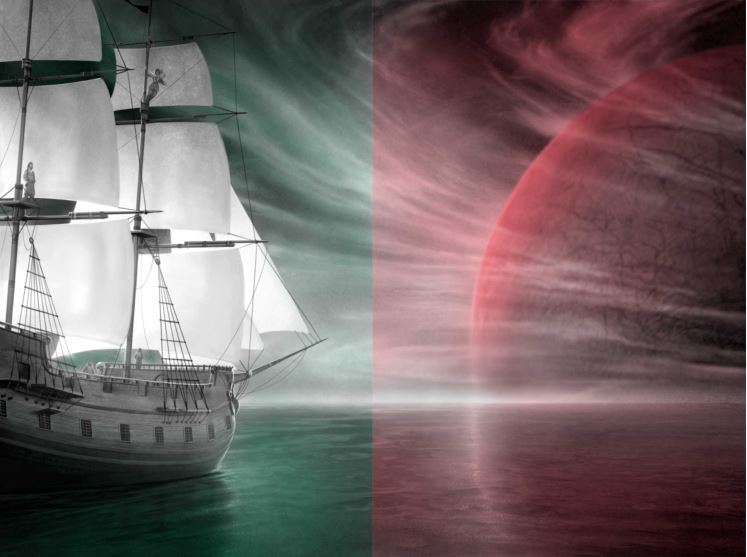
The oceans of Lumar aren’t liquid but instead a desert of deadly spores, undergoing fluidisation (look that up) thanks to undersea air vents. If moisturised in any way, the spores explode into various things, based on the colour, with the eponymous emerald sea becoming strangling vines, blue as bursts of air, red as crystalline spikes, and so on. The spores are dropped from the planet’s 12 moons, that hold a low geosynchronous orbit. Here’s a fanart depiction of that, if you’re having trouble getting a clear mental image off that sci fi mouthful.

I love this. It’s so imaginative. The book explores almost every reasonable question you could have about how life adapted to that kind of environment. Where do they get their water from? What happens when it rains? What happens if spores get in your mouth? What happens if you’re sailing and the airflow cuts off? What does warfare look like with spores involved? It’s this kind of exploration of the idea to its fullest potential that made me fall in love with Brando’s worldbuilding and magic systems in the first place.
And my god, some of the imagery it creates. This early scene of a ship being pulled down into the spores by tendrils generated from a splash of water around it is so striking. This is one of the coolest things that’s happened in a book in years.

A worldbuilding nitpick though. What do ships do with the crew’s waste? In real world vessels of the type, the head drained directly into the sea. Men would pee over the side if they had to go while on duty. This is obviously not an option on the spore seas. The results would be inconvenient at best and deadly at worst. So what do they do with it. Do ships have septic tanks in the bilges? That’s a lot of ballast, and how would you drain it?
I don’t think it’s out of line to ask this. We joke in this fanbase about people coming up with bizarre sexual applications of the magic systems like shard dildos and Brandon acting appalled before reluctantly admitting it would be possible. But there’s a lot of shit in this book. There was that whole chapter about the tosher. Conversations about human by-products are clearly on the table here.
Actually, even on the islands it’s a question. You can’t just have sewers draining into the sea, or into rivers that flow to the sea. I know historically people would chuck chamber pots out the windows into the streets, but this is a world where regular rainfall should get all that flowing toward the ocean. I don’t think the people on the Rock would bury it either. Their only source of water is a single underground aquifer. If an underground waste pit starts leaking into that they’re almost literally up shit creek.
We need to spring this one on him in a livestream or something.
Getting back on topic though.
The actual human characters were fun too. Not enough to gush about the same way I just did for the setting, there’s not really anyone who’s going to stick with you the way some Stormlight and Mistborn characters do, but they’re charming to the last and the story makes sure, with mechanical precision, that each one has a satisfying conclusive moment for their role on the crew and their relationship with Tress.
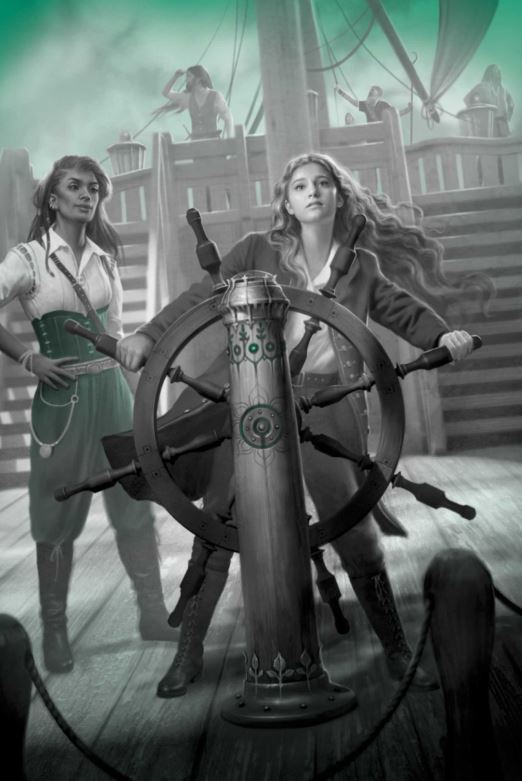
Tress as a protagonist is well written to serve the story’s themes and messages about stepping outside your comfort zone, thinking outside the box to solve problems rather than just blundering through, and having compassion for and a willingness to help the people you find around you, even when it might be more pragmatic or outright safe to leave them behind. The narration even jokes about her pausing to do something as uncharacteristic for a fantasy protagonist as carefully considering her situation before making a big decision. I don’t know if she’ll ever top Cosmere hero tier lists, but she’s hard not to like, and you have to appreciate how her portrayal is hopeful the best of humankind’s abilities to grow, to care and to solve problems.
The book also has exactly the number of characters it needs, but I think the Dougs bit the narration does is a great way to keep the larger crew out of the main cast’s way without dehumanising them entirely.
Which brings us to the narrator, longtime Cosmere man of mystery Hoid. You know how fantasy novels will sometimes do a section where an in-universe storyteller just gets an extended bit of dialogue to spin a tale, often interacting with their audience directly, opining on events, and leaning on their tale’s fourth wall? Brandon’s done it with Hoid a couple of times already. Rothfuss loves doing it. Tress is a whole book of that. It’s fun, it’s often funny. Hoid’s interjections are sometimes even thought-provoking. If you like The Princess Bride and Good Omens, at least one of which Brando namedrops directly in the afterword, you’ll like this too.
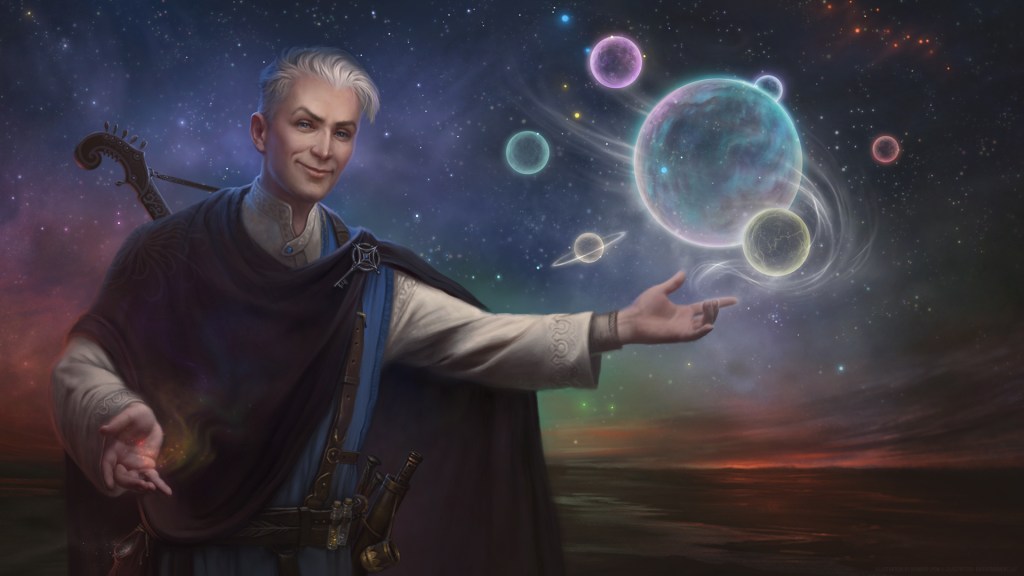
I don’t think it always works. Someone here, either narrator Hoid or author Brandon, isn’t always as funny and witty as he thinks he is. There are some jokes that fall flat. Some wordplays that feel like a strenuous reach. Some of the stuff that Hoid says and does because of his curse comes across as a very basic brand of quirky. A bit 2010 internet idea of random. Oh crazy Hoid put socks on under his sandals the absolute madlad.
It’s never on the level of cringe of Shallan’s cleverness at the start of the Way of Kings, but there are moments.
But there are gems too. Some actual laughs. Some lines that really get you going oh. I really liked the one on the first night Tress spends sleeping on the deck, talking about the two abysses of the sky overhead and the sea underneath, and how the sea was somehow deeper and darker. You might have noticed the ill-fated ocean liner over my head. I’ve got kind of a passing interest in maritime travel and disasters and shipwrecks, and that line has stayed with me.
The book has some interesting Cosmere connections, hinting at the futures of a few familiar worlds, but it doesn’t lean on these things, they’re more like easter eggs. I imagine a new reader could safely go through it without feeling isolated by the references – they fit right in with Hoid’s other flights of fancy. I think it would have been ideal if this book had come out before The Lost Metal. One part of that book that didn’t reach its full potential was the Ghostbloods subplot, bringing together magic users from a number of different worlds. That arc hinted at a lot but didn’t really give us the time to explore all those overlapping systems in the kind of detail I would have liked.
In that sequence, on top of all the familiar stuff you’re trying to keep up with, there’s a character using an aether, which is the same thing the spores of Tress are. And without the explanations this book gives, it really feels like he’s just able to create a lot something from nothing at all, which felt so out of line with how magic in these stories is usually handled. I think if I’d read Tress first and knew before I saw that section the materials required and limits placed on Aether materials I would have had a much easier time accepting it.
And I guess while we’re on the magic, I’m really disappointed by the lack of the usual Ars Arcanum at the back. We get what, five out of 12 aether colours outlined in the text. I want to know the rest of them, Brando. I’m desperate to know these things. I hope I don’t have to wait.
I think that’s everything I can get through spoiler free. Click here to skip over the spoiler section.
I think the confrontation with the dragon outshines the book’s actual finale, but that’s not a real complaint. It’s more about how good the dragon bit is than any major weakness in the ending.
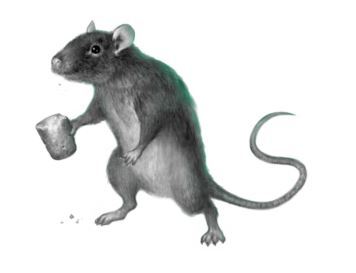
The one thing I was hoping for a bit more from was Huck and Charlie. When Huck was introduced, from page one, my first thought was ‘oh, it’s Charlie.’ I never entertained a single other option. And there was the talk of curses leading back to him, and the way Tress would ask something like ‘are there other talking rats’ and he would tell an obvious white lie like ‘my whole family can talk just like I can,’ carefully never saying directly that his family are rats too.
It was so obvious and took so long to come out I started hoping I was being set up for some kind of twist or subversion. There was validation in the narrator going “about time” when Tress finally gets it, but not enough for how long I’d been sitting on the answer.
Obviously Brandon expected readers to figure it out at least a little way ahead of time, but I’d be curious to know exactly when he expected them to twig.
But look, one slight misfire of a reveal isn’t enough to take the lustre off an ending that is otherwise as delightful as the rest of the book.
End spoilers.
Just as we wrap up I want to talk presentation. It’s not a big thing for a lot of readers, but hey, I paid a lot of money for this book. Cover design is gorgeous. Some of the foil here is misaligned by a factor of milimeters, but you have to look really close to notice it, so I don’t mind that. I appreciate that it matches the height and depth of the Dragonsteel edition leatherbounds, but it would have been nice if the spine format was the same.
I love these little flourishes around the chapter numbers that grow chapter by chapter, and I especially love that when the adventure moves between seas their colour and style change to match. These kinds of details warm my heart.
The illustrations throughout are lovely and capture the style and atmosphere of the story fantastically, but some of them have questionable placement. The pieces Crow Revealed and a Battle of Wits are both inserted before the moments they depict, both kinda giving the game away pages in advance. I know that structurally there are often certain limitations on where colour inserts can be bound into a book, but I wish a little more had been done to make them work with the flow of the story. A few pages late is far preferable to a few early.
There’s not much to say in conclusion that wouldn’t be repeating myself. The blemishes on this book, both in story and presentation, are few and far between and pale in comparison to all it gets right. It is a delightful adventure and worthy addition to the Cosmere. My hopes for the rest of these secret projects are sky high. Mostly sky high. I’m lowering them a smidge for the second one, which is to be non-Cosmere and just doesn’t sound as much up my alley from the campaign’s summary of it. But projects three and four. Sky high.
 Captain M Entertainment
Leave a comment