
Over about a week, I reread the whole Egghead arc, start to end, going about a volume at a time. I’m going to be very curious to see the blind reactions from people who catch up from this point on and experience the whole thing blind, because it is so hard to believe this is two years’ worth of content.
Egghead stands in contrast to Wano in a host of ways, some for better, some for worse. The most obvious one, and the biggest pro, is the pacing. Holy shit, this arc is fast. It ricochets like a pinball from idea to idea, from set piece to cutaway and back again, almost faster than a reader can keep up. Perhaps too fast at times – I would have loved to have seen the researchers in the Fabriophase and some of the moments in the cutaways be a little more fleshed out, and it feels like momentum is just starting to build after the cutaway when we’re slammed headlong into Kuma’s flashback. But unlike Wano, where you get to about your fourth straight volume of fighting on Onigashima and feel ready to move on with three and a half volumes to go, there is no chance for anything here to outstay its welcome.
Do not let this year’s rough break schedule fool you; it was so unkind to the escape sequence it’s not even funny. The things you overthink week after week just don’t stack up the same read as a volume. Example: I complained in my chapter review about Bonney transforming into Nika twice, saying it would have had more impact if it had happened just once, at the climactic moment, for Saturn. But reading continuously, it didn’t bother me at all. The two transformations felt like a continuation of the same event, an ongoing moment where she transforms, runs out of energy and flags, then finds a second wind to pick it up again because of Saturn’s arrival. The sense of flow is so much stronger.
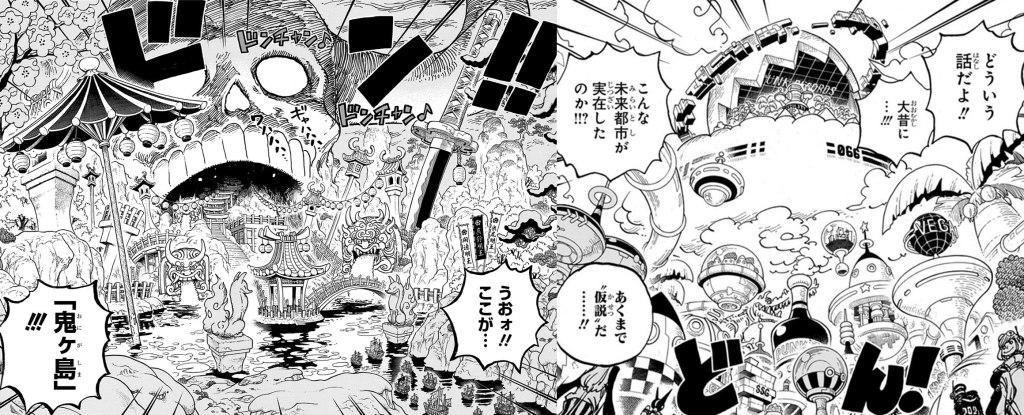
To compare the pair, the battle of Onigashima was set up in the narrative as a raid, but the scale of its storytelling made it feel more like a war. Egghead’s big build up to the Marine blockade and tense period of futile negotiation before the first shots are fired carries the weight of a looming war, but when the action starts for real, it has the feeling of a raid. In an instant we go from anticipation to Borsalino being right there in the middle of the crew’s territory while a bombardment starts from the outside in. And everything from there is a desperate scramble to stay ahead of forces that have our heroes outnumbered and outgunned. When the whole thing plays out at once, you get a great feeling of how cornered the Strawhats are. All the weekly complaints that one character or another didn’t act stratgetically enough or take a long enough moment to express shock or mourn an ally’s sacrifice melt away as the action rolls. I bought fully that there wasn’t time for that kind of thinking or feeling until after the battle. Hell, putting a transcript of Vegapunk’s speech into talk time calculators gives estimates from 12 to 25 minutes, depending on talk speed. That’s how long the past five months of One Piece have taken in-universe. I’d be shocked if the whole climax, from Borsalino starting the attack, took more than an hour including the speech.
And I have to give praise to the move to pull in all five Elders, when things were already feeling incredibly hopeless, just to make sure the crew truly only escape by the skin of their teeth.
There’s a lot of “if”s in looking at how it played out. If the Elders hadn’t prioritised stopping the broadcast over targeting the crew… If they’d sent an admiral who wouldn’t hesitate over personal feelings… If the Giant Pirates hadn’t arrived when they did… We tend to talk ourselves out of tension when we have a week to do it, but the situation felt a lot more precarious in its completed form.
On the flip side, holes open up in the sense of space and framing of Egghead’s set pieces, inclusive of cutaways. When talking about Wano, I’ve lauded praise on Onigashima as a setting, for the complexity of its layout and the thoroughness of its mapping. But despite the sheer amount of things to keep track of, it never felt like anyone teleported across the island, or showed up next to the wrong landmark or experienced any kind of contradiction in their placement on the stage. Oda obviously cared a lot about making it feel like a functional locale. For Egghead, not so much. How is Future City laid out? Doesn’t matter. The only thing really important is the cloud machine in the middle. The buildings are clustered close when Luffy needs something to bounce between and scattered far when the Elders need space to be summoned in. Why is Luffy in Franky’s hand before Bonney’s flashback and lying on the ground far behind him after? Did he land next to the food machine or not? Shouldn’t Nusjuro’s leap up to the Labophase have landed him next to the Sunny, instead of far enough away that Zoro and Jinbei have room to chase him? Even outside of the main story, the pre-arc global events have Blackbeard fighting outside the Amazon Lily sanctum in one panel and black holing the buildings inside the next. Sabo’s Marie Geoise flashback frames it as if he has time to meet Bonney, escort her outside, then make it back into the Empty Throne’s room in the span of Cobra’s meeting with the Elders.

Continuity of space matters less to Egghead than it has to previous arcs. Setting wavers before the needs of plot. I’m sure this serves (or is because of) the arc’s swifter pacing. Less planning, fewer positioning issues to spend panels or pages reconciling; just put them close enough to where they need to be and most readers won’t notice. Me though, I love that kind of attention to detail and am disappointed to see it go. Hopefully Oda will reassess his priorities again for future arcs and strike a better balance between Egghead pacing and Wano intricacy.
It also doesn’t feel as tightly plotted as I’d like. While it can often be hard to distinguish the worldbuilding-only red herrings from the genuine plot setup, there’s a few here that feel especially blatant. The light gloves is the big one. The ability to lock the dom shoes and the front entrance to the lab that’s intangible from one side and solid from the other also feel like they were intended for moments they never got. We have Franky telling Lilith to use the General Franky to move the Sunny, only to go with Brook’s ice slide for a gag. There are ideas that feel like they outright contradict themselves, such as the rules for Pacifista authority hierarchy, or why petty theft is worth execution by Pacifista when the machines didn’t even ask for payment. Holy hell, why not just say the Pacifista recognised Luffy’s group as pirates instead?
Rereading the early stages looking for clues that York was the traitor is an exercise in futility – she’s onscreen, visibly not doing anything when the Frontier Dome is hacked! Boo! To compare with Wano again, Kanjuro’s treason was deftly handled, with enough clues to make a solid guess at while remaining just ambiguous enough that the confirmation still worked as a reveal.
Though in Oda’s defence, there’s a couple of lines of dialogue that feel a lot more pointed on the reread.

(the first one was updated for the volume release, which the SJ app hasn’t updated to, so I couldn’t get a clean, digital screenshot for it)
To swing back to the positive notes, the retro future style of the Egghead environment is a joy to behold. The last laboratory environment at Punk Hazard was samey and sterile, but Egghead is full of vibrant ideas. The futuristic buildings and mechanised sea beasts are classic Oda work. There are some killer spreads from start to end. I love the shark looming under the water in 1061, the group scene in 1074, the cross section of the Victoria Punk in 1079 and the big reveals of Punk Records and the Mother Flame in 1113 and 1114 particularly, but there’s more good ones than I could list. And, of course, the horror development of all Five Elders arriving would not have landed the way it did if all of their designs didn’t absolutely slap. Stunning, stunning monster design.

Where the Egghead design work falls short is the crew’s outfits. Okay, Egghead was a winter island that’s been airconditioned into a temperate one, so a lot of the outfits contrast breezy summer clothes with wintery aspects. Hawaiian shirts with hoods. A one-piece leotard with a fleecy lining. As if the traditional clothes have fused with what it makes sense to wear now. But that doesn’t fully work, does it? The outfits are fabricated in real time by science, not adapted over time by the locals. And not everyone gets those aspects anyway – plenty of characters just get futuristic bodysuits.
Luffy’s Gear Five transformation is badly let down here. Instead of getting a unique, white version of his big coat and bulky dom shoes, those garments just disappear from his body when he transforms and come back when he returns to normal. (This plays into the continuity complaints as well.) It feels like a branding choice, like the “base” outfit for the transformation hasn’t been iconified enough yet, so we can’t have it changing. That’s cynical and speculative, but the bottom line is I’m not a fan.

And the elephant in the room: the women’s outfits. I don’t want to come across like a prude. Sex appeal can be good and fun and healthy when it fits into the narrative and characterisation. Nami showing a lot of leg isn’t something that should bother anyone at this point. But the fact that every female character gets the same style, with Bonney and Stussy wearing almost literally the same thing in different colours, when there’s so much more diversity in how the men can look futuristic? Hell, Lilith and Atlas showcase alternate possibilities that maybe at least one of the newly arrived women could have followed the example of. When your sex appeal is so obviously ‘for the author’ instead of ‘by the character’ it breaks immersion and becomes an issue with your storytelling, and though Oda has straddled that line in the past, he firmly crosses it with Egghead.
This was not the Strawhats’ arc. I can understand disappointment about this, that none of them are particularly spotlighted or given any chance to grow. I’m neutral on it, personally. Not doing more with the sciencey Franky or Chopper is a bit of a missed opportunity, and while Robin had a promising start, she’s sidelined even harder than the rest of the crew in the back half. But this is a big story with a while to go. The main crew will always be around to do more with. They can afford some time in the background. A tougher blow is the treatment of Stussy. After all the intrigue about her starting from Whole Cake Island it feels like Oda totally ran out of ideas for what to do with her following the shock betrayal of Cipher Pol early in the arc. She really does just fizzle out, her choice to sacrifice herself (even though the Vega-clones said earlier that dying for the Stella was their duty) undercuts a suggested arc of learning to recognise and accept her own humanity despite her origin as a clone. I really hope there’s something more planned for her character in the future, because this is a sad note to play out such a potentially interesting figure.
Forgetting the Strawhats and Stussy, the real characters driving this arc are Vegapunk, Kuma and Bonney.
Vegapunk is our fascinating central figure. While he presents a charming mad scientist archetype at the outset, it becomes apparent as the story progresses that his morality is much more grey. He’s a flawed figure who chose to support the blatantly corrupt World Government to get his ideas funded, despite his Revolutionary sympathies. He sells out his ideals for the convenience of it. He prefers not to think about how an invention might be misused or by who until the World Government’s firing of the Mother Flame-powered weapon forces him to. Though technologically genius, he’s socially naive and easily manipulated by totalitarian overseers who tell him he has no choice but to carry out their cruel orders. Vegapunk is selfish. He expresses regret, but not hesitation to ask Sentomaru and Stussy to throw away their positions and outlaw themselves to save him. His clones, which are talked up to have been made into individuals by their diverging experiences, still have an expectation that they will die to save the original. We learn at the very end of the arc that he had the opportunity to drop it all and flee before the Marine siege began, but instead chose to die in a blaze of glory, unable to stand the prospect of a life hunted and without funds to continue inventing. It would feel a little more honourable had so many not sacrificed their lives and livelihoods to prolong his life by a few short hours. And it’s not like he would have lived in total poverty anyway, with the ability set the whole Labophase adrift on a cloud!
People talked, during the weekly read, like these character flaws and the bad decisions Vegapunk made because of them are flaws in the narrative. I have to disgree. I think they make Vegapunk a more compelling and layered character than his cartoony first impression. It would be a problem if they were inconsistent, or if there was some dissonance in how the narrative seemed to be wanting us to feel about him. (For a contrasting example, a lot of the present day talk about Oden and framing of his legacy can feel at odds with the flaws and mistakes demonstrated in his flashback.) Luffy’s drive to help the old scientist comes mostly from ‘his people fed me’ and ‘he asked and I already said yes’ rather than any genuine affection, and the range of reactions from the wider crew, Zoro in particular, provide their own emphasis that we maybe shouldn’t be entirely sure how much we liked Vegapunk to begin with.

The other side of the character coin is Kuma and Bonney’s heartbreaking story. There is no moral complication here. These are good, sympathetic people who have been utterly and completely screwed over from birth (from both of their births) by the world they live in and have to fight and struggle to win back any happiness for themselves. Their flashback will go down as an all-timer in a series packed with memorable backstories. You can’t help wanting to see them end up happy.
A final character shoutout has to go to Borsalino – undeniably a villain, but with a complicating internal conflict that keeps you guessing about his movements, his goals, and if he’s holding back, or even going to switch sides throughout the battle.
And a last negative for balance, as much fun as Lucci and Kaku’s returns were, Kaku has a rough start, falling for holograms and the Frontier Dome as he made his entrance. It’s admittedly been a while since I last read Water Seven, but despite being one of the funnier Cipher Pol agents there, I don’t think he was ever an outright buffoon. Thankfully, he starts feeling more like himself after the Death Game begins.
The final stages of the Egghead escape are accompanied by a mixed lore drop and lore recap. I mean it when I say ‘accompanied,’ because when you’re not reading weekly it’s crazy how spaced out the panels of the speech feel among the action. But this is the sequence which makes Egghead what it was built to be – the first arc of the final saga. The sinking world and establishing of consequences for Ancient Weapon use are a great way to up the stakes for the final battle and pay off on the past quarter century of worldbuilding by putting every supporting cast member from every past island at stake. And while some parts certain do confirm things we either already knew or were 90% sure of, that kind of thing is important for getting all the casual readers on the same page as things really start to build up.
The epilogue chapters, like so many arcs before, do a great job of pulling things full circle right when you think Oda’s out of time to close the last few lingering holes and redeem the final dangling flaws. The choice to sacrifice Saturn for Garling is a bold and exciting way to bring a new villain in for the final arcs. I would love to eventually find out if this was an impulse decision, or if Oda’s really been planning for more than two decades to sacrifice one of the old men in favour of the guy with the Shanks connection.
I’ve waffled a bit, so let’s break the pros and cons down as a final set of TLDR dot points:
- Egghead’s blistering pacing feels like a response to Wano’s sluggish performance, but is at times an overcorrection, causing scenes to feel like they jump forward and the setting to lack depth and structure.
- The weekly read, especially with breaks was unfathomably bad for the arc’s final act. The speed of the action and levels of tension feel like an entirely different story taken all at once.
- Egghead has fantastic environment design and introduces the incredible demonic forms for the Five Elders, but the handling of outfits for the crew and supporting cast are hit and miss.
- Egghead puts the Strawhats on the backburner and squanders Stussy’s potential, but does fantastic character work on the complicated morality of Vegapunk, the tragedy of Kuma and Bonney, and the conflicted antagonism of Borsalino.
- As a part of a larger final saga, the arc lays important groundwork for all the final players of the arcs to come and serves a vital purpose of getting casual and hardcore readers aligned on the lore and stakes.
So yeah. Fun arc. A few too many caveats to its wins to rise far above the middle of the pack, but it demonstrates an ongoing willingness to try to correct the things that didn’t work in the last arc, develop new and old characters in resonant ways, and keep the series and its story unpredictable and exciting. And with the new Elbaf arc starting with a unique amnesia-drive opening, I’m confident Oda still has the drive to keep trying. One of the things that has always appealed about One Piece has been its ambition. It’s flawed, but it has flaws in places other series don’t even have. Other big shonens felt like they were starting phone it in before they were half as long as One Piece is now, but Oda keeps swinging for the fences.
 Captain M Entertainment
Leave a comment