I’m going to put it out there. This is the best One Piece chapter since the Reverie kicked off in mid-2018. The Emperors’ bounties and Roger laughing in Wano came close, but this is the first thing to truly make me feel like I did back at that last big reveal. While I don’t think that the post-arc lore dump of Wano and Vegapunk’s broadcast are quite the failures some sections of the fanbase make them out to be, this is definitely puts in perspective the kind of blow-it-wide-open reveal the naysayers wanted them to be. But would this reveal really have been as big as it is without the little push of extra anticipation and context we got from waiting another couple of arcs?

We open by tying up some lingering questions about last week’s big finale. Twins, not clones or anything crazy like that, and Shamrock is the elder. I’m curious about Shanks’s return to Marie Geoise – would bet anything it happened right after the Roger Pirates disbanded, after learning about the One Piece. Seems a safe guess the scene where he asks a bunch of questions of Roger and cries about the answers was a precursor.
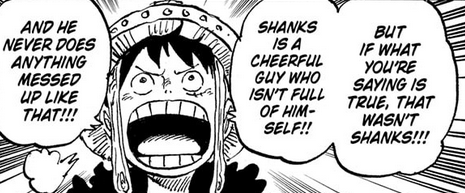
It’s also really, really apparent now that Loki can see despite the blindfold. Sensing attacks coming is one thing, but picking out facial features is another entirely. A big point was made in Dressrosa of Issho not being able to know what Luffy’s face looked like, and him being a literally blind admiral would probably be top of the list for Observation Haki, so there may be some kind of special trick to Loki’s ability to see. And on the topic of Observation, Shamrock tells Gunko to extinguish her presence. We’ve long suspected there was a way to hide from powers of Observation, but I think is the first time anyone’s actually talked about using it.
Happy to see another Devil Fruit-fused weapon show up as well. I was starting to think Oda had forgotten his SBS promise to get Vegapunk to explain that, but this makes it feel like it’s still on the cards. Shamrock’s Cerberus behaves a little differently from ones we’ve seen previously though: it’s able to manifest the animal fully separate from the sword. Could this have to do with the wreath of black smoke that suggests an Awakening for the power? There’s a lot about Zoan Awakenings that are still mysterious, given that Luffy’s still acts more like a Paramecia. Still, I really enjoy the three heads flying around on spiked collar propellers; it’s a very creative visual. Alongside Gunko’s arrows, I’m feeling pretty good about this arc’s fights.

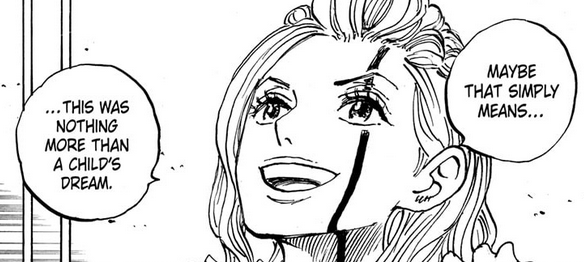
Shamrock plans to take Elbaph’s children hostage as he departs, and I think that’s where we’re getting our main plot for the arc. There’s a random three panel scene of the Walrus School used as a scene transition later in the chapter, seemingly just to show the kids are apart from the adults and vulnerable. This would give Oda the chance to elaborate on the ideas of the new generation being “soft” that he’s been building up, and to give Collun his hero moment. And on the topic of kids, I think we get a little more on the reason the next generation is being raised peaceful and where Oda wants to take that toward the end of the chapter. Ripley says the image of racial cooperation in the mural seems like a “child’s dream.” Kids may be chaotic and raise hell at the best of times, but there is an optimism in them, and an ability to dream of the impossible in a way adults can’t. Elbaph is nurturing their kids’ ability to hope and giving them the tools to make social ties with outsiders so that the plainly childlike dream of a world that works together can be realised. And there’s no way that’s going to end up being a bad thing.
It’s nice that Luffy kinda knows who Belle-mere is now, similar to his deference to Saul. He’s not the type to ask about tragic backstories, and we know he struggles to listen to a long-winded tale, but once he’s heard about someone important to someone important to him, he’s not going to forget it.
And man, the mysterious hat guy is on his way up too so we can have another bombshell reveal next week. I’ve been waiting for this guy since the cover story. It’s nice attention to detail that he talks up the slope beside the main path – of course the giants’ stairs wouldn’t really work for anyone human-sized.
The rest of the chapter builds into the text of the Harley and the reveal of the Harley and its accompanying mural. And man, this is huge. It looks like everything we’ve been waiting to find out put on display at once, but in a vague enough form that we can’t be totally sure of what part of it is which big, exciting thing. I can’t wait to spend years looking back at these last two pages as the details finally unravel. it’s crazy. And it gives me arcs I want to reread over the coming weeks to look for clues in the details. Anything with giants – Little Garden and Ennies Lobby, maybe Thriller Bark for Oars – and all the ancient mythology of Skypiea seem like good starting points.
The Harley text presents three worlds separated by apocalyptic events, none of which truly end the world, but instead reorder and remake it, much like the Norse Ragnarok. It provides a prophecy – the end of the Third World in which the characters now live – as well as two pasts. A version of the Void Century was always a given, but another set of mythologies for a world before the Void Century. I really didn’t think we’d get much of that in the story – vague hints of how utopian things were before the World Government overthrew the Ancient Kingdom, sure, but not a whole detailed end of the world story for them. It’s not clear either how long before the events we know of this is all meant to have taken place as well. The Second World could just be the Void Century, with the First covering everything before it. Or it could be further and further into the past.
I’m taking the mural to depict just the first and second worlds. Some will say the right side is the future final battle of the series – and while I think there will be some parallels to it, we won’t see it fully recreated. It’s primarily an image of the past.

The First World, represented by the right side of the mural, seems to have been some kind of dystopia. There are slaves praying for salvation, forbidden from reaching for the sun (sound familiar?), but enslaved by who? The Earth God and the Hellfire Serpent? Other humans, such as the king figure in the mural? The images seem to depict the people of this era descending into the earth via an enormous elevator and returning with a glowing energy source. There are complicated mechanisms underground and very modern cities above. My read would that be people were enslaved to mine a power source compared to the sun from the core of the earth – and led by the arisen (or created) god Nika, they took control of this power source for themselves in a massive uprising. While the Earth God and the Serpent are said to wreak destruction across the world, I think the former slaves ultimately won this conflict, even if it was a pyrrhic victory. The serpent, whether literal or metaphorical, lies dead as the Red Line (possibly called the Red Wall at the time) dividing the world so they “will never meet.”
The use of the Forbidden Sun is curious too. We see a chain of slaves lugging pieces of it from the lift over to a boat going into the city, but the dark section that the ark rides on seems to be spreading outward from a piece of it that’s been let go by its slave. Is the sun making the ocean down there, as well as powering the city? A couple more sit below, with the people lining up to descend into the earth, possibly to power the lift and provide light. Maybe there were multiple uses, or multiple parties exploiting humans to mine the Sun before the uprising.
The big unknowns to me in the First World are mostly on its rightmost side. We have the ark Noah, seemingly being used for the same biblical purpose as its namesake, even guided by an angelic (Lunarian?) figure. Perhaps even in the First World, there was knowledge of the rising sea levels that are spelling doom in the Second and Third Worlds, or at least knowledge of the means to do so. I wonder if part of the motive for raising the seas was to fill in the mines of the Forbidden Sun so no more of it could be acquired by anyone. There’s a king with two oars. And there’s a craft not unlike Enel’s Maxim, but also not unlike the impression we have so far of Uranus, throwing down a bolt of lightning. The dragonlike creature breathing fire at the Serpent also doesn’t seem to be represented by the text. Did the humans offer the Sun to a literal Celestial Dragon in exchange for its power to face the Serpent? And what’s with the other celestial bodies behind the moon, mostly obscured by the text boxes? Could my old pet theory that the world of One Piece used to have multiple moons finally be paying off?

The right hand side of the mural then depicts the climactic battle of the Void Century, in which an alliance of twenty kingdoms claimed victory and rearranged the world with themselves on top. The text talks about “breath in the void,” which makes me think the Second World was a very empty place at its start. The Celestial Dragon that fought the Serpent departed, but left a powerful impression. And to fit with what we already know of this era, the humans remaining used the Forbidden Sun they now have control over to build the futuristic society Vegapunk researched. But for whatever reason, be it envy of the Ancient Kingdom doing this, or power lust, or a hope to recall the original Celestial Dragon by worshiping its image, or being a slaveowner from the First World who wanted to turn things back to how they were, Imu rallied twenty kingdoms to oppose the Ancient Kingdom and killed that First World Forbidden Sun they were still using, rendering all the technology it powered inert.
A Forest God taming demons might speak to the advent of Devil Fruits in this era. The talk of the Sea God’s storms gives us an interesting point to compare with the other gods though. Consider: we know the Second World drowned in a massive sea level rise, leaving only mountains uncovered. That sounds pretty good for the wrath of a Sea God. But we also already know what caused the sea levels to rise, and it’s technology from the Ancient Kingdom. A machine only named for a god. Do we then take the First World’s Earth God as a terraforming machine rather than a literal entity that summoned a big, living snake? The Forest God may be simply an attempt to explain Devil Fruits, just as many real world ancient gods were made to put a face to natural phenomena.
Most of this image is a battle. A multinational group tries to stop a figure who brings to mind Imu’s monster silhouette in the throne room and a group of guys in spacesuits. Joyboy leads, and his alliance includes giants, minks, fishmen, sea kings, ancient giants, tontatta and Lunarians. There’s a second minklike figure in white, which has me thinking Sulongs may once have been a separate species who’ve passed all their traits to regular minks via interbreeding. The whale is a real mystery, but recalls Laboon, the culturally significant Whale Tree on Zou and the scarred up gam of whales the crew saw on the way to Punk Hazard. Whales that were oddly receptive to Brook’s song. Hmmmm. There are also two identifiable nations in Joyboy’s group – Alabasta and Wano. Alabasta is a strange one, given that it will end up a World Government nation. Maybe Lily was caught between two worlds, extorted in some way by Imu. If she was forced to betray Joyboy, it may have been the reason his alliance failed; but even so she ensures a way for his will to be inherited making her “great mistake” and scattering the Poneglyphs and preventing Imu from claiming a total victory.
Once again, we have the line that they will never meet. The first thought for this one is the Grand Line, building on the Red Line of the previous era. But it’s worth considering what Vegapunk pointed out in his speech – the ocean alone serves this purpose. Most people never meet cultures outside their own because travel is so difficult and dangerous.
And the Third World passage is honestly pretty straightforward. The new era has made an empty space in the chaos of history. People of the D – increasingly likely to be an image of a half moon – lurk in wait and the remnants of the people who fought with Joyboy anticipate the dawn. This ultimate Forbidden Sun power that was valuable enough to enslave people to mine it in the First World and powerful enough to create futuristic tech in the Second World will be rediscovered. The restrictions of the Red Line and the Grand Line over the world will be ended, and people will meet and mix cultures and assimilate again.
One of the cool things across the whole text is that is answers the question from a couple of chapters ago about the three versions of Nika. We actually have a liberator, a warfighter and a dancing, laughing man across the eras. All are true!
That’s about as far as I can go in interpreting and analysis this behemoth of a reveal without going some rereads. It’s so dense with info and we clearly don’t have the full story yet. There’s so much that has to tie in – the city Enel found on the moon, the reason the Celestial Dragons are so obsessed with genetically engineering giants (we can make so safe guesses about why they love dragons so much now), sky islander peoples, the longarm/longleg/snakeneck/three-eye tribes, whatever the heck Blackbeard has going on and so much more. We’re gonna be going back to this for years, and in the spirit of its in-universe presentation, I doubt we’ll be able to agree on the best possible translation for the Harley text until the end of the series, where the things it references are all revealed.
Elbaph has been on a crazy run of hits so far: Robin and Saul’s reunion, the Shamrock reveal, and now this. Emotional payoffs, confirmed theories and building the bigger mysteries. We know this is an arc Oda’s been waiting to do for a looooooong time and it feels like he’s going all out to make it worthwhile. Can’t wait to see what’s in store for next week.
 Captain M Entertainment
Leave a comment