
(this review covers the whole series but should scan as spoiler-free to all but the most sensitive of readers)
Robin Hobb’s Realm of the Elderlings comprises 16 full length novels, one novella and half a dozen short stories, but its not as intimidating as it sounds. The novels are divided into five arcs with distinct beginning, middles and ends and timeskips of sometimes close to a decade between them (the main story ends up taking place across nearly 60 years!), so there’s built-in spots to take breaks, and things are regularly reigned in so it never ends up suffering from the bloat of supporting characters and subplots that hamper other huge sagas.
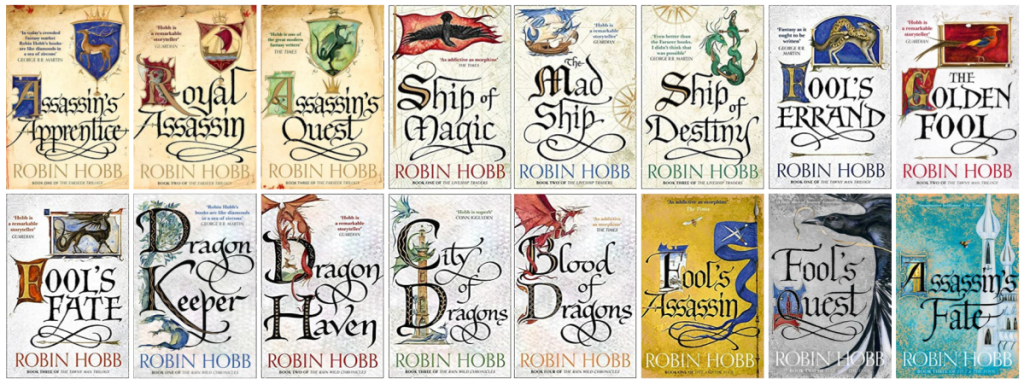
There are two narrative threads that the series alternates between from arc to arc.
The first follows Fitzchivalry Farseer, bastard son of a disgraced prince who is taken in by the king and told his two choices are either to disappear quietly before anyone thinks of propping him up as an alternate heir to the throne, or to prove his usefulness by apprenticing under the crown’s ageing assassin. And as he struggles with court politics, Fitz forges a bond with the king’s jester, a mysterious and androgynous figure known only as the Fool, who claims he can see the future. Fitz’s stories are told from a first person perspective, framed by him trying to take down his memoirs later in life.
The other is set on the Cursed Shores, where traders and pirates deal in magic artifacts stolen from the ruined cities of an extinct civilisation. Here, the Vestrit family is divided by a inheritance dispute. Eldest daughter Althea was promised the family’s Liveship (a vessel with an animate, talking figurehead) by her late father, but her brother in law Kyle Haven stole it from under her, weaponising the social and legal precedents of the trader world, which say that women belong in the homestead instead of behind the helm. Meanwhile the pirate Kennit is brewing a plan to make himself a king, but he’ll need a Liveship of his own to do it. These arcs use the rotating set of third person POVs more traditional for modern fantasy.

While there are references and character cameos between the two narrative threads, the strongest connection is the reader’s growing understands of who/what the ancient Elderlings were and why they aren’t here anymore. And the final volume, despite being a Fitz story, takes a tour through the Cursed Shores and gives all the major characters there a moment to shine for the saga’s finale.
Hobb’s language is beautiful and efficient and so, so evocative of each character’s headspace that you can’t help feeling their sadness, frustration and occasionally joy along with them. The psychology of the main cast is rich and detailed and they all scan as genuine, believable people. This is the kind of character writing where some characters need to make a mistake multiple times and be beaten over the head with a lesson repeatedly before it sinks in enough to change their behaviour (especially if they’re a main character, and especially as hell if it’s Fitz), which certainly feels realistic to how real people tend to be set in their ways, but can also verge on frustrating.
The long timeline plays to the advantage of a lot of these heroes when you eventually get to see them grow from young adults to actual adults and approach familiar dilemmas with newfound maturity and perspective (while also making all new grown-up mistakes). Hobb also uses it for some of her most devastating emotional blows, as the cast confront some of the harder realities of ageing, such as outliving beloved pets and mentors, and outgrowing lifestyles and relationships you once fought and sacrificed to acquire. When this series wants you to bleed, it will cut you to the bone.
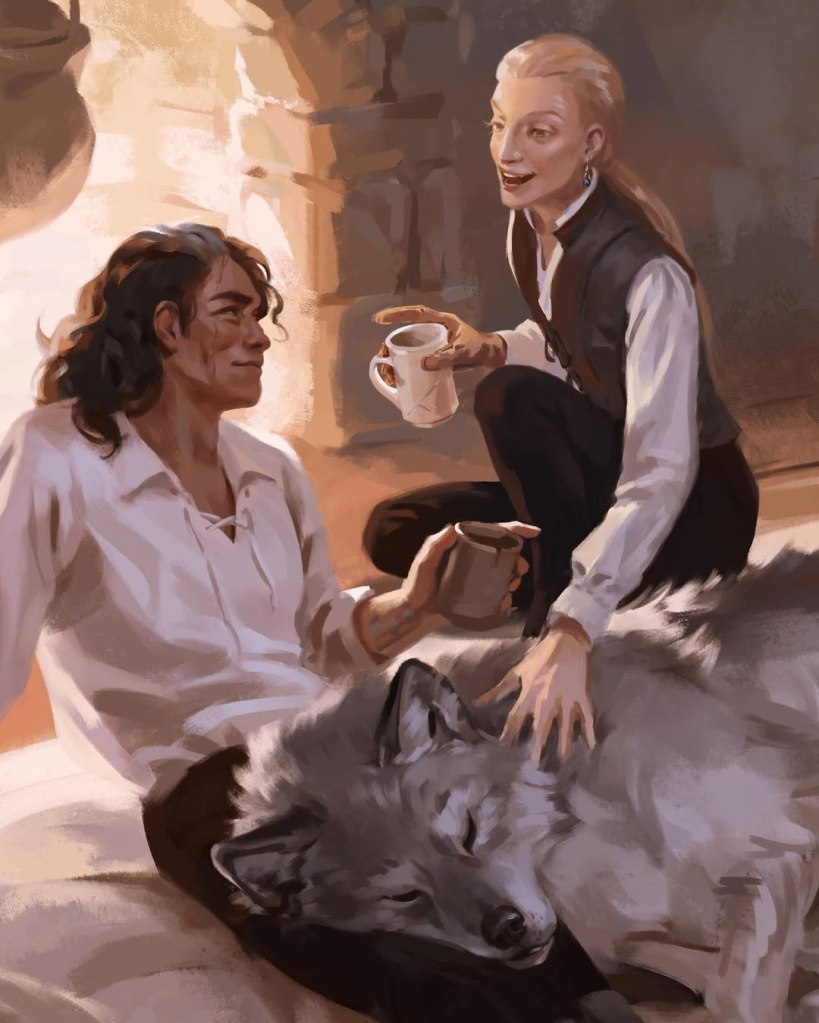
There are a few fantasy standard megalomaniacal royals and mad prophets among the roster of villains, but the most effective and memorable ones are the everyday bullies, the tyrant bosses in the workplace you can’t afford to leave and the abusive partners that every has encountered at some point. The petty evils performed by people who can’t help turning the smallest amount of social power against the people closest to them. Hobb writes these bastards so effectively (and is so good at putting you in the emotional zone of the victim) that I actually felt my temperature rising and heart rate increasing through several scenes. I can think of few characters I’ve wanted to reach into the page and throttle more.
I have very little negative to say about this saga. Some individual books could maybe have had their pacing tightened, the fourth arc is kinda weirdly structured and not quite as compelling as the stories around it. But overall Hobb has rocketed to the top of my list of fantasy authors over the past year and a bit of reading. It’s been a long time since a book has pulled such visceral emotional responses from me, and I think it will be a while before anyone is able to do so again.
Readers be warned though, the tone of this saga is fairly bleak, and most protagonists are put through physical and emotional wringers before being allowed even the most minor or bittersweet of wins. Just about every common content warning applies to at least one book, including sexual violence, domestic abuse, graphic injuries in the context of battle, torture, surgeries and butchering fresh meat, animal deaths, facing various prejudices and bigotries, and spending a whole lot of time in the heads of characters battling depression, addiction and suicidal impulses. I wouldn’t say any of it was gratuitous or felt like it was there purely for shock value, but this overwhelming grimness over such a long saga is going to mean these books aren’t for everyone. But if you have the stomach for sad and dark stories, I can give no higher recommendation.
 Captain M Entertainment
Leave a comment