Oda takes a chapter to put a bow on the God Valley storyline and ease us back to Harald. And it feels like a reasonable ending for volume 114. It’s always nice getting that Jump cover/colour spread combo as well. The spread has some nice, autumnal vibes with some pleasing new outfits for the characters who made it in (Nami in particular), buuuuut I don’t think we really needed to go back to the Wano cast so soon after Yamato’s cover story. The Jump cover is simple, but it gives us Rocks’ colours, so that’s a guaranteed crowd-pleaser. I like the look, but I’m not looking forward to the amount of Buggy theories we’re going to get from the blue hair. It also looks like Oda is picturing a red shirt for Garp in this sequence – that means the anime already has this wrong in Kuma’s flashback, but maybe the long-dormant digital colour manga has enough of a gap to get it right when they get there.

It’s very interesting that Rocks appears to legitimately be back to normal in the opening pages here. Conqueror’s Haki being able to do that lines up with it banishing the Elders from Egghead, and it gives Oda an out for saving Dorry, Brogy and anyone else who gets taken over in the present. Going with understated final words instead of a big speech is a common Oda choice for beloved characters – see Merry and Ace – which makes it feel more deliberate that Rocks has come off as a lovable rogue rather than the outright villain he was built up to be. And the knowledge that Rocks could likely have been saved if Rayleigh and Scopper had arrived before Garling’s squad did makes the tragedy complete. The world conspires against the man to the end.
Not sure what to make of God Valley’s apparent implosion into the sea. That’s not anyone’s power that we know of, and it’s a crazy thing for a normal fight to do. I guess knowing that most of the One Piece world is mountaintops, it could make sense for the ceiling of a chamber inside the mountain to be shaken open, letting the top of the mountain (and the sea) collapse into it. Maybe a bit of a reach, but it could be.

The following spread is a real winner though. That’s an awesomely dramatic sailing scene. Seeing pirate ships and Marine ships flee equally from the destruction while lightning splits the sky and a new era begins.
Cool to see the storyboarded page from the Film Red promo material finally making it into the series. Not much else you can say about it.
If I’m honest, I still don’t quite understand how Garp game away from this thing shining like he does. The God Knights don’t seem to be so top secret Garling couldn’t be given all the credit. For him to have attacked Saturn/Imu directly and to wield at least 50% of the conqueror’s power to undo a Domi Reversi feels like it should be grounds for execution. And at the same time that his son turns traitor? Remember how the top dogs of the WG believe that things like being a god or a criminal get passed along in the bloodline? We know from things like Smoker being given credit for Alabasta or Koby and Rocky Port that the WG likes to make heroes of its Marines for the propaganda, so earlier in the series it would have been easy to roll with Garp being propped up that way. But we’ve seen too much of the Government’s hard lines now, and we know Garp has crossed to many of them.

I’m not quite sure what to make of Sengoku’s philosophy in his chat with Garp either. Does the size of the oranisation really give cover to any of this, acting like the top dogs might just be making weird choices because they legitimately can’t keep track of everything below them. But it wasn’t insanity in this case, it cold, calculated cruelty in an attempted grap of resources, and it came directly from the top and kept out of sight of the lower levels. It doesn’t really hold water, and it does feel a lot like, as Garp says, Sengoku turning a blind eye to keep his career going. Sengoku implies he wants to make change once he reaches the top, but I wonder if in the present day, now that he’s retired, he thinks he succeeded. With Sakazuki in charge, the Marines are at least as bad, if not worse than when Sengoku came in, I think that’s inarguable. And does Garp truly believe Sengoku made it through his career without being corrupted, or did he have one of his trademark internal conflicts and couldn’t find the courage to kill Sangoku like he says here? It would be interesting to see some vignettes of how this relationship and their goals changed over the decades, how the morality slipped one compromise at a time.
The talk with Rocks Loki remembers raises a few questions about their relationship and Rocks’ morality as well. One strongly inferred feature of Rocks’ plan is the legendary Elbaph Devil Fruit’s ability to revive the sleeping Galleila (what power could that be), and the reason he wanted Harald is to have the current king of the giants to give them an authority they would recognise. This was all laid out ten chapters ago and reinforced here. So it would actually have been an easy win for Rocks to take on the prince of Elbaph. Loki is ready and willing to be groomed as a tool in Rocks’ master plan, and just as royal as his father. So what stops Rocks? Doesn’t want to use a kid that way? Or is he so enamoured with Harald he needs to have the man as a partner and equal, a point of pride to have won him over rather than subjugate or bypass him?

And while we’re on that doomed friendship, I actually do feel sympathy for Harald here. Rocks must have seemed so invincible to him. We’ve talked already in recent weeks about how unlucky Rocks was at the end, the wrong person on the wrong island at the wrong time; the wrong additional hostage bringing extra attention; the wrong people arriving first after the fight. Just one domino falling a different way would have changed Rocks’ fate, and Harald knows it could have been him. I don’t agree with many of Harald’s choices, this one included, but it’s a sharp pain to live with the loss of a friend because you didn’t realise how desperately they really needed it when they asked. He’s a well-written character with layers of internal conflict to peel back.
The pair actually have me thinking of the Guts and Griffith of Berserk’s Golden Age Arc. One has too great a respect for the other to stand being anything less than an equal, the other has ambitions that leave little room for friendship. The conflict between these motivations ultimately dooms the relationship. If I’m drawing Berserk comparisons, you know you’re doing something right.
And speaking of nuanced characters whose choices I wouldn’t have made, Garp and Dragon’s scene is great. So much said with so few words and one action. I’ve raised issues in recent weeks about Garp staying in the Marines and how much he has to overlook about them and how much the WG has to overlook about him to make that happen, but scenes like this make him such a compelling character. Since Marineford, the constant internal conflict between duty and family have made him one of Oda’s best written characters.
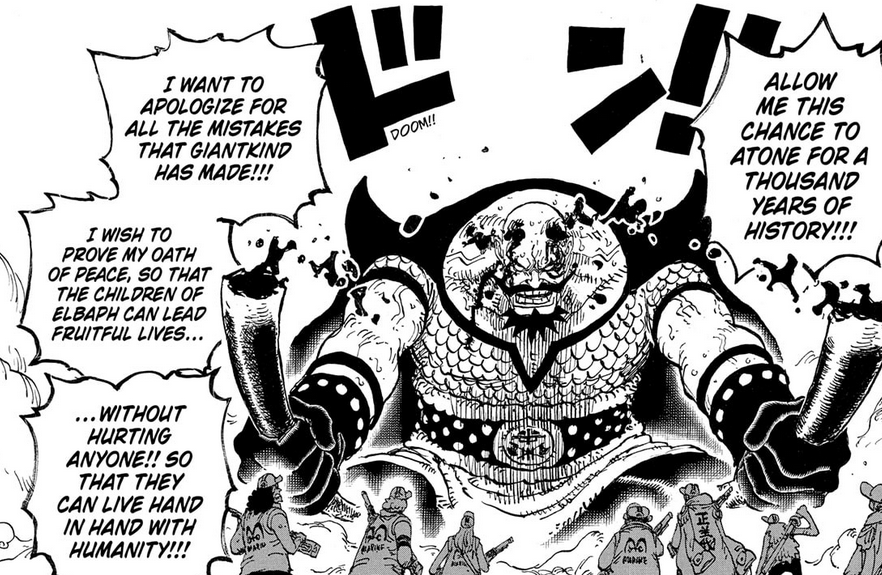
Finally, such an ominous scene to end on. The grand gesture of a man repenting, but it’s not really about the sins of his ancestors, is it? You can feel the weight of choosing propriety over friendship and regretting it driving Harald now; from shifting the family dynamic away from the traditional, to grovelling to the WG. The former would be a pretty clear positive if he was going to be around to integrate his families, but the latter ends on such a grim choice of words. And Oda puts Imu’s eye in to make sure there’s absolutely no missing the point. (And if we wander back to the Berserk comparison, losing Guts also spurs Griffith to take a series of rash actions that will ultimately undermine the kingdom he’s been working towards and end with his transformed into a demon. Hmm…)
Often in One Piece, it’s the bits between arcs that are the most exciting. Seeing a big even ripple out and change the world is where the extensive worldbuilding a massive cast pay dividends. Never thought I’d see one of those sequences inside a flashback, but Oda pulls it off for an unexpected hit of a transitional chapter.
 Captain M Entertainment
Leave a comment