-
One Piece chapter 1100 review
We know that aside from 100 and 1000, Oda’s never really written around milestones, but you still generally find something that feels like a big step on each hundred chapters. While we have a pretty damn good chapter of One Piece this week, I don’t think there’s anything that really qualifies it as a giant leap forward for the story. Maybe all the classic Warlord cameos are meant to feel like the reward for the big eleven-hundred. Maybe, given that the celebratory colour spread is slated for next issue, the big moment missed by one. Or maybe that’s just because of how Jump’s scheduling panned out and I’m overthinking the whole thing.
There’s an irony in Borsalino, in the opening pages, contrasting the climates of Egghead and Punk Hazard. He thinks Egghead’s so much colder, but give it a few years and Punk Hazard will be half frozen over and Egghead will be fully climate controlled.

There’s a lot of characterisation on show in this first scene. Vegapunk is painfully naive in failing to check for bugs in his lab, and this still won’t teach him not to trust the Government. Borsalino has a laid-back and personable demeanour at a glance, but he’ll do his job if he has to. And Kuma. Poor, well-meaning Kuma, loses all sense of perspective where his daughter is concerned. I don’t think he heard a single word that wasn’t about Bonney, even as Saturn offers him basically the worst terms ever. There’s a comparison to be made in Kuma’s reaction throughout the scene to Hancock asking Luffy to choose between freeing his friends and getting a boat. That same misdirect on what the initial reaction means and the laser focus on the people who need saving at the expense of all else. Except Luffy’s version played out in his favour whereas Kuma… well, we’re in a One Piece flashback, so you do the math.
Saturn’s character is also front and center here. It’s that he’s a bastard, all pragmatic and cruel.
I really enjoyed the montage of treatments, slice of life scenes and construction work to show the passage of time here. There’s some nice fanservice in seeing the (probable) moment the Vegaclones were conceived, and Vegapunk leveraging more underworld connections that would have to go back to his MADS days, this time with Storage King Umit. It’s cool that all the underworld figures from Big Mom’s party keep sticking their heads up to connect corners of the world.

There’s some wonderfully nostalgic fanservice seeing all the classic Warlords and a few others reacting Kuma being commissioned into their number. Curious that Doflamingo, proclaimed “champion of evil” sees another miscreant in Kuma, buying into the hype completely. Having been involved in World Government info tampering personally, and setting records straight with his crew on the fall of Flevance, you’d think he’d at least acknowledge the possibility of spin on Kuma’s story. I wonder if the apparent interest in another outright bad guy in the crew ever lead Doflamingo to reach out to Kuma. It might explain them turning up to the meeting together back when they were both first introduced.
An Ace appearance is always welcome. We knew he was offered a Warlord spot, but I think it’s new info that he toppled one before that. This is a little bit of a lesson in taking spin-off material as fully canon, because like, you’d think that event would warrant at least a mention in Ace’s novel or its manga adaptation. You know if they’d waited a few years and done those today the authors would be asking Oda for an original design for the beaten Warlord and making the encounter into at least a small scene if not the whole story, and its absence makes those volumes feel all the more secondary in retrospect.
Jinbe noting the growing political power of the Warlords is also a touch I like. We’ve known about powerful figures abusing the Warlord system for their own schemes almost as long as we’ve had One Piece, but I get the sense that the first generation legitimately acted as privateers and over time more and more people with things to hide have forced their way in. The group becomes both more dangerous and harder to control.

It is adorable that Kuma uses Bonney’s drawing as his jolly roger. No notes, just a great touch. You can really see how thin his commitment to being a marauder is. Also, is that a bear ear on the side of his ship? Maybe we all figured as far back as Sabaody there would be more layers to Kuma, but I doubt anyone expected him to do something that cute, especially with his imposing first impression.
There is a strange current of speculation online that Kuma has been sent to Windmill Village to deal with Luffy or something similar in the last page. Are we not paying enough attention to see that Kuma is already there when the orders come in. Whatever the Government wants (if the orders matter to the story and aren’t an excuse for him to namedrop his location) it doesn’t seem to have anything to do with our protagonist. But maybe I shouldn’t get too high and mighty – getting orders relating to something on the island he just happens to be stopping at for a resupply or whatever is definitely not too much of a coincidence for Oda, so we’ll see next week what the deal with all of this is.

Next week, no matter what, we’re somewhere in vol 109, and I think we have to start building up to the climax of this flashback. Right now, it feels like there’s something missing for the ending, a factor we don’t know about yet. Kuma losing his will wasn’t a shocking betrayal, it was a deal he walked into willingly. In fact, it feels like we prettymuch know it all – he spends some time as a Warlord, is made fully into a weapon at the time the Pacifistas are first deployed. Maybe he’s able to leverage that final request to defend the Sunny because Bonney had already escaped and the Government was wary of him running off with all that tech and became more pliable to his requests (or Vegapunk liked him enough to go behind his bosses’ backs). Mission complete, he’s made a slave until the Revolutionaries grab him and run, and we’re basically up to the present. It would be anticlimactic to just play all that out in fast forward, so I think Oda’s going to work some kind of a stinger in there. Probably something to tie into how and why he’s awakened to himself and begun rampaging while the Egghead Arc happens.
Looking forward to colour pages after quite a few chapters without, and for a final surprise gut punch to put the cherry on top of one of the series’ darkest and most effective flashbacks.
-
One Piece chapter 1099 review
I’m glad to see Oda’s break treated him well after the last chapter, because this one is not only completely finished, I’d say it’s one of the cleanest looking we’ve seen in a while. The lines seem very sharp relative to the sketchiness that’s become a trademark of the last few years. There’s areas of roughness, sure, but I think most of the chapter is high quality work. I wonder if Oda came to some kind of realisation or new technique to even out the process, or if he’s simply pushed himself extra hard because he feels like he needs to make up for the state of the last one.
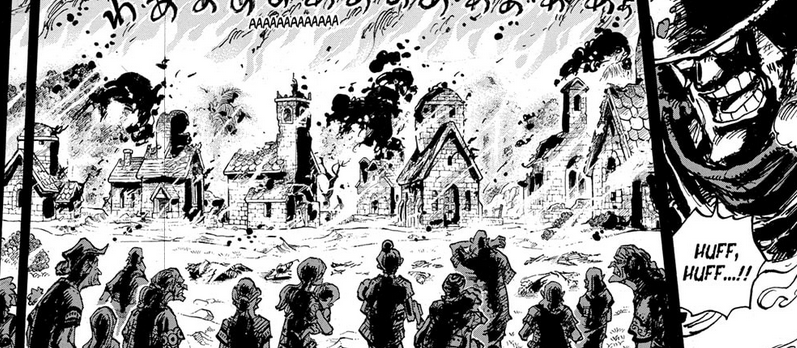
Either way, this is a fairly transitional chapter when you get down to it, ticking off the boxes we knew needed to be ticked and filling in blank space in the timeline. No shock that Kuma traded himself for Bonney in a deal with Vegapunk, nor that his tyrant epithet was propaganda or that he stumbled onto the throne accidentally after confronting Becori. Predictable or not, these developments needed to be shown (in part because not all the casual readers are going to remember the vague statements about Kuma’s past from hundreds of chapters ago that the hardcore fans had used to piece together their existing ideas of his history through implication) and we actually get through them pretty quick, hopefully to set up this flashback’s next big gut punch for chapter 1100.
Bonney getting her Devil Fruit at random at this point is certainly a surprise. I wonder if there’ll be an SBS answer for how it ended up in the hands of a girl who can’t go outside. Or will it just be a mystery forever like Robin and her Devil Fruit.
The misdirect gag between Bonney’s aging and Conny’s appearance is fun, and I was almost not expecting to see an explanation for Bonney being able to impersonate her so easily at the Reverie, but it also feels a bit like evidence of a changed plan. Wouldn’t shock me if there was an early outline somewhere that made Bonney an actual part of the royal family (perhaps Ginny was originally a local, some distant relation of Bulldog who was enslaved after a cruel twist of fate) and Oda decided to go another way when he reached the point of actually doing the flashback and mapping it out event by event. But it still fits together as what it is, this is just me as a writer trying to dissect things.

Could Bonney learning to base her elderly form on Conny be the origin of her distorted futures? It would explain her being able to take on Kuma’s physique despite the lack of blood connection.
There are some awesome continuity callouts in Kuma’s piracy montage, from the islands he scattered the Strawhats to, to Abdulla and Jeet, to the Revolutionary Army regional commanders showing up again. And of course references to the purging of Grey Terminal and the explosion at Punk Hazard around the chapter. It’s also cool seeing Egghead before Vegapunk made it into Egghead. Can you believe the difference in less than seven years?
Vegapunk is frighteningly naive in his ideas about how the clone soldiers will be used by the Government, but it tracks with how we know him in the present as well. it’s hard to say what Kuma’s read on the old scientist is in this scene, especially the panel at the bottom right of page 16, where he looks surprised and concerned by Vegapunk’s declaration of “mighty warriors from the future.” I think Kuma has seen enough that he understands how the World Government would use things like that, but for Bonney’s sake (who we already know matters more to him than the Revolutionaries’ cause) he can’t say no. So he justifies. He falls back on Dragon insisting Vegapunk’s intentions are good (and hey, he was cool about the Buccaneer thing). He hopes against hope something good actually will be made from the clone soldiers. He trusts himself to deal with the fallout if it goes wrong and take the burden on his own shoulders, as he did with the ousting and return of Becori.

Unfortunately, we know it won’t be that easy. Saturn is set to take away Kuma’s mind and rob him of the chance to set right the abuse of his clones. That makes me think that part of Kuma’s agenda when he’s on Egghead and at least partly in control will be to destroy as many Pacifistas as he can, or at least the facilities that make them, to put an end to his own misuse. The Seraphim are likely to be salvaged, as the World Government’s endgame weapons, but the annihlation of the regular cyborgs would be a huge blow.
I don’t think we’re quite close enough to the end here to wrap up the flashback for 1100, nor is it really positioned for a huge lore bomb like some are hoping for. I think the big thing next week is just going to be the tragic but inevitable betrayal of Kuma that makes him what he is. This is also potentially the end of volume 108, but I want to see where 1100 leaves us before I put any final bets in on that front.
-
One Piece chapter 1098 review
This is a big one. Lots to talk about, lots to think about. A lot of… interesting reactions from fans on all corners of the internet that I want to reflect on. The first thing that stands out is the art. While mistakes have happened and corrections have been needed, the is the first time in 26 years we’ve seen Oda submit an unfinished manuscript. Other authors have done this in far rougher states far more regularly, but it’s still a shame to see Oda break his streak. I wonder if something happened. A health issue? Scheduling with the live action? Perhaps a staffing one. The primary inking seems to be done across most of if not the whole chapter. What’s missing is the erasing of pencil shading and sketch lines and the application of screen tones, which I understand to generally be the staff’s job. Whether Oda finished the inks so late that these final touches couldn’t be added, or if something happened to the normal screen tones guy, it’s hopefully a one off.
If it’s not a one-off (and a handful of panels with leftover pencil shading from the last chapter do suggest a slightly more ongoing deadline crunch) we might be back to two weeks on one off from next year to keep this from happening again. But that’s a concern for after the November/December break season.

Oda delves into some heavy topics this week, and the collective gut reaction of the fanbase has been explosive. It’s interesting to look at how much of an impression this particular chapter has made, given that we’ve been able to infer that these sorts of things happen for a long time now, after seeing the Celestial Dragons taking slave wives at Sabaody, the Boa sisters’ slavery-related trauma that left them distrustful of men, and the story of the girl who took her own life after being freed that one commoner sought revenge on the Donquixotes for. Perhaps it was the degree of ambiguity the previous hints afforded. Sure, you have to stretch for it, but you could say those older examples don’t have to lead to sexual assault. Ginny returning with an infant who very obviously takes after her is a tougher hurdle to throw ‘he wouldn’t really put that in a kids’ series’ at. Even so, Oda is careful about nowhere coming close to even using the word ‘rape,’ let alone actually depicting it. The reader is still expected to connect the dots. It’s a nonconfrontational method for putting this dark subject on the page in a way that will hopefully not disrupt its young adult rating or alienate the portion of its audience that’s sensitive to the topic.
Looking over the weekend’s spoiler discussions, some of the fanbase is kinda treating this like Oda put a Berserk-level scene in the series out of nowhere, when the truth is that he’s done everything he can to hold the subject at arms’ length. Never shown or stated, but told through heavy implication. Ginny comes back ravaged by a disease (despite what some people are saying, there’s no real reason to believe it’s an STD) that conveniently disfigures her beyond the point that any distressing physical wounds from her abuse as a slave would be recognisable and kills her outright before there’s any chance to dig into the trauma, the feelings and the ordeal of recovery and living on. One Piece is not talking about rape this week. It doesn’t want to. There’s an almost mystical, stork-like quality to the way Ginny vanishes for two years and returns with a baby and no chance to say more about where it came from beyond what we think filled in that gap in her timeline. The inferred conclusion is easy to see for grown adults like I assume most of us here to be, who’ve seen this subject matter covered before and have no allusions about the small, personal evils humans are capable of inflicting on one another. But I do wonder how much of the series’ younger audience, that makes up so much of the Japanese readership, is going to be able to read between the lines, or what their prevailing interpretation will be. If you’re fanciful enough, (like the people who think Mother Caramel and the other orphans simply ran away and hid instead of getting eaten by Big Mom) you can headcanon up a version of events where Ginny smuggled out the child of another slave, or found an orphan she couldn’t abandon on the way back to Sorbet, and while evidence in canon will strongly resist those ideas, it doesn’t outright contradict them.

And I’m sure debates will rage about whether or not this was an appropriate way to handle a topic so sensitive to so many. I don’t think there’s any such thing as a qualification to objectively judge such a thing. What shocks, what feels blunted and what does and doesn’t scan as sincere is going to vary for each and every one of us. For me, while I definitely wouldn’t point to this chapter as a go-to example of handling rape in fiction, the implications-only, arms-length approach keeps it from feeling like an edgy shock value move. For a series that doesn’t have the tone or the time to go all the way into the tempestuous introspection of real sexual violence-related trauma but still wants to be true to the darker corners of its established world and the history it draws on, this was probably the safest option, and smartly chosen.
It’s a shame to see Ginny go so abruptly and so badly though, right after two chapters of getting to know her. For all my overanalysis and cautioning above, my gut reaction sits as the first reply to the Arlong Park Forums spoiler thread, and holds true to the full chapter release. “Fuck me, that’s dark.” My mouth fell open as I realised the story being told. No one should be surprised that Ginny died, but I expected it at the climax of the flashback, with at least a chapter’s warning that it was all coming to a head. I am well and truly caught off guard by this one, a swift jab in the gut out of nowhere, and the flashback isn’t even done yet.

On Ginny’s death, we have the also somewhat sensitive topic of female characters being ‘fridged.’ That is, being assaulted and killed for the sake of giving a male character something to angst over, a trope that gives some readers a feeling women are being treated as disposable. I may be swinging at ghosts here, but I feel like I’ve seen just enough people mention this (and the following point) on different corners of the internet that it’s on my mind. I’m not going to say that Ginny doesn’t tick the boxes for this trope, but I also have to wonder what the small number of people saying this were expecting. One Piece is an action adventure story that puts death and maiming on the line as the ultimate stake and consequence for its characters regularly. It has a 26-year theme of inheriting the will and goals of loved ones who were unfairly snuffed out before their time. If you’re doing these things in a story, putting death on the line and defining your cast by the vows they made to the fallen, unless you make every character a man, you’re going to end up killing off a woman for the sake of another character’s growth at some point. Ginny joins the likes of Bellemere, Hiruluk, Tom, Olvia, Scarlet and Cora in dying tragically so a more main character can grow. Complaining about this in One Piece is the equivalent of asking for horror movies with more queer characters and calling it ‘bury your gays’ when typical horror movie things start happening to those characters. Context is important for judging the use of tropes like this.
And finally, there’s been some chatter about Bonney’s depiction in the story now that we know her true age. Egghead’s costume design has been very biased towards female fanservice and low camera angles, and it does scan a little offputtingly to have included her so heavily in that. Especially with some people noticing Sanji acting significantly less heart-eyed toward her than most women, implying she’s exempt from some of the stuff normally aimed at adult female characters. But my gut reaction isn’t as visceral as others’ have been. Like, usually the skeevy anime trope is the opposite, the young-looking character who’s really a hundred years old, reading like a truly desperate attempt to justify gawking at kids if they’re just ‘wise beyond their years’ or some shit. But the opposite scenario, someone being this much younger than they appear, is so outside the realm of reality that it’s not really worth discoursing about.

And there is a weird vibe in some of the comments on that. Especially when they’re saying ‘how could Oda draw a 12 year old like this’ but the example used is just her normal outfit, which is just short shorts and a tank top that could easily be worn out in pubic on a hot day. Feels like they’re saying ‘how dare a person I’m ultimately not compatible with initially seem attractive!’ Like it’s somehow confusing that Bonney would look good at a glance and then not be actually appropriate to be with when you learn more about her. Acting led on by it even. Strange and uncomfortable take from certain corners of the internet. How do these people deal with seeing in the real world who look pretty but have an incompatible personality, or interests, or politics, or lifestyle? Sure, the reason isn’t normally going to be ‘turns out she’s mentally 12,’ but you’re going to struggle if you can’t mentally pivot from ‘looks interesting’ to ‘off limits’ easier than that.
With all that heavy stuff out of the way, let’s enjoy some worldbuilding and fun details. Did you notice in the montage toward the end of the chapter that Kuma actually got that iron cage crib built? Cute, but you have to wonder the impact of sleeping behind bars on a baby’s development. How about the crucifix on the church wall? It’s got split ends like the cross seen on Oars’ loincloth and carved on the walls of the secret straw hat room, and where the arms meet is a symbol not unlike Alabasta’s flag and the Kozuki Family crest. Could Kuma’s religion be more than just a stock standard Christianity stand-in?

The contrast between the shots of Kuma’s home life with Bonney and his battles as a revolutionary makes for a fantastic montage through the middle of the chapter. The wartime shot at the top of page 9 is super intense, it’s going to absolutely be a highlight when it’s funny cleaned up. Bonney makes for a cute and charismatic kid, with the emergence of her present-day brashness a comedic highlight. Where does a girl raised almost completely indoors pick that stuff up?
And we go from the extreme gestures right back to scenes of childishness as she grapples with her developing illness and naively misunderstands the timeline she’s been put on. Poor girl. The Sapphire Scales illness is an interesting addition. Like I said above, it doesn’t scan as an STD-analogy. Transmissibility is never brought up as an issue in all of Kuma’s time in close quarters with Bonney, and comparisons are made to White Lead Sickness. That makes me think it’s a genetic issue. And what better kind of malady to bring Vegapunk into this flashback to treat, given his work on genetics with MADS. I don’t think it’s her Devil Fruit keeping her alive in the present. If anything, rapidly aging to appear as an adult would force the disease to advance faster. Having the skill to age up herself while ageing down the disease isn’t outside the realm of possibility for shonen writing, but I wouldn’t expect it of a five-year-old. Plus, the disease didn’t return to an unaged state the same way she did when the sea water (presumably) nullified her powers.

Bonney not being Kuma’s biological child is an interesting development given her distorted future that took on his body shape. But then, it’s not like we’ve seen enough Buccaneers to know for sure that the bulky frame is a trademark of the race. Sure, they’re said to be tough, but this is One Piece. Scrawny characters have shown incredible strength and durability, and many obstinately normal humans have had proportions far more variable and exaggerated. I see no reason a (one Piece world) human couldn’t achieve Kuma’s body type with the right gym routine and a bit of dedication. But we’ll see.
And we end on a stinger for the next chapter, with King Becori’s return. Where did he go, I wonder? Up to Marie Geoise for who knows how many months or years of bootlicking? And who ruled while he was gone? But with this, we can perhaps see the rest of this flashback taking shape. Kuma, in no mood to see his daughter’s limited time get cut any shorter, confronts the king directly, inadvertently ends up put on the throne, perhaps similar to how Dalton was able to be legitimised after ousting Wapol. With Government connections, he’s able to reach Vegapunk and petition to have Bonney’s life saved. But because of his history as a Revolutionary, the Government doesn’t let him have what he wants for free. But who could refuse, in his position?
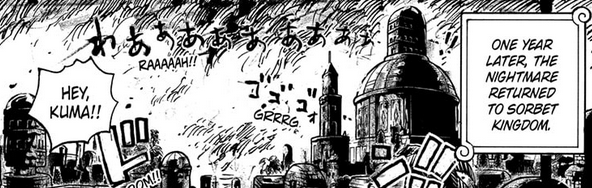
I remember writing during Oden’s flashback a few years ago that I was enjoying the scenes playing out and seeing the long-hinted at backstory getting filled in, but that I was in no danger of weeping for Oden. There was an emotional investment that I never quite made in that story. Maybe it was because we knew about about Oden’s death in advance that it was too foregone a conclusion, or maybe it just wasn’t the right story to appeal to my tastes. The contrast here is that I’m genuinely feeling things at the twists and turns of Kuma’s flashback. This is not just a good read to quietly enjoy, it’s getting a genuine emotional rise out of me. Highs and lows of Wano be damned, Oda’s still got it.
As a final thought, this installment brings us to the 10th chapter of volume 108, but probably not the last. This doesn’t feel like an ending cliffhanger yet. But I can’t see the flashback ending in one more chapter either. Are we going to get two 12-chapter volumes in a row, or will the volume gap simply cut through Kuma’s story?
-
One Piece chapter 1097 review
Back on three chapters in a row! I was starting to lose hope, so even this chapter’s short length can’t take the shine off this win. Ginny has to win some kind of award for being the chapter that took the shortest amount of time between being introduced and appearing on a chapter cover. Excepting maybe Luffy and Zoro at the very start of the series. It’s also rare for a chapter cover not featuring the Strawhats to feel so closely connected to the content of the chapter. The last time I remember feeling that was that one time Perona showed up right at the time she made her first appearance in years for one of the Wano interludes.
The start of this chapter spends a long time building our sympathy for Kuma. We’ve known for a while that he would be a tragic figure, and the noble goals he expressed in a desperate situation last week made us like him, but here, seeing him take on one of the series’ greatest acts of self-sacrifice again and again we really get what a good and likable person Kuma has grown to be. There’s some fun lore for his fruit here as well, learning that removed suffering would eventually return to its owner. I guess it works differently for his own removed memories though. I think this development also makes it completely clear that Kuma has ended up the way he is in the present as a means of taking on a huge burden for someone else in exactly the same way. The remaining questions are ‘who?’ and what circumstances resulted in sacrificing his mind being the only way to save them.
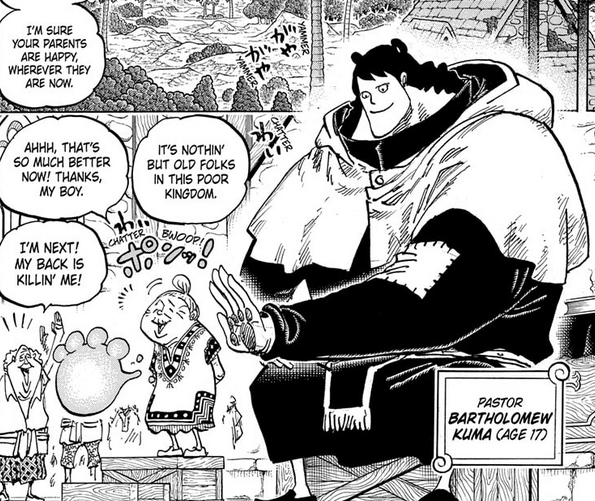
Despite the obvious-seeming build-up that Kuma and Ginny’s relationship will be the heart of this flashback and her inevitable death will be its climactic moment of heartbreak, Oda leans away from the romance between the pair, with a timejump and a marriage proposal, and a level of ambiguity about whether they’re actually intimately involved at this point at all. Romance has never been Oda’s strong suit so it’s probably smart of him to emphasise the dramatic and desperate circumstances and mutual moral outrage about the state of the world that brought them together instead.
And we go a long time without Bonney here. Maybe those theories about her being mentally and chronologically a child have some weight after all. At minimum she’s younger than she appears, barring a massive misdirect.
The next sequence, at 22 years ago, is peak World Government politics. Money at the heart of it all, loopholes for the ultra-rich to save themselves (or at least their wallets) and the denial of human rights all the way through. No accountability or oversight, no compassion for the common man. No wonder the world needs Revolutionaries.
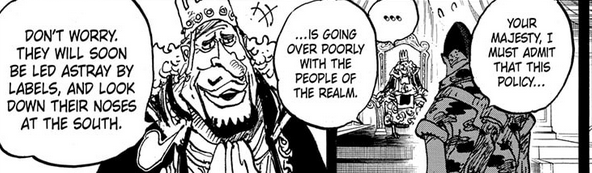
And that’s exactly who arrives! The drip feed of Dragon info continues with the revelation that he used to be a Marine. I’d love to see any kind of interaction between him and Garp, knowing this. There must be so many complicated feelings between the two of them. And Dragon is 100% in the right. We can see in this very chapter what the Marines defend. There is no justice there.
What surprises me is how much time we’re spending away from Sorbet Kingdom. Some are lamenting the idea that Kuma’s ‘Tyrant’ epithet is just a grandiose name, but we know outright that Kuma is recognised by the public as a ruler of the kingdom. But how (and why) does he become a king after joining up with the Revolutionaries. Does taking the position relate to whatever deal he cut that ended in his cyborg state, or did he seize the country and declare its independence to use as a Revolutionary base and solve their supply issues? Maybe not, considering they’re already using Baltigo at this point in the flashback and will remain there until (almost) the present day.

The final page of the chapter, kind of like the escape from God Valley last week, really rush ahead. It’s a shame not to see more of what the Revolutionaries got up to in the eight years between scenes, but as with God Valley, this is Kuma’s flashback not Dragon’s, and there’ll be time for the important bits of that later. Still sucks to jump around so suddenly, and to feel like we’re ending the chapter mid-scene. I’m glad it’s not a break week, because it would well and truly suck to not know what happened to Ginny and have the last panel focus on Dragon’s reaction to her predicament instead of Kuma’s. Sure, it’s a common Oda move to reveal something shocking out of nowhere then flashback to show how it happened, but the pacing of this one feels off. I imagine the next chapter will save it though, with the flashback and Kuma emotional beats the story needs, and when it comes to the volume read the gap between reveal and explanation should be barely noticeable.
My assumption is that Ginny’s captivity will be the beginning of the end of this flashback. It seems primed to involve Kuma with the Government and manipulate him into being branded a tyrant and giving up his sense of self. This was something of a transitional week, but the next one should be a big pick up. Looking forward to it.
-
One Piece chapter 1096 review
I knew it. I knew we’d be coming back to God Valley later. I feel vindicated for not getting my hopes up too high. Oda does a great job of building up what a massive convergence of big names it was, even if we only get a prelude here. At least the fanbase seems to be taking this blueballing better than they did the similar fastforwarding in Kaido’s flashback last year.
Oda takes the chance to show off what he does best here, introducing a ton of striking one-off character designs for the Holy Knights (very interested in the one with the bull’s skull for a headpiece), the nobles participating in the hunt (with Mannmeyer dropped as potentially the tenth of twenty Celestial Dragon family names) and the various pirate and marine crews coming to fight.

The World Government’s dystopia is in full swing here, with emphasis placed on not even the children being spared, and the cruel lie of salvation in three week’s time. While Ivankov is right about false hope being a useful tool for keeping the spark of life alive in prey, I think he misses its perhaps more pertinent utility of pacifying the fodder to prevent exactly the kind of operation Ivan’s group pulls off. People with hope of things working out don’t take matters into their own hands. People with other options, even slim ones, wouldn’t gamble on a million to one shot of successfully raiding the Most Dangerous Game’s prize pool. If you hear there will be some survivors, your point of view as the protagonist of your own life tells you that the story can’t end here, that you must end up in that small number for things to go on. I don’t think humans are inclined to really see themselves losing a death lottery while other options still exist, even if the odds are against us. A shame we can’t all have an Ivan to guide us from the 0% chance the powers that be said was a 3% chance to the 1% chance that is the actual only hope.
Garp’s presence in this chapter is something I’m torn on. I can’t get a read on if he knows the full details of what the Celestial Dragons are really doing, if he thinks it’s just some inspection or pleasure trip for them. If he suspects only that it’s not good but maintains a plausible deniability of what to keep himself from acting out. I love Garp as a character, but he’s always been a protector and enforcer of this world’s most heinous systems despite his sympathetic motivations. And in these days when Roger is his rival, you would think this is Garp at his most wild and rebellious and willing to disobey orders, but he’d still rather face Roger than deal with the slave hunt.
Maybe if he knew what monsters the Five Elders really were he’d actually be interested in measuring his strength against theirs.
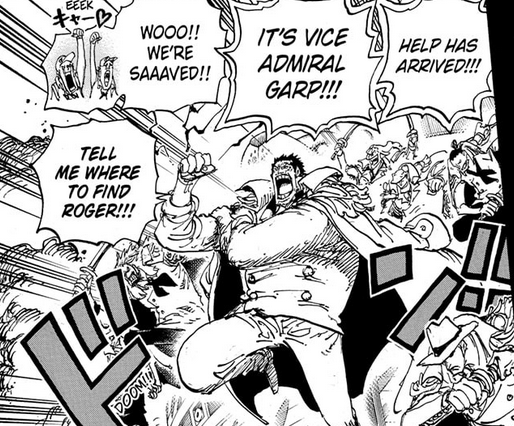
At a guess though, I think he doesn’t know the full story, and will find out about the slave hunt only after arriving. Remember that Sengoku’s recollection of Garp and Roger’s teamup at God Valley was to “protect Celestial Dragons and their slaves,” which is an interesting choice of words to say the least. Why make a point at all of protecting slaves that were already (literally) branded for death? Perhaps the truth is that both were protected, but the Celestial Dragons were protected from Rocks, and the slaves were protected from the Celestial Dragons. I’m sure he could find a way to play off giving the slaves a chance to run as “just protecting your property from getting cut down by Rocks, go after then when it’s over” and pretending he didn’t know better. Remember in chapter 957 that right before talking about the teamup at God Valley Sengoku is reflecting on how much Garp’s personal moral compass disagrees with the Celestial Dragons and how close he’s come to being eliminated for insubordination. I think we’re edging closer to the full picture here, and I hope that’s not just my enjoyment of Garp’s character talking.
The cameos as the battle builds up are amazing to see, really tying in 20 years of continuity to make it all feel connected. From the number of Rocks Pirates that ended up being used for Thriller Bark zombies to Boggard finally showing himself again.

I do wish we got to see a little more of the operation to rob the prize pool, and the how of Kuma’s escape. Did he blast other slaves away in different directions before pawing his own group to the one island, or did the rest of the 500 just leave first? I’m willing to buy a teleporting man escaping from the likes of Saturn without having to watch it more than I would most other characters, but at the very least the moment he’s forced to give up on the idea of taking anyone else and leaves the island would have been good to see to make Kuma’s role in this sequence feel closed off. As it is, the end is pretty abrupt.
That said, the dialogue with Saturn lays out the core themes at play fairly succinctly. A lot of people characterise One Piece is being a story about freedom vs authority, which it is in many ways, but it’s also massively (I might even say moreso) about universal personhood vs selective personhood. The heroes of this story, whether they sail free as pirates or rule as kings, are the ones that accept all people as human beings, while the villains, whether monarchs or pirates, are the ones who think there are certain people undeserving of human rights and human status based on arbitrary and uncontrollable things like their place of birth or bloodline. Doflamingo, who was both a cruel noble and the evil kind of pirate, literally stole the human forms of his society’s underclass, if you want to get really on the nose about it.
(There’s an essay in there somewhere, full of choice villain quotes about ‘discrimination creating solace’ and hero quotes about ‘existing never being a crime’ and the series’ most poignant death scenes ending with words of thanks from the departed for showing them love in a world that would not otherwise have afforded it to someone of their origin)
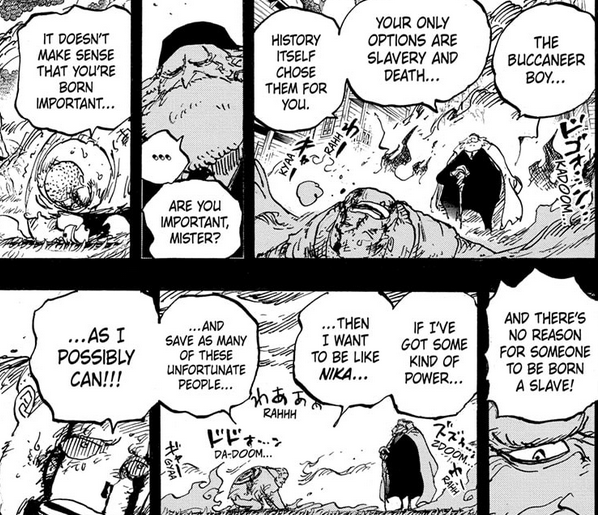
Getting back on topic, we get an origin for Kuma’s bible-carrying habit. Religion is an interesting topic in the One Piece world. Though the World Nobles are self-styled gods running a technical theocracy in their own name, they aren’t really concerned with worship (beyond paying tribute), and there obviously aren’t any public churches of Nika. This vaguely Christian-looking faith shows up often enough to feel like a widespread belief, but there’s almost nothing we actually know about what they believe, how they worship, and what kind of organisation (if any) the church has.
Ivan ducks out. That might be the last of him for this flashback, but I’m not sure if it’s really the last time he’s seen Kuma. Presumably their paths must cross as Kuma’s ties with the Revolutionaries develop. But will Ginny live for that second encounter? My hopes aren’t high. The happiness that grows through the super-cute scenes at the end of the chapter can’t possibly be built to last. Once again, Oda is setting this flashback up to hurt. Badly.
If I’m honest, I was worried I wouldn’t find much to write about for this chapter. The amount of fanservice at the start had me thinking there’d be little to do except list out the deep cut cameos, something other people online already dead based on the scanlation release that wouldn’t interest me to write. But I was happy to find a lot of meat on its bones when I looked a little closer. This is One Piece firing on all cylinders.
-
One Piece chapter 1095 review
So are we all just getting comfortable in the assumption it’s going to be two weeks on, one week off from now on? It’s rough, but that’s life. I was around for all the venting and complaining when it first went to three on, one off during Dressrosa, and I think if we can survive that, we can adapt to this as well.

The shock and reverence the Marines have for Saturn’s appearance is interesting to watch here. While the World Government has always been technically theocratic, literally deifying its rulers, we’ve never seen much in the way of worship for the Celestial Dragon pantheon, or at least their allegedly world-creating ancestors. My read was always that they didn’t really care if their subjects truly believed the myths or revered them, so long as the taxes were paid and a healthy fear of their power – whether divine or military – was maintained. But the opening pages show a more genuine-feeling awe among the Marine rank and file. It’ll be interesting to see if Oda goes any deeper into this.
I’ve mentioned the Vice Admiral with the streak in his beard as a character design that stands out in the past. In the middle panel of the second page you can see him seemingly preparing to pull the crescent-shaped blade thing out of his skull to use as a weapon. What kind of power does this guy have?
And speaking of weird powers, Saturn has healing, vision-based force blasts, and a wider-range pressure field strong enough to keep even Sanji and Franky from standing up. On top of the whole summoning circle thing. Fascinated to see what this Devil Fruit ends up being, and how many liberties have been taken with whatever obscure folklore inspired it.

I expected Borsalino to be dazed but far from out of the running yet, but the official translation makes it seem like he’ll be taking more of a breather. I still think we’ll see him fighting again before the arc is done. A little more surprising is instead going for a ‘you have failed me for the last time’ Saturn is pretty understanding that it’s “Nika” he was up against, and makes a very hardcore villainous move to stamp out Luffy without any capture or monologue or messing around. At least as a first reaction. He gets himself chatting on the next page, but going for the kill first still makes a statement. As does asking outright for the cruellest order to start the killing, that’s a sick bad guy line. Great to see Franky get a moment to save the day. With all the hopes of Egghead being more his arc, it’s nice that he at least to gets be on ground level for this pivotal confrontation.
Bonney tells us outright that it was Saturn specifically who ordered her father’s destruction, wrapping up one part of the mystery, and it looks like we’re about to find out the rest. While going into a Kuma flashback redoubles my confidence that his arrival is going to be what saves the day, I’m once again finding myself wondering how this arc fits together structurally. Wano’s darkest hour was the destruction of the ships and apparent loss of the samurai army, which was used as a springboard for Oden’s flashback, reiterating the stakes before the Strawhats showed up for the rescue and restored hope. It came up only when absolutely everything was against the heroes. But is this that? Maybe if Borsalino got back on his feet first. Maybe if Lucci was holding the upper hand in the dome instead of fighting Zoro. Kind of like when we went into last volume’s cutaway sequence, it feels like things are too in-swing to call this a natural break point.
I don’t want to say outright that I think this is something wrong with the arc. The frequent breaks and the new schedule we’re all not quite used to yet warp perspectives on longterm storytelling until a reread is done. I could be missing the forest for the trees. But it just feels off somehow in the moment.

On the topic of comparing this flashback to the cutaway though, volume 107 was made extra long to accommodate the whole cutaway in a single book, so maybe the same can be expected of this sequence. We’re in the seventh chapter of volume 108 currently, allowing room for 3 to 5 flashback chapters. Oda’s able to make that kind of pagecount decently meaty, and any more might turn into a lot of time to spend away from the main cast again, however compelling the lore and history of God Valley ends up being.
But yeah how about this flashback? God Valley? The Figarlands? Holy Knights present? Five Elders present? Stories of Nika being shared? The possible origin of the Revolutionaries? An event Roger, Garp and Rocks were all present for? All at once? This sounds like Christmas. A lore dump on par with the original Reverie Arc.
But I don’t want to get my hopes too high just yet, Kaido’s flashback showed that Oda’s still more than willing to hold some details and bigger-picture ideas back for later, even in the story’s endgame.
Anyway, Oda’s setting this one up to hurt. The cruelty of the Celestial Dragons is taken to new heights here, especially represented in the death of Kuma’s dad, that’s so casual, so incidental, so unfeeling that it’s happened before you even realise what you’re reading. None of the usual build up and huge response, a father is just gone in a couple of panels, and slaves have no time to grieve. And a mean play by Oda that the killing gunshot has the same sound effect of the drumbeat from the song.

The way Kuma’s dad delivers the myth of Nika, complete with the drumbeat, before his death though, that makes me feel a little disappointed we couldn’t have seen this kind of thing sooner. It’s perfect on its own, just give a version of it to some background Impel Down prisoners, or slaves at the Sabaody markets. One little moment like this would have made the Nika reveal at Wano read so much more smoothly. If you put me in the live action writers’ room, or in any kind of creative role for a hypothetical anime remake, that might be the biggest thing I’d push for.
God Valley’s actual origin was quite a surprise after all the speculation surrounding it, to have not been some longterm sacred site to the World Government. The Buccaneer race is another interesting twist in the story, but have also been left pretty vague for the moment. Is their only distinguishing feature their improved strength and maybe their large size? I’m not sold, considering that characters identified as regular human have been shown growing bigger and stronger. But maybe they don’t need to be anything special in terms of abilities. The World Government has shown itself to care pretty deeply about preventing “criminal” bloodlines from continuing, as shown by their rhetoric surrounding Ace’s execution. The situation only gets more dystopian when we learn here about seemingly-mandatory at-birth blood tests and hospitals for undesirable blood groups. Pretty rough world to live in.
Although, nearly 50 years ago is a long time for such precise blood testing to exist. Weren’t we told that Bloodline Elements were first discovered by MADS? At the time of this flashback, Vegapunk would be 18, and Judge just 9. I don’t think they’d be unlocking the mysteries of genetics together yet, let alone passing that info onto the Government. So what other method is the Government using to test for these outlawed races?

Ginny is a cute character design. It’s a shame she’s about as doomed as One Piece characters get. On the assumption that she’s Bonney’s mother, she’s at least getting through this Most Dangerous Game hunting trip to be old enough to have kids, but it already feels inevitable that her premature end is going to be the emotional heart of this flashback. Conspiracy theories about her surviving and being Ivankov’d into any modern day adult man are fun, but I’m not holding my breath for a second. And if she is Bonney’s mum, and that’s still an if, it probably rules out the theory that Bonney is chronologically still a kid, just to make the timeline work.
Hopefully the next chapter has enough info to lay out the trajectory of this flashback. The (presumed) need for Ginny to grow up means it can’t totally be centred on God Valley, but maybe we get a feel for how long we’ll be sticking around there and how much of the main event we’ll actually get to witness. See you all in two weeks!
-
One Piece chapter 1094 review
Well that’s an escalation I wasn’t expecting to see for at least a few more chapters. It can’t be emphasised enough how brisk the Egghead Pacing is compared to Wano. A problem for the crew like Bonney being stuck down below is raised in chapter 1092 and by just 1094 she’s been rescued and is already being pulled into more important events. The breaks make it all feel like it’s taking longer than it is, but this kind of thing was taking half a volume worth of one panel at a time updates to get done just a year and a half ago. The binge read of Egghead is going to so refreshing comparatively.
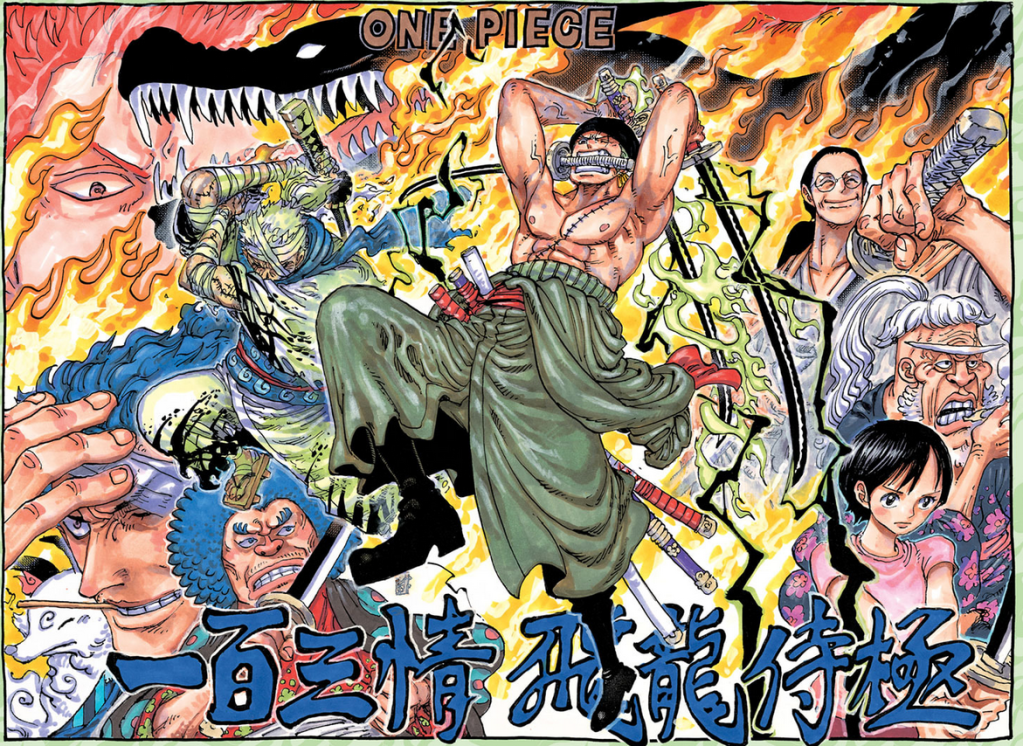
There’s some great art for the Jump cover and colour spread this week. Can you imagine if this spread had come out during Wano though? I can only imagine the theories and headcanons and expectations that would have been raised from it.
The scene of the Pacifistas turning on the Marines actually manages to be pretty intense. Oda’s done a good job of not letting these guys feel like fodder, so I have no problem believing that the ability to control them equals control of the battlefield. It would be easy for the power scale of have slipped enough that you wonder how especially first gen Pacifistas were an effective countermeasure against the Whitebeard Pirates at Marineford (and the ease with which Luffy, Zoro and Sanji wiped out two of them for the Sabaody reunion edged on this) but instead they remain consistently threatening as an army more than a decade on.

Sanji sensing Bonney and Vegapunk questioning the scientific validity of his radar is definitely one of the better jokes the series has made of his womanising nature.
I’m still not expecting a full set of fights for these vice admirals, but glimpsing their different Devil Fruit powers and personalities in scenes like Bonney’s one here helps make the scale of the world feel bigger. Oda doesn’t let his characters get away with being nobodies.
And then it happens. I was expecting a slow arrival for Saturn, escorted carefully onto a secured part of the island with some kind of honourguard, not for him to teleport abruptly into the middle of the action with crazy magic powers. And he kills so casually in his bizarre yet intimidating transformed state. I had reservations about the Five Elders being combatants instead of just politicians, but if this is the kind of appearance and entrance we can expect from them all, then I’m on board. I don’t even know what kind of being to say he even is yet. I’ve seen some possibilities thrown around that seem compelling after googling the names, but after Nika, there’s a precedent for important Zoans being based on in-universe deities with whatever powers Oda needs them to have.

Meanwhile Luffy finally lands a solid hit on Borsalino. It’s definitely not the end of the fight though, not by a long shot, even if Borsalino takes a chapter or two to shake off the hit and make it back from where he’s been thrown. And that’s terrifying, actually. I was expecting Saturn’s arrival to wait until Borsalino was mostly or totally beat, maybe forcing an exhausted Luffy into a retreat. Now we’ve got a seemingly haki-spent Luffy with two high level opponents ready to fight him. He could barely keep Borsalino from breaking off to complete his Vegapunk assassination mission when it was one on one. We haven’t seen enough to for sure if there was any hope of taking them both on together in a straight fight (I doubt it) but when the win condition is more complicated, the odds start to seem impossible.
Finally, we get another little hint at what’s coming in Kuma’s flashback, positining the Elders, or at least Saturn, as the guilty party behind Kuma’s mind being wiped. This offers another compelling reason Kuma might have searched through Marie Geoise and abruptly left, if it’s personal between him and Saturn. His arrival on Egghead with a will to fight could end up being the thing that makes it possible to protect Vegapunk while dealing with Borsalino and Saturn both.
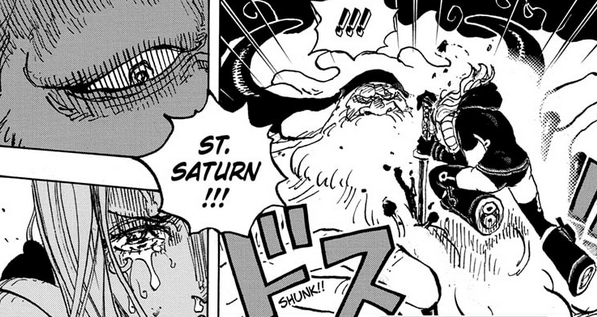
Bonney’s attack feels rash, but I’d be willing to bet she’s saved Vegapunk’s life here. We saw what Saturn can do with a glance. He’s not fucking around here. Which means every moment someone is keeping his attention elsewhere is a better chance of Vegapunk’s head not being exploded. She’s definitely going to need a rescue sooner rather than later next chapter though. Good luck, Sanji!
Moments like this are what really makes the endgame feel like it’s in motion for this series. It gets so hard to predict where we could be in a chapter’s time when so much is happening at once in each chapter. And, as at the end of every installment lately, I hope we’re back onto the normal schedule now so we can all enjoy more of this good stuff while it’s coming.
-
One Piece 1093 review
At this midpoint of volume 108, we get a short chapter without much to say except how enjoyable this current battle is. Gear Five has really taken the shackles off and goes a long way to silence any who thought the endgame fights would devolve into haki power scaling.

I love Borsalino’s expression as Luffy winds up to throw him away. He really is just down to see what happens next, it’s hilarious. And very interesting to see Luffy has both the power and the mindset to try and end a fight by just lobbing a dude off the island and into the sea. Of course we’ll never see it happen to an enemy who can’t easily make it back, but I still like seeing it.
Things are developing quickly here, which is great to see. It’s easy to think that in an Onigashima chapter we could take a whole week establishing Bonney’s predicament in the lower level and starting to plan a rescue, at minimum, but here it’s all happening at once, and combined with the idea of retaking the Pacifistas. And that last panel suggests this part of the story isn’t finished developing yet. There’s one last move to be made in the Pacifista tug of war yet, and when it comes there’s now a lot more characters that we like in the danger zone. We’ve been shown already how quickly a Pacifista army can turn the tides of a battle.
Zoro’s fight with Lucci sure is… still happening. There’s not enough of it to say anything substantial.
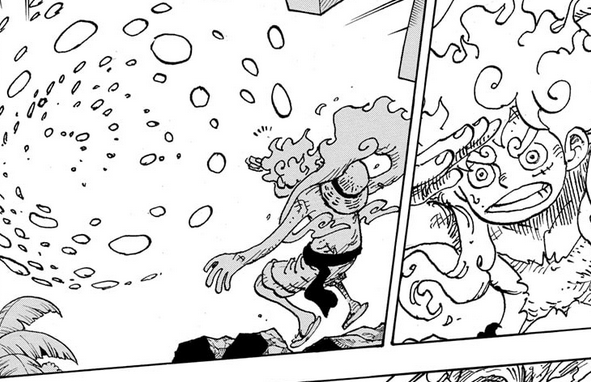
The meat of this chapter, however, is Luffy and Borsalino. The admiral turning into particles is a really cool effect, and the panel of him returning to Luffy, with all the negative space, is really dynamic. And he makes holograms! It’s such a cool use of the fruit. The implied motion of them lining up to attack Luffy like afterimages, only for him to kick through them all at once is really satisfying. I wish I had enough faith in the anime to look forward to its version of this.
And we see exactly how difficult an opponent Borsalino is to protect anything from thanks to the lightspeed movement and the clones. You appreciate far more what Rayleigh did at Sabaody to hold him back having seen how hard it is for Luffy here. In a fight like this, it’s not enough just to match your opponent, you have to threaten him enough to hold his full attention, which is another task entirely.
And I think I spy a parallel with the crew’s last encounter with the guy in that panel with Usopp and Brook. It’s a shame Oda couldn’t have put them in a slightly better position for contrast though…

And then Luffy eats a laser. Because of course he does. I can almost guarantee there’ll be something in the future related to all this Nika stuff that the way he lights up from the iniside here and has beams blasting from his eyes and mouth (and nostrils) feel like foreshadowing. I mean he looks kinda like a human sun in the second panel of the light show anyway, and that might be the whole thing, but my gut reckons there’ll be something that feels like more of this. I don’t know what. But there has to be something. Oh, but Oda should have given him two more beams coming out of his nipples, just to tie Franky into the whole thing.

Speaking of Franky, I like that he trusts Lilith with the General Franky. I wonder what feedback she’ll come back with after getting to pilot it. Could this be the start of the Franky and Vegapunk relationship so many hoped for?
It’s a shame to work up all this energy just to hit another break. Unless we get back to three weeks on, one week off soon I’m going to just stop hoping for it. We could do worse than two on, one off for a new normal, but if definitely rules out the 2025 finish that was probably never on the table to begin with. I’d rather it take longer and be done right, but I also hate waiting…
-
One Piece chapter 1092 review
Things really feel like they’re getting back in gear this week, proving that the last chapter’s burst of energy wasn’t just a one-off. And no more break either, to keep the momentum going.
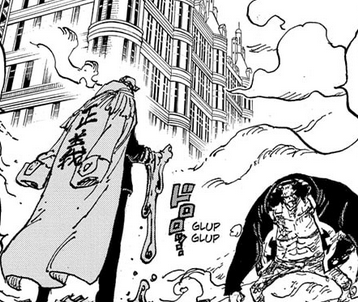
While it’s not the Egghead material I think many were hoping for, the opening Marie Geoise flashback does show a willingness to return to events parallel to the cutaway sequence in their own random breakaways from the current story. I would guess we need to see this now to be ready for Kuma to burst back into the main story in a few weeks. But why? What is he doing and what is his mission? One theory states that his push can’t send things past the Redline so he had to climb it himself to get to the other side, but that doesn’t explain his choice to attack the Celestial Dragons. If it was just getting over he’d have blipped away as soon as he reached the top. Some say the programming of the giant robot in Egghead has been put in his body and it’s repeating its attack from 200 years ago, but then why give up so quickly, even in the face of Sakazuki? I’d have wanted to see more struggle between the real Kuma and the robot to foreshadow him wrestling control from it. The prediction I’ve liked most is that he came looking for Bonney in her last known location and has bailed after getting enough of a look around to know she’s not there. I don’t think he would have a way to track her specifically, but he’s almost definitely coming to Egghead now, if only just to get repaired before continuing his search.
All I know is that the repeated emphasis on there being no will or mind left inside him makes it all the more certain he’s clung onto himself somehow.
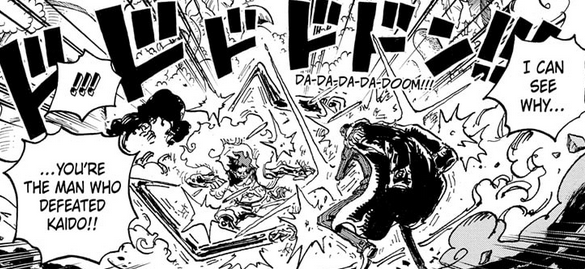
And back at Egghead, in the present, Luffy vs Borsalino is on. I enjoy that Luffy’s lower gears still get to come out despite the marketing dominance of Gear Five following its reveal. And it’s a strong showing for Borsalino as well – if Snakeman’s speed and unpredictability was revealed as a counter to the literal future sight specialist, it backs up the admiral’s lightspeed claims to be able to keep up with it so effectively. The ability to hit and run from such an enormous range really shows how annoying Borsalino’s fruit can be when he gets serious.
While Borsalino’s expression doesn’t change much as all this goes down, the memory of Vegapunk’s pride in Vegaforce 01 speaks to something going on under the surface. I think it’s a shame to see Vegaforce go as well, but I guess we can’t have him overshadowing the arc’s other big robot.
Gotta appreciate Bonney and Franky’s willingness to throw down with an admiral the way they do. Franky especially for boldly choosing to fight lasers with lasers. We get a little more on Bonney’s change of heart as well, that her anger with Vegapunk isn’t gone, only shifted to another target. But who? And where are they? And should we have expected already that Borsalino would act so familiar with her? There are a lot of gaps to fill in with the inevitable flashback when Kuma arrives on the scene.

Ah, but where is Bonney after that kick? Borsalino was able to send Luffy through the impassable barrier, but that was with much more of a wind-up. And if she did make it through instead of being thrown back, the Fabrio-phase is occupied by the Marines currently, so with her laser damage on top of being worn out from the offscreen death game, she could be in a really rough situation.
The last spread is a great bit of Gear Five insanity to take things to the next stage. I’m fine with the giant Luffy big damn hero moment grab becoming a Gear Five icon, but Oda should probably hold back on the next use a while so it doesn’t get run into the ground. At least one arc without it from here, please. It has to give Borsalino some pause to know Luffy can make it in and out of the barrier on his own, so that he can’t just attack safely from outside like he did with that first kick. Sure, Luffy takes damage with each trip, but when has something like that every stopped him?

The robot in the Fabrio-phase powering up is surprise though. It didn’t do that when Luffy and Lucci were fighting. Or at least, we weren’t shown it doing that at the time. Whether or not this is an oversight I guess will depend on if it just lights up while Gear Five is active, waiting for a command, or if it actually moves on its own.
As we shift into the (presumed) back half of volume 108, Oda seems to have his pieces in place for the climax. Luffy and Borsalino have skirmished to test each other, but with the latter’s determination to do his job and the former having seen how quickly he can reach Vegapunk if left alone, the battle can only escalate. Meanwhile Kuma is coming, with more hints being built for the flashback, and Bonney potentially in danger to give him a hero moment. The only outlier is Saturn. Whether he’ll enter the fight to increase the pressure on Luffy, or be the extra opponent that forces the exhausted Strawhats to retreat, or who even knows what. I could see volume 109 being the last of this arc, or at least the last full one, if things go forward quickly enough. But maybe it’s too soon to make such a bold statement… Let’s just see what the next stage of the fight has in store.
-
One Piece chapter 1091 Review
Oh wow, it’s happening! And to be completely honest, until Oda started setting up that Borsalino was going straight to where Luffy is in the last chapter, this rematch wasn’t something I’d really seen coming or expected. Sure, Borsalino was instrumental in the crew’s crushing defeat at Sabaody, but even that was overshadowed in the same saga by Sakazuki’s slaying of Ace. In my mind, that put him at the top of the Marines as the boss for Luffy to fight, with the three admirals under him the opponents for Zoro, Sanji and I guess Jinbei. Luffy getting a taster against a single admiral first, like his fight with Blueno before Cipher Pol, or Katakuri before stepping up to the Emperors for real, just hadn’t crossed my mind the same way.
Which is crazy in hindsight, because this chapter goes so far out of its way to impress on the reader how much of an impact that loss had on the Strawhats, and how long coming a shot at redemption has been. Even looking back over Marineford, even though it’s Sakazuki who strikes the final blow to Luffy’s spirit and scars his chest, Borsalino is a much more consistent thorn in the young captain’s side as he tries to cross the battlefield, repeatedly kicking him back and sabotaging his efforts with long-range laser shots. Oda must have known even then that he wanted these two to collide again eventually, and he wanted it to be cathartic when they got there.
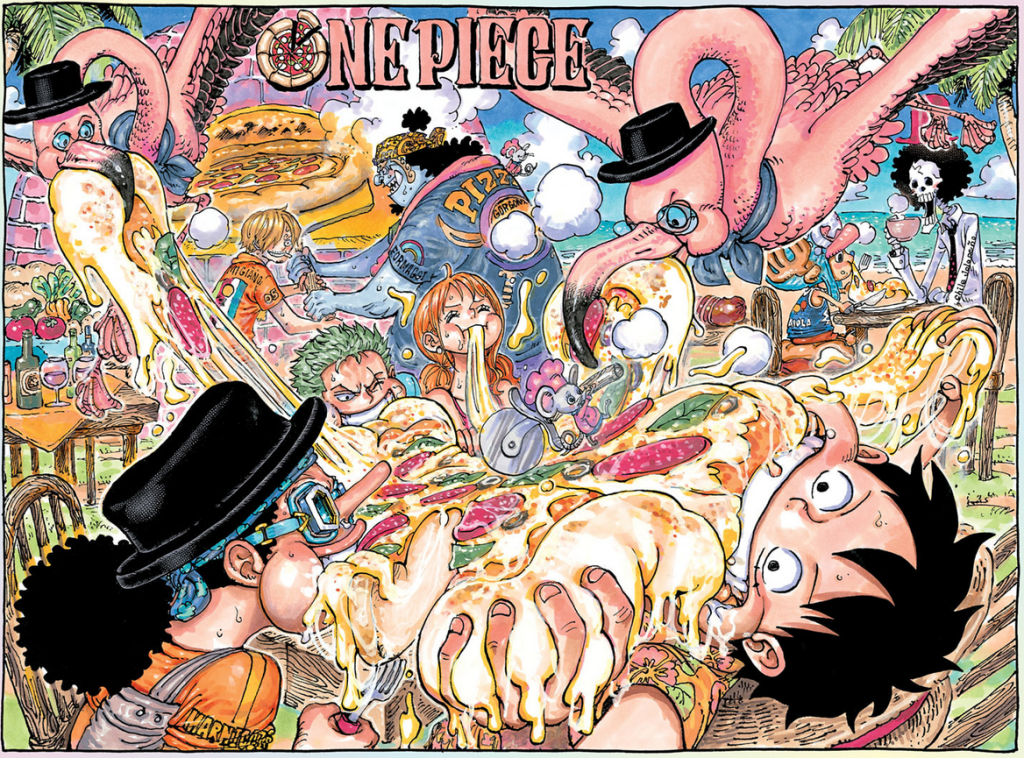
But that’s for later. Starting out we have a beautifully cheesy colour spread. Just last chapter we had Luffy and Bonney talking about getting pizzas for the road as they left the island, so I guess Oda’s had a craving lately.

I’m so happy to see as much of the Marine invasion of the island as we do. It’s subtle in black and white, but you can see the flash of light from Borsalino’s attack on Sentomaru from the end of last chapter illuminating the island from the centre, shadowing the tops of the clouds, signalling the wider attack. The spread of the Weaponised Sea Beasts attacking the fleet is gorgeous and chaotic in every way you could want from a vingette of a battle. The lion best with tubes and cables complementing its mane and the visor showing onomatopoeia for its actions is a standout design in a classic Oda way. We technically did see it already, when the crew first met Lilith in chapter 1062, but I didn’t appreciate it enough then.
I don’t feel a strong emotional attachment to Borsalino and Sentomaru’s fight. It’s nice that Sentomaru gets a better chance to show his stuff than the earlier encounter with Lucci allowed. It’s interesting to know that a backstory being summarised in an SBS doesn’t necessarily exclude it from being shown in the story as well (and maybe the SBS’s accidental spoiler on this relationship gives us a hint of how many things Oda holds in his mind at once, insure if he’ll get to put them in the story for real or not. But yeah, as sad as it is on paper for Borsalino to have to take out Sentomaru after training him and knowing him since he was a kid, it takes a little more interaction than just affectionately calling him ‘old man’ to tug at my jaded heartstrings. And speaking of who’s emotionally impacted here, it’s interesting that only Vegapunk Stella has tears to shed for Sentomaru. Obviously the others would have access to the memories of Sentomaru’s upbringing, but I guess the sentimentality didn’t come with them.
Gotta agree with Saturn that it’s a shame to lose the Weaponised Sea Beasts. And I don’t think he and I would agree on much.

There has to be some commentary later on how Lucci ended up uncuffed long enough to pull a move like he does. Even if it’s just something dumb like the crew’s idiots assumed that fighting side by side meant forging some kind of bond. Well, it’s good on Lucci to have been so patient about choosing the moment when his enemies were most distracted to have the best chance of success.
I’m not sure how much of a fight to expect from Lucci and Zoro, but it is technically a loss from back in the day that there was never personal payback for, just like Luffy and Borsalino. Maybe they should’ve brought Kalifa along too, so Sanji can also show how far he’s… what? He hasn’t worked on the shortcomings that lost that fight for him at all? Alright, yeah, let’s just forget that one.
And with that, the fights are on. The vice admirals are going to be invading the mainland unimpeded, but despite their convenient numbers and likable designs I doubt they’re going to make it to the Labophase quick enough to get full, dedicated fights. Maybe a few panels worth of skirmishes while Luffy finishes up with Borsalino and the final preparations to launch are made. Well, however it plays out, just having the significance of Luffy and Borsalino’s rematch sink in fully this week has combined with the live action release to give me a burst of One Piece energy! It’s a great time to be a fan, break week or not.
Captain M Entertainment
Reviews, news, retrospectives, thoughts
 Captain M Entertainment