-
One Piece chapter 1150 review
I said I couldn’t wait, but now that I have this chapter, there’s an oddly bittersweet about something as endgame as a prospective final boss’s powers being revealed. Not just because it means the ending is creeping closer, but because how risky this kind of escalation ends up being. There’s an obvious storytelling need to make the final (or final-ish) guy stronger and more unique than everything before, to give them an extra surprise skill that goes outside and beyond the normal system. Make it like they’re cheating so it feels extra satisfying to beat them. A lot of stories mess it up. It’s a delicate thing to change the rules so late in the game. So here, One Piece navigates a treacherous footing as Oda makes the decisions that will either cement him as the one that stuck the landing, or will have us all reminding ourselves that it’s about the journey not the destination.
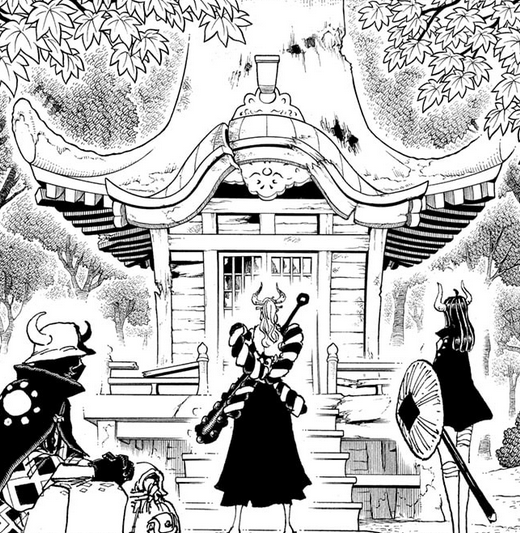
Speaking of endings, the Yamato cover story has to be close. But there’s one more region to visit from the original travel plan. Is Oda building up to a stinger, or will it just be an epilogue?
The first spread here is rough around the edges in a whole bunch of ways. First is the group of giants that run in. Are they adults from the village? They have to be, the pirate group doesn’t show up until a couple of pages later, and when they do they come out of the trees at the back of the line instead of from the front. But I don’t remember a party setting out from the village in any previous chapter. It’s not hard to believe it happened, it’s just a little odd not to have gotten one panel setting it up. (I’m open to having missed it, those early chapters of the kidnapping came out in a very busy time of my life; I didn’t absorb them as deeply as I normally try to.)
Second, the choice not to draw the thorns surrounding Collun as the first giant approaches him makes that panel hard to follow. Even if they are meant to be fully invisible, the translucent version used in previous chapters makes for a much smoother read. Particularly if you’re an early scanlation reader, where they don’t fill in the sound effects to help out. And on the topic of that sound effects, the one in the bottom right seems like it should have been drawn with the traditional sound effect white stroke around it to stand out. And there’s a couple of other examples of this later in the chapter, making the effects less readable and the panels feel murky. These have to be unfinished.

And finally, there’s the sheer amount of art escaping the panel borders. The haki bolts I could have taken as an intentional effect, but Collun’s mouth up above and the rendering on the giant collapsing down below are definitely not supposed to be like that. It’s a cool window into how the series’ inking is done before a final cleanup, but it’s never nice knowing a chapter came so down to the wire that it missed that last polish. At least it’s an easy fix for the volume release.

Going back to the actual story, the scope of Imu’s haki blast is immense considering the size of the island. And it’s strong too, if a member of the Giant Pirates would go down to it. The party in the Underworld must have gotten at least a tingle of that. We’re so overdue for a cut back to them, but I don’t want to miss any of what’s happening up top.
I’m a big fan of the classic devil look the possessed Gunko takes on. The wings have to be Imu’s, but I wonder if the tail and pitchfork are coming from her power. Honestly makes it feel a bit on the nose in hindsight. And then she makes this arcane summoning circle just to fire a mundane canon through it. Fantastic bit, especially when it gets repeated later to draw book which then opens to provide a gun and a knife. What was the point of the book? Maybe this is just what you have to resort to when your borrowed body doesn’t come with the pockets normally provided by a pair of pants. Whatever else comes of this, I’m glad Imu isn’t just an ‘even stronger energy blast’ kind of villain. The weapons remain mundane, but they’re used creatively and augmented by soft powers like portals and mental control.

A couple more weird bits on the next page. Jinbei’s observation haki has to be running in top gear to be able to tell that Gunko transformed at all from this distance. And then there’s the discussion about where Luffy and Hadjrudin went. Seems like it’s Brook saying it, but him and Usopp were both totally snookered at the feast scene. Hard to believe either of them picked up that much about all those people sneaking off. Maybe this info should all have come from Nami. I guess there must be a whole offscreen segment where Gerd returns to the party after beating the info out of Rodo to gather up the rest of her crew plus Sanji to go chase Luffy and Zoro. It’s one of those things that’s technically possible, but it’s not good for the flow of the story that I’m going back nine chapters and inventing my own scenes to explain it.
Love to see even more of Robin being a badass at the bottom of the page. I wonder if she’ll join Chopper in puzzling out the ways to fight immortals. It’s a good role for the two analytical Strawhats.

Dorry and Brogy finally arrive and Oda takes the time to show Imu/Gunko being a physical match for them rather than completely relying on the mindwipe hack. Do we think it’s weird though, that Imu summons both a relatively normal shortsword and a shotgun that’s way too big for a human but still too small for a giant? Maybe they have limited control over exactly which weapons they can draw. Or maybe the size is designed to suit their real body. Well anyway, the shot to the arm is a much more abrupt and extreme injury than I usually expect from One Piece, even if there’s a good chance the contract lets him regenerate it.
And it’s that contract where things get really interesting. I have so many questions about how this works and what its limitations are. You would think it would take some kind of submission or true defeat to become vulnerable to a power like that, but maybe it’s just as simple as stepping on the circle. Love how rather than getting sucked in and spat out, the victim instead gets stuck halfway and the circle itself flips over before the evil version pulls themselves out by the legs. Kinda goofy but also weirdly unsettling in its own way.
The dialogue surrounding this is crazy too. Not being bound by logic or common sense under Mu’s control sure sounds a lot like what Lucci said to Vivi about the Celestial Dragons in chapter 907, that “gods are not bound by logic.” What does Lucci know? And how far do I read into this idea that demons are the “proper form for life to take,” like some kind of demonic carcinisation. Does it suggest Imu is a natural born demon/devil with a superiority complex?
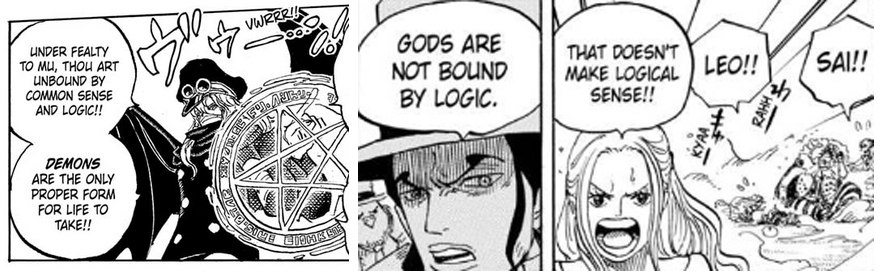
The scanlations found the name “Coeurl” in the characters for the contract. Even after reading the summary for Black Destroyer I’m not quite seeing how that’s relevant. Will have to track down the full story maybe. At least the imagery in “Domi Reversi” is easy to follow.
The final spread takes the already impressive previous-chapter page of the Sleeptid invasion and escalates it. What a truly crazy way for this arc to go. Could this be why the initial enemy force was so small, leaving us all to think this wouldn’t be a 1v1 fight kind of arc, because the crew’s going to have to fight Dorry, Broggy and their crew instead? Have to surpass his “masters” could be great for Usopp’s growth at least.
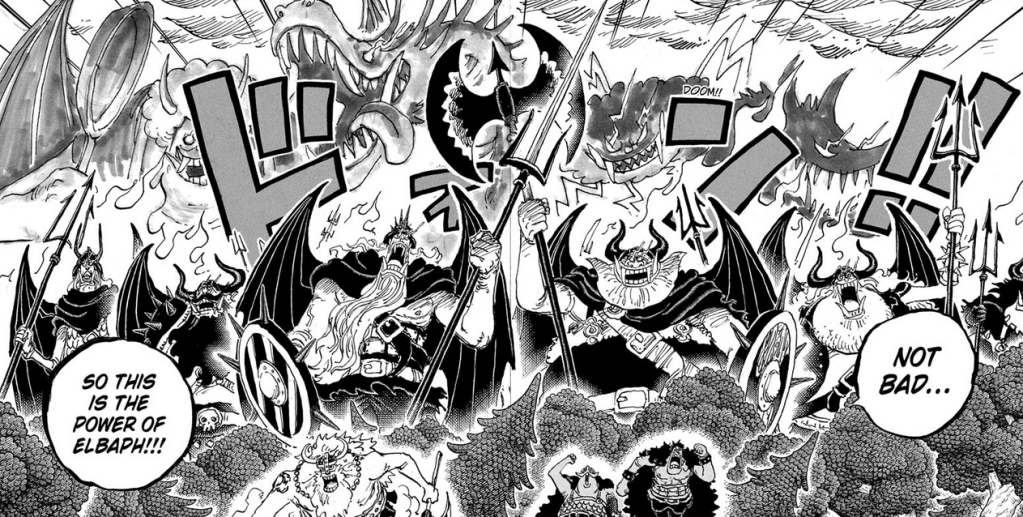
There’s so much to consider about how this insane power is supposed to fit in with the One Piece we’ve known up to this point, and so much we still don’t know about it that it’s hard to do more than just ramble off possibilities. Is Imu the demon/devil-taming Forest God from the Harley text? Are they a devil that had once been tamed by that god but was freed when the Second World ended? Is this actually just a broken, Nika-style Devil Fruit, say a Human Human Model: Devil or Model: Satan? And of course all imagery of devils and hell in the series bear re-examining after seeing this. Impel Down’s uniforms, for example. (Hey remember how last week Sommers had a Crimson Hell attack, the same name as Impel Down’s first level?) Was there a world where Impel Down was a tower prison either for or run by demons before the Second World’s apocalyptic flooding let the World Government turn it into a submerged oubliette for their undesirables?
I think back to Dressrosa and Doflamingo, and how his big thing as a villain was being a puppetmaster, able to sow chaos by influencing or directly controlling the various parties he’d wronged so they clashed with each other. How he made Luffy fight Bellamy when he didn’t want to, forcing him to hurt his friends. Even just the way he preferred to rule the kingdom, be served by the people and look down from above when he obviously had the power to level the island in an afternoon when he wanted to. Given his knowledge of Marie Geoise secrets, you have to wonder if Doflamingo’s intent was to make himself into a mini-Imu all along, and the whole arc was foreshadowing and stage-setting for this ultimate battle.
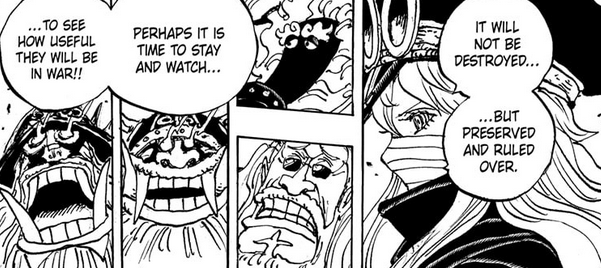
And of course, we have to think about Loki and his crimes. Oh, he killed a bunch of allies and family members and acts like the situation was more complicated but doesn’t directly explain. Oh, the guys who got killed had a Holy Knight summoning circle in their palace. That feels like a few puzzle pieces fitting together from where I’m sitting. Going to be bonus tragic when Luffy inevitably shows us how to flip back captured pieces without killing them.
Because freeing them is what he has to do. We learned two arcs ago that the hero represents a god of liberation. Now that we have an evil god of dominion and conquest, what the hell else could possibly happen?
This has already turned out rambly so I don’t want to waste too much time signing off. All I will say is thank god it’s not a break week, because this is a lot to sit with.
-
One Piece chapter 1149 review
Wow, hey, I didn’t see that coming. And in fairness, I play it fairly safe as far as theorycrafting goes. The conventions of storytelling – the structure of rising and calling arcs of action and character growth, the long and short term pacing, the way foreshadowing is doled out – all are the way they are for good reasons. A lot of fan theories these days emphasise some big, shocking clickbaitable twist hiding in plain sight, but in reality nine times out of ten the thing that will happen is what’s being built up in the standard ways.
But then there’s that tenth time, when the author swerves and subverts and escalates past where you thought the limit was. Done purposefully, and after enough time of colouring inside the lines, and you can catch even your most analytical readers off-guard.

The choice to include Lilth and Bonney in the colour spread is interesting. I wonder if this one was drawn back in Egghead when they were more prominent and left unused, or if they just got in by default because none of Elbaph’s locals would fit. Usopp and the cat seeing the bill is a fun detail, you just know Nami set the prices. I’m in two minds about Bonney’s tray though. Like yeah, it’s probably “rip-off” like what the Japanese text says, and there is exactly one confirmed instance of deliberate colour spread foreshadowing in the series’ whole run, so it’s not a safe bet. But come on, the tray even has kind of a squashed shape instead of being a perfect circle, making it feel even more like a tombstone. Maybe that final page twist has me in a mood for conspiracies, but I can’t help paying attention to it.
I’m glad we get to see a decent amount of fighting between Scopper and Sommers. It’s getting hard to tell if this arc is going have room for traditional, extended one on ones, so I was worried we wouldn’t get to see the full creative applications of his and Gunko’s powers. Pleasantly surprised that Haki isn’t being treated as the be all, end all solution to immortality here. It’s obviously effective up to a point, but not enough to put the Holy Knights fully out of the battle. Anyone else notice the Impel Down callback in one of Sommers’ attacks too?
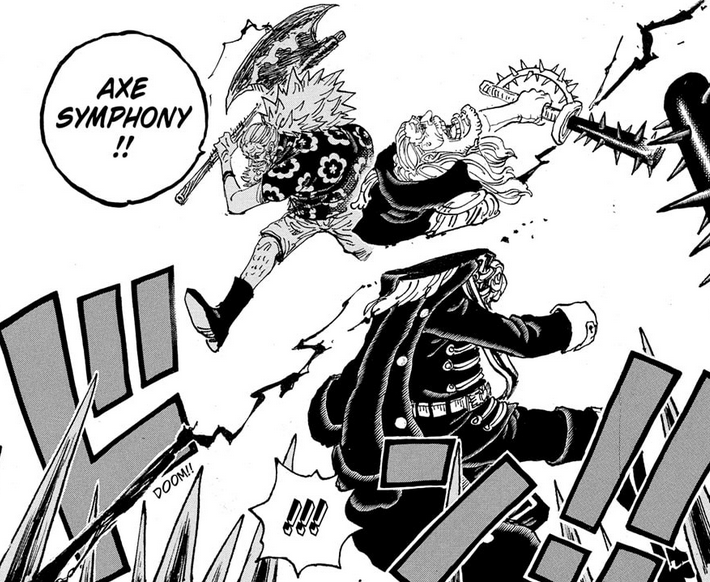
This is also a great scene for Chopper. He doesn’t call out Brain Point by name, but being the only one present to really notice how effective Scopper is managing to be and making the pragmatic choice to follow him instead of wasting strength on the others (having seen that Robin couldn’t cut Gunko’s arrows and Saul couldn’t do anything for the thorn coils around the children) is Brain Point behaviour. And since he follows Scopper over the edge at the end, he’s going to be the one in a position to relay the secret to the others later, whether by returning alone or escorting Scops to Luffy’s group.
The school and library start to burn. That’s one timer running, but I’d be surprised if any real damage is done to the books. The school can be rebuilt if it burns down. I wonder if the answer will be as simple as Biblo deactivating his power so that the books shrink down and become easy to move, or at least consolidate in a corner away from the flames. But even without personally feeling the threat, seeing Robin and Saul’s reactions as it goes up is heartbreaking.

And speaking of heartbreaking, god damn, Ronja. What an awful thing to put on a child’s shoulders. In light of the final pages, I find Gunko’s reaction to the child’s tears interesting. She thinks Ronja should be happy to be saved, no matter what has been sacrificed in her name to make that happen, even if surviving this means a life of servitude. Is Gunko herself enduring a scenario where everything important to her was lost, leaving her with only a life in the Celestial Dragons’ grip? This is followed by another tragedy: Collun’s love for his dad foiling the rescue. Understandable coming out of a kid raised in a well-defended land of peace, but you can see the pain in Scopper’s face. I’m surprised the future sight vision of Collun’s death was so graphic. Good way to get readers in the mindset that made Scopper back down though. His injuries are pretty rough, and with the fall to go with them I might have feared for Scopper’s life in any other series. But he’s going down by the side of the best doctor he could ask for, who also happens to be able to transform into a big, fluffy cushion if he can get ahead of him in the air.
And then the final spread just punches everything into top gear. Gunko knew Brook? Pre-piracy Brook lore? His army days and knowledge of Germa and the Holy Knights? God damn, this has been a long time coming. That alone would have put me into overdrive, and then Imu drops in to say hi. Why is the Holy Land burning? How far does their power over the marked ones go, now that we’ve seen telepathic communication, body hijacking and remote termination? What is Imu actually going to do via Gunko that she wasn’t already doing? Is Imu able to bring any other powers of their own through into her body, like, say, their transformation from the Sabo’s throne room scene? Given the lightning, is this an application of Haki, or at least Imu’s Haki being used by Gunko’s body (and that being possible, could the Strawhats with CoC lend it to their crewmates for future battles)? And I legitimately cannot tell if getting possessed made Gunko’s hair grow or if it was just hidden before.

Awesome week to be following One Piece, made better by not having a break to nurse this cliffhanger through. I can’t wait to see where Oda’s going with all of this and what long-awaited Imu lore is going to be delivered through their presence.
-
One Piece chapter 1148 review
Highs and lows this week with a great scene for Robin but the regeneration problem seeming to be solved in the least interesting way. There’s still time to right the ship on that second one, but we’ll get there when we get there.
The Holy Knights are moving around pretty quickly between chapters here, Gunko going from her position with Sommers and the captive Strawhats all the way to the kids’ location. Sommers also seems to be leaving in that direction in his first scene, but she’s outpaced him to a pretty ridiculous degree.

Ronja was the most upbeat of the kids in her intro panel in the last chapter, and she keeps her spirits high this week even has her situation deteriorates. It’s heartbreaking. Man, I thought Collun was going to be the standout kid character, followed maybe by Johanna, but Ronja’s speech, with her still-smiling breakdown at the end, have rocketed her to the front. Oda has played with the contrast between tears and a smile before, perhaps with the most commentary in Wano via the Smile fruits, but I think it’s most effective in scenes like this one where the character forces themself to put a brave face on in a situation where anyone would forgive them for despairing that are the most affecting.
And man, who’s going to say that Elbaph’s kids are too soft after this? They might not be as enthusiastic about violence as previous generations, but little Ronja is still willing to put her life fully on the line for her beliefs. I won’t here a word of slander; the bravery of Elbaph has been passed down just fine.

Robin fights Sommers, and it’s everything I want from a Robin right. She hits fast and hard with disabling blows, working like an assassin, and then, because she’s the smart one, she even has a plan of her own for the immortality that genuinely catches her opponent off-guard. Hard to imagine anyone doing better with the info they have now. Her one misstep was underestimating how hard it would be to get the others out of Gunko’s arrow wraps. I have no doubt that if even one other Strawhat got free, they’d have been able to finish the job and push Sommers to the Underworld.
Again we raise the question of Gunko’s weakness. The arrows can’t be moved by others, they aren’t burned by fire and they can’t be cut with a knife. What’s the answer going to be then?
And before we leave this scene, I really enjoyed bandage mummy Brook and Nami’s spirited commentary against Sommers and for Robin.
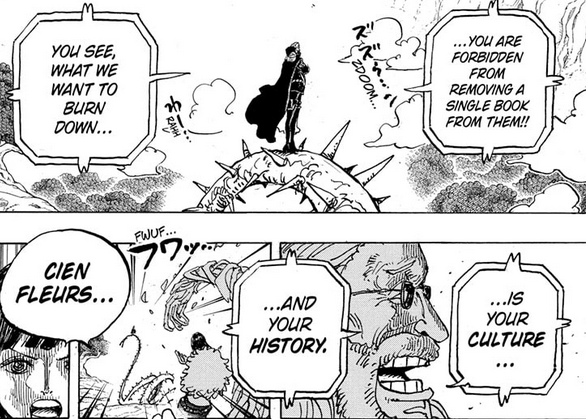
The chapter ends with the order being given to burn the library and the school, but I have no doubt they’ll be saved. Sommers emphasises earlier in the chapter that the World Government’s goal is to erase the giants inconvenient history and culture rather than just taking their lives, but the result will still be the end of giants as we know them. Again, this is a real world tactic of oppression and genocide. Consider the Australian Aboriginal Stolen Generations, where thousands of children were segregated fully from the elders of their culture to receive a white education and prevent the customs and beliefs of the Aboriginies from being passed down. Erase the culture and history so you can rebuild a people as whatever you want them to be, whether that’s assimilated parts of your own society gradually breeding out their racial traits, or as the mindless mercenary barbarians you have on retainer.
But the last page is where the chapter starts to lose me. Scopper cuts off Sommers’ hand, which doesn’t regenerate. Not only is there an art mistake (the cut hand changes between panels) but the implication seems to be it’s his Advanced Conqueror’s Haki that’s causing the lasting damage. Siiiiiiiiigh. Look. I’m a fantasy reader. I can forgive a lot of “chosen one” stuff as long as the stories and characters are interesting. I can read into all kinds of ambiguities about whether the outcome was inevitable or if the hero was just the right guy in the right place at the right time. I don’t think Nika retroactively undoes any of the stuff Luffy fought for before the power awakened. I don’t think his famous family has carried him on his journey. But I would say that locking the way to hurt the final bosses behind the one in a million super special power, and perhaps further behind its better version that “only a handful of the very strongest” can achieve is a step too far. Committing to that would be a misstep.
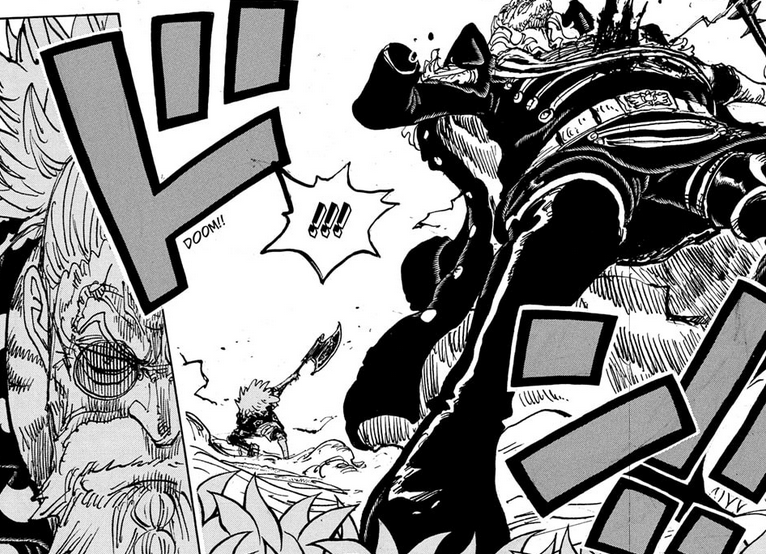
But we’re not committed to that yet. Let’s spitball some alternate possibilities while we have the chance. Option 1a: The mark: We’ve been told that part of the Holy Knights’ powers are enabled by a “mark” they all wear somewhere out of sight. Maybe the secret is to remove or target the mark. But I wouldn’t bet on that. Sommers should know where his mark is and wouldn’t be so confused about what’s happening to him in that case. We also saw Gunko getting annihilated almost down to the waist a couple of chapters ago. Most of her lower body is visibly bare, so that mark would have to be pretty intimate to not have been destroyed by the explosion.
Option 1b: Scopper is marked. Perhaps people with the mark can harm each other. The Roger Pirates could have discovered the secret behind this power on their journey and some of them may have chosen to take a measure of the power themselves as a personal sacrifice for to be able to stand up for the next generation.
Option 2: It’s Haki, but not the way we think. In early Wano, a big emphasis was placed on Luffy learning the internal destruction application of his Armament Haki. I think it’s curious that this never really comes up again. I’ve assumed for years that it’s what Luffy used to penetrate Kaido’s scales and do real damage to him, but they never talk about it directly. Instead, the technique emphasised in that battle is the off-body emission, used for the ‘fight without touching’ clashes and to push through the magma cloak at the end. So maybe internal destruction was setup for this, where with fine control your injected Haki can block the regeneration until it wears off or the enemy forces it out with their own Haki. Adding Conqueror’s coating would obviously make it more effective, but in this case it’s not a prerequisite for fighting. I think this would be the ideal middleground.
Option 3: It’s the axes. Whether seastone or something rarer and more endgamey, a special custom godkilling weapon for each Strawhat would be a neat final set of powerups. Having it be Seastone could play into the lore already setting up Wano as important for being the sole source and best workers of Seastone. It would tell us a lot about their role in the Void Century days and the future.
Those are my best guesses, but I’m curious to see what the fanbase comes up with given a week off to think. My fingers are crossed for something creative and unexpected from Oda that blows us all away next chapter though.
-
One Piece chapter 1147 review
On my first quick readthrough, I thought this looked like a bit of a bridging chapter, but rereading and taking down notes scene by scene I found a pretty decent amount of meat on its bones. Not much new in the cover story, except in the background, is that a random samurai claiming Who’s Who’s mask as a prize or something? Maybe forcibly unmasking him? Are we going to see the guys real face in the next installment?
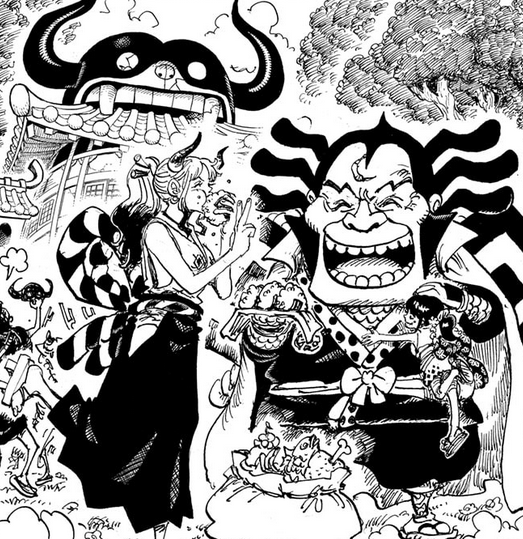
And the next curiosity is Saul’s familiarity with not just the Holy Knights but their apparent immortality. I would have thought that was a closely-guarded Marie Geoise secret. Although, I guess you only have to hit commodore to be able to see the Five Elders’ powers, so it’s not out of the question a vice admiral would have had clearance. And as a giant, the higher ups must have taken a special interest in Saul, so maybe he was given a chance to see the ability in action that way. Either way, this flashback with Saul providing extra reasons not to fight is exactly what I wanted last week when I was saying Robin and Chopper’s surrender felt too abrupt.
I’m surprised Gunko went out of her way to capture all four of the Strawhats from Collun’s mission. Really looked like those guys were all going into freefall, and fairly spread out from each other as well. Really gives you an idea of how much speed, precision and range she must have with her powers.
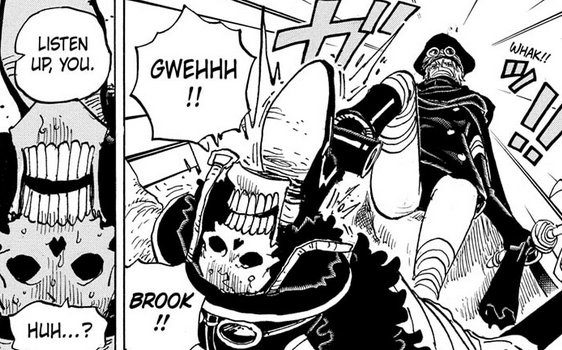
Well, it gives us a chance to see Brook and Gunko interact. I’m very curious about Book’s like that there’s ‘something about that woman.’ The scans interpreted this very directly as him recognising her from somewhere, while the official translation keeps it vague. I’d love for someone with the raws and some Japanese skill to clarify it. Leaping off from the recognition angle, did she come to one of his concerts during the timeskip? Or maybe (extreme longshot) we’re going to go into discussions about immortality over her having been around since before Brook’s death. Probably not, given that Garling has visibly aged during his Holy Knight tenure, but catching up with an unchanged immortal would be a really fun way to use Brook’s powers. I loved seeing Brook declare his loyalty to Luffy here. Funnily, Gunko clutches her chest after the first time she kicks him – is it hurting her heart to attack her favourite singer? Not that it stops her from laying into him in the following panel, so maybe I’m overthinking it. And what I’m glad to see about this scene as a whole is not a single mention of panties. So many people speculated about Gunko and Brook’s meeting and how he’d react to her pantsless state or if he’d be the origin of that fashion choice. But honestly, from discussions of the female Egghead outfits to here, I think ‘panties’ is a word the fanbase uses a little too liberally for any kind of minimalist bottomwear. Despite the visual similarities, a bikini bottom or the lower half of a leotard or one piece swimsuit aren’t the same thing and don’t carry the same connotations as actual underwear. That’s meant to be the whole thing with the Japanese panty obsession, right? Seeing something private that would be taboo to reveal publicly. Something designed as outerwear, even with the same amount of skin showing, isn’t going to give a perv like Brook the same voyeuristic thrill. Like don’t get me wrong, Gunko’s outfit is still ridiculous, and so were some of the Egghead design choices, but it feels like an exaggeration calling every frame of them ‘panty shots,’ you know? Anyway thank you Oda from not taking the low-hanging fruit, please don’t immediately prove me wrong next chapter.
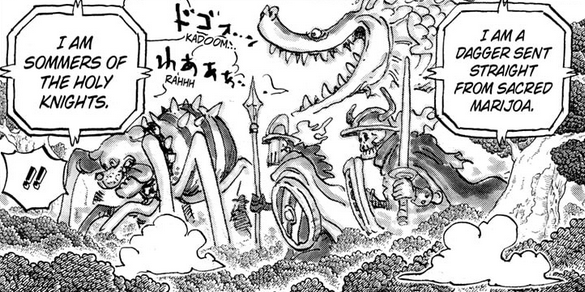
Going back to the battles across the island as Sommers starts his broadcast, I love that we’re still getting more nightmare designs as the set piece plays out. A dog spider, a pumpkin-head man (who’s missing the normal shading in his first appearance), a sea serpent, a griffin and a kraken join the fray. The variety and designs are wonderful.
We get names and a little snippet of characterisation for the ten captive kids as well, which is a good start on making their rescue/escape something we as readers are invested in. Collun’s already setting himself up as a leader among them, following his expected arc. Johanna’s line seems to imply she’s an orphan or something. And that with her having black Ancient Giant horns like Loki and Harald. Could be something, could be nothing. I’ll be keeping an eye on her.
On the Great Erik, it’s curious how they talk about the ship leaking. You wouldn’t think that matters much on a svar. Maybe just a weird translation of talk about a hull breach. The wives and mothers being the thing to take the giant warriors down is hilariously unexpected. I don’t think anyone pegged that when we were laughing about one kid picking his mum as a fear and her showing up in the corner of the sleeptid reveal spread. What’s really interesting is the mums here using fire and lightning powers. We know Elbaph isn’t a friendly nation to Big Mom, but even so (or perhaps because of that) her powers have obviously become synonymous with a mother’s wrath.

Hey, we’re at the map drawing stage of the set piece already. That tends to be a big landmark on the way to the climax. And it’s just good to have confirmation of relative positions.
And in all the fun of the escalating battle, Oda has to slip in something real. Subjugation through the destruction of libraries and schools, the malleability of an uneducated populace. A time-honoured tactic of fascists and dictators everywhere. And very, very reasurring after the early chapters of the arc played up the decline of warrior ways and the school and library as the pet projects of a then evil-seeming king. I think we can say with confidence now that this won’t turn into a ‘new generations soft’ kind of narrative. And I love Robin’s intensity when she stands up to resist this. She’s had a great start to this arc and it looks like she’ll keep being one of its central Strawhats. Now we just have to find Usopp’s role…
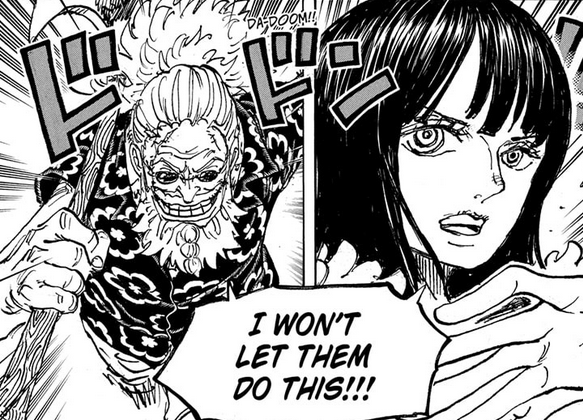
What of Gaban though? I wouldn’t say he’s been particularly death-flagged, but this is the kind of spot the pros of the last generation take one for the team so the actual protagonists can shine.
The arc is feeling well set up as we move toward the middle chapters of volume 113. I’m looking forward to seeing Robin in action and what Collun and the other kids do now that they’re awake and aware of their situation. And there’s Luffy and Loki’s eventual arrival to wait for as well.
-
One Piece chapter 1146 review
Whew, I’d really hoped to get through this before the next chapter’s spoilers dropped, but life just gets in the way sometimes. Hoping to be back to a degree of normalcy next week.
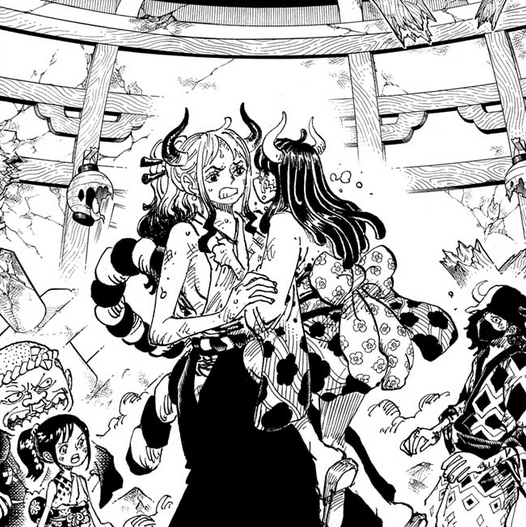
Good to have One Piece back from its break in this busy time though, and I’m happy to be getting (at least a little of) exactly what I want from the Holy Knight confrontations. Off the bat, Yamato’s cover story takes a big, expected step toward giving them their own crew. Thirty chapters deep though, is there really time to recruit any more Beasts Pirates besides the dino siblings?
Gunko talks about the World Government wanting to use the giants as a mercenary force, and the chapter takes the time to emphasise that, from little things like Ripley carrying Franky as he fights to the gorgeous spread of the crew ripping apart the nightmares. The average, noncombatant giant might be beatable by the best of humans, but I would wager there are more average giants than there are top level humans, and the potential of a fully trained giant fighting alone or a moderately trained giant supporting a top level human is terrifying to consider.
I’ve repeatedly hyped myself up for the creative potential of Gunko’s arrow powers in a fight, referencing Soul Eater’s use of a similar power multiple times, and the reality does not disappoint. I love the redirects of both projectile and close range range attacks, I love the zippy way she moves around to dodge and strike along the arrow lines, and man do I love Usopp freaking out when the arrow points to him, and Nami trying to pull it to another target. Funny how Saul’s group didn’t seem to try that for the kids. But I wonder if the the arrows being physically tangible but immovable to other people could be key to fighting Gunko. Imagine just hopping on top of one and charging up it the wrong way to meet her attack with your own.
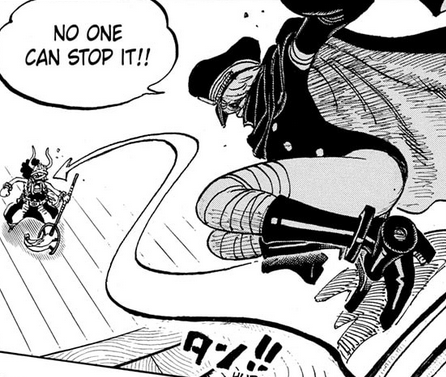
We also get confirmation that the Holy Knights share the Five Elders’ regenerating properties. I’m happy to see this. The power scale for raw, physical might more or less hit a ceiling with Kaido. Trying to pull out another gang of enemies who are just stronger would have verged on late Dragon Ball levels of absurdity, so making these guys undamageable puzzle bosses is a smart move. They can be a serious threat without raising questions about why they can’t solve all the World Government’s problems on their own.
Plus, I’m curious about what the weakness will ultimately be. Joyboy’s haki seemed to dispel the Elders’ demonic forms, but it didn’t do any apparent physical damage, and the Holy Knights don’t seem like they can transform like that. I hope the answer is a bit more interesting (and less monster trio exclusive) than just haki.
Finally, holy moley, Usopp went for the kill. Even as the most “normal” Strawhat, this is a look at how he might measure up to a an actually ordinary, undefended human, and it sure makes a statement. And we’ll just be sticking a pin in Brook knowing about the Holy Knights out of hand. Iiiiiiinteresting.

The confrontation ends with the Strawhat group ejected from the svar, so I guess they’re being sent to the Underworld to pull Luffy and Loki into the battle. And speaking of battles ending, it’s a little disappointing to not have seen more of Killingham and Summers’ ones. There are hints – Killingham being able to induce sleeplike states even adults after all and Sommers’ field of thorns. I think seeing a bit more of the futility of fighting with Sommers could have gone a long way to make Robin and Chopper agreeing to hide make sense. As it is, it feels a little abrupt, even callous of them to accept Saul’s sacrifice so readily.
The last lines of the chapter are a big lore hook, implying again a level of familiarity between the Holy Knights and Harald. But contrary to all previous build-up, Sommers here suggests Harald either defied or outright betrayed them by changing the country’s culture. So not as bad a guy as we thought? But if he’s not, why did Loki kill him, and if it’s because Loki is evil, why is he being set as a parallel with Luffy earlier in the chapter. The mystery keeps building! This arc’s flashback is going to be something else.
Seeing Gunko in action gives me a good feeling about the direction of the arc. Good, old school puzzle powers and a bit of mystery building for the flashback, increasing both Harald and Loki’s moral ambiguity. We’re in the early stages of a new volume with nowhere for the momentum to go but up. I see a good few weeks ahead.
-
One Piece chapter 1145 review
Oh, I’m surprised the anime colour spread gets to be included in the official release as a part of the chapter. When I heard it wasn’t drawn by Oda and the chapter had a normal cover anyway, I figured it was just colour pages for the magazine. Wonder if it’ll keep its place in the volume, or get moved out of the way to the back like the enormous WT100 spread did. Oda may not have illustrated this, but I can see him doing something in this ballpark, and having the clock showing the new Japanese timeslot is fun.
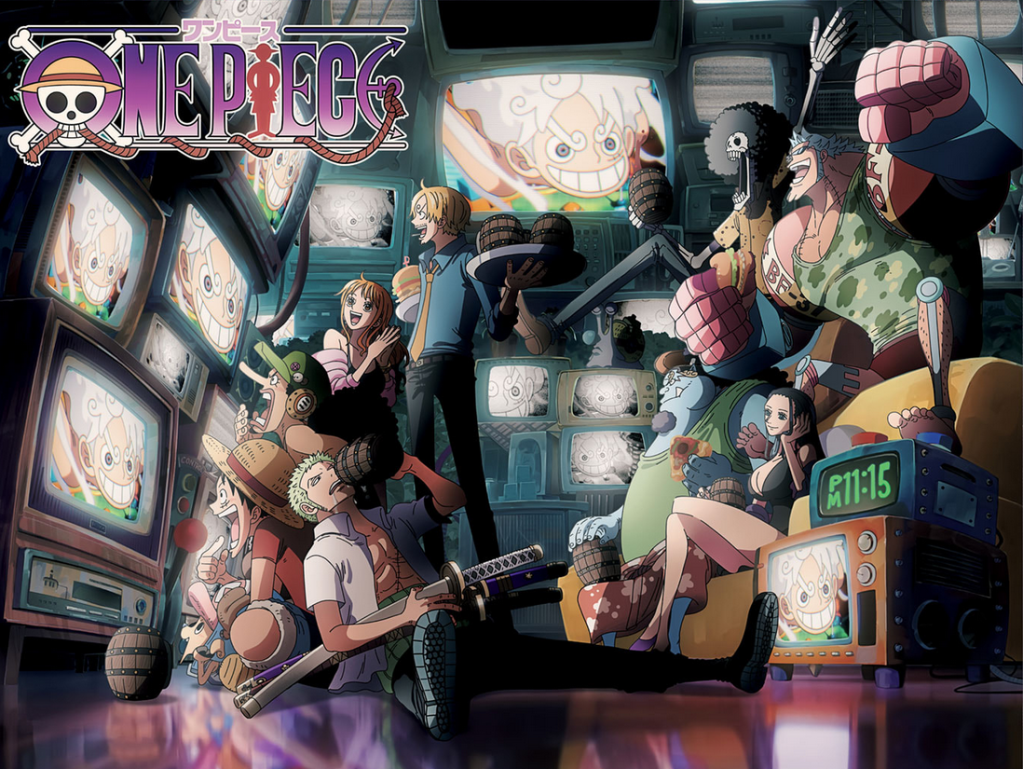
I’ve been manga-only for a long, long time, but I’m keen to see what the anime can do with some time off and a switch to a more seasonal format. The first episode off the block still only covered a single chapter, which doesn’t fill me with confidence, but maybe they planned that one out before the break. I’m willing to give them a couple more to see if anything changes.
The hunting scene makes an interesting opener – kind of a non-sequitur considering all the action building elsewhere on the island. I guess if this is the start of a new volume it could work as kind of a cold open to the book before getting back into the meat of things. Either way, it’s neat to see Zoro and Sanji working together. And I suppose they’d have to – the Groggysaurus is freaking big. Look at it tower over Goldberg in the opening panel. I wish there’d been at least one shot where it gets properly sized up against a normal human to show what a beast it is. Unfortunately, the perspective on the final shot of Zoro slicing it makes him look way bigger in proportion to it.
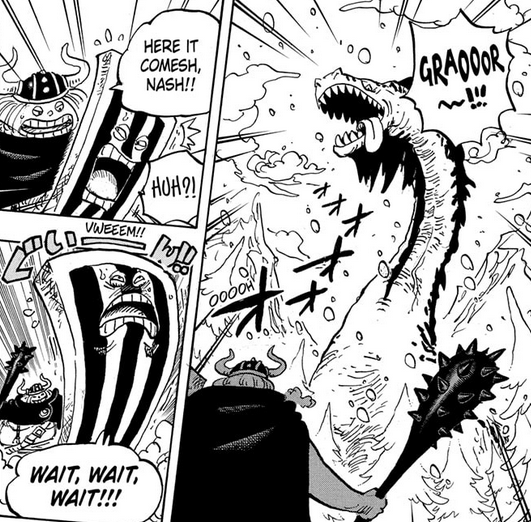
And there’s some lore here with Goldberg’s homie shield, Nash. This thing was first shown off in chapter 899, just as Whole Cake Island was wrapping up, in Hadjrudin’s segment of the Grand Fleet cover story, which was perhaps suspiciously just a series of character intros rather than a mini story like the rest. How far in advance has this been planned? I’m definitely curious to hear any details about a fight between the giants and Big Mom after she left Elbaph and acquired her powers. Does it have to do with the marriage arrangement with Loki that fell through, or did some giants at some point come to settle things over her childhood rampage? Feel like I’m forgetting whether or not this was hinted at anywhere else. It’d be cool for it to end up being plot relevant, but my gut is saying SBS summary.
I love Luffy’s inept attempts to nurse Loki in the following scene, and Gerd egging him on is a great punchline. But, of course, the big thing here is Loki’s connection to Rocks in an obviously twisted, abusive version of the Luffy-Shanks dynamic. I’m now ten times more invested in the inevitable Loki flashback. What did he admire in Rocks and how did he try to emulate it in his mysterious falling out with Harald?

And I’m going to throw this out there more as a thought than an actual theory, but what if this has something to do with the blindfold? We know Loki was wearing it at a young age – about the age he seems to be in the flashback panel here. But his helmet conveniently obscures the whole top half of his face. There are lines that might be the bottom of the bandages peeking out, but they might just be trickles of blood. At face value (heh) it seems like Newgate is scolding Rocks for impaling Loki, but what if it went further than that? Suppose Rocks took Loki’s eyes. I’d need a few more hints before I call it likely, but it would definitely make for compelling drama.
Cool moment for Jinbei here, even if it hasn’t been that long since he saved everyone from a fire the same way on Onigashima. The real surprise is the ticking clock of Elbaph burning being silenced so soon. If not that, then what?
We also get some more chatter about hiding your voice from CoO from Gaban. I’d love to learn more about this.
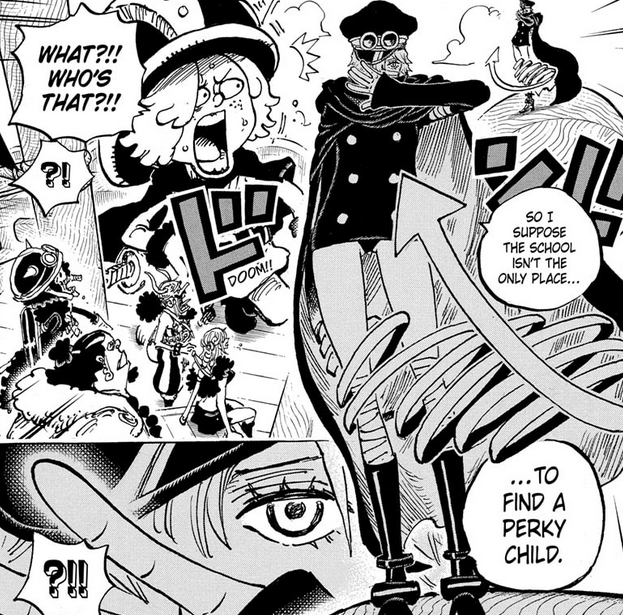
Gunko’s arrival of Collun’s svar promises a good confrontation for next chapter. Definitely curious to see how a Holy Knight stacks up against a pretty decent spectrum of low to high level Strawhat combat threats. I’m not into powerscaling and want to distance myself from most of the kinds of talks that come up if you search ‘powerscaling’ (which is a whole rant of its own for another place and time), but yeah, I want to see how strong these guys really are. The hype is big, but savaging wild animals and a chained man doesn’t tell us much.
Plus she doesn’t seem to have noticed Brook is there yet, so that’ll surely be fun.
Finally, while we’re on this, that’s such an Oda set of panels, when she appears (embedded above). It’s basically three shots overlapping each other, all showing the same moment from different angles and at different levels of closeup. The top one bisects the bottom one but doesn’t look out of place because even though the element going across the top breaks the line of sight between the crew and the thing they’re reacting to, it’s actually that same thing. You just don’t see other manga artists doing them like this.
I think the next chapter will ultimately be a loss for the weaker Strawhats, even with Jinbei present. Something to get Collun in position to be a damsel for the adults and a hero in his own right to the weaker kids. Maybe this results in the Strawhats being ejected from the svar and dropped to the Underworld to meet up with Luffy’s group and pull them into the situation. I can only hope it’s educational about how the rest of the arc and the final confrontations with the Holy Knights will play out.
-
One Piece chapter 1144 review
Yeah, I think this is the end of volume 112. Oda has lately favoured rallying moments and bits of intrigue over dire and desperate cliffhangers for recent volume endings, so Dorry, Brogy and Scopper leaping into the fray is the perfect moment to cut things and leave readers excited to see what’s coming next.
That said, it’s also starting to feel like we’re moving into the middle stage of the arc where the pacing slows for the action to play out. The set pieces are building bigger and bigger, but I’m finding myself with less to say each week because it’s just the stuff already established playing out. Which is fine, and normal, and a necessary part of any big shonen arc, and they all feel better on the reread than they do to wait on week by week.
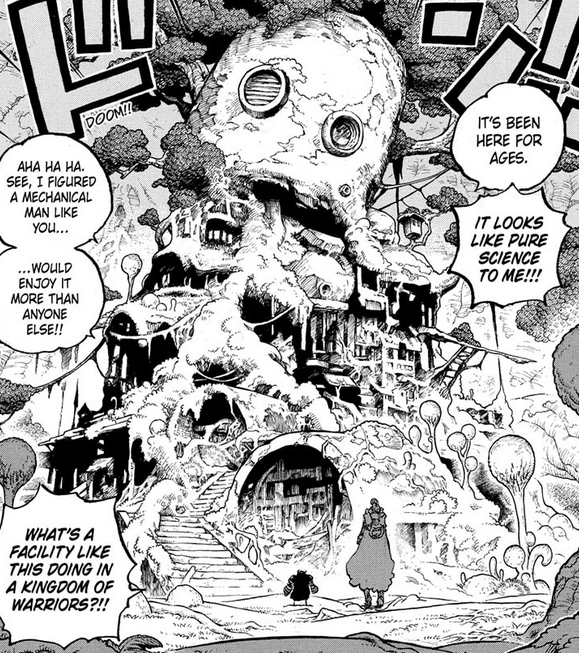
This week’s one big lore piece is the ancient facility in the opening scene. The art here is awesome with deep shadows and overgrown detail that really emphasise the age, and that 3000 year figure almost certainly making this First World tech is crazy. I thought it would be years before we came back to that. Glad that it gives Lilith something tangible to do in the background instead of just fading away as well. What’s rough is the spoiler providers assuming this is a robot – I’m not saying there’s no chance of that, but it’s far from as certain as the summaries suggested. Yeah, that dome at the top looks a decent bit like the heads of the robots from Castle in the Sky, but there’s no body. And yet, the perception of it as one is almost certainly going to persist in the fanbase and overshadow any other theory. To shout out another possibility I’ve already seen, there was a comment suggesting the top section as a cylindrical segment of a rocket. I’m not convinced enough to put money down on that, but I still like the idea.
Usopp gets a really fun joke quietly slipping in that he wants to fight as the giants get ready to fight the nightmares. We get what looks to be a broad division of labour for the coming set piece with the Strawhats and Collun (surprised he wasn’t at the school, but he still gets to fill his expected role as the one kid fighting back, so it’s not that big of a shock) taking on the human-size intruders while the giants face the big ones. There’s some good, quick logic from Brook and Jinbei picking out the number of enemies and the fact that giants might have trouble pinning down a threat so small, as well as Nami getting on Collun’s good side to get access to a boat they wouldn’t have had otherwise.

It’s neat that Gunko is a Soul King fan. Crazy it’s taken this long for that to come up, actually. And cool that it’s an enemy instead of an ally, for that potential drama. If her pantsless state is all for his sake I’ll crack it though. And the whole conversation that follows is a fascinating reminder of how evil the Celestial Dragon mindset is. These guys have seemed pretty affable so far (outside of the whole kidnapping children thing), but reading between the lines of Sommers executing enslaved musicians for missing a note. That’s an insanely cruel pastime to so casually bring up. And the only objection at the table is for making fun of Gunko’s interests.
Attention to detail check: the Great Erik still shows the charred evidence of being shot at by Marine ships and getting ignited by Mars’ fire break on Egghead, as well as the figurehead being haphazardly tied on after Nusjuro severed it.

For all the feeling that this set piece is just starting to build, the nightmare monsters seem like they’re going down fast. Dorry and Broggy knock down three in a single panel at the end of the chapter while the other adults fell the draugr, accounting for a decent portion of the creatures from the reveal spread already. Almost too easy. Makes me wonder if these monsters are really gone, or while the children sleep will Killingham be able to pull infinite copies from their minds? How many back to back Hakoku Sovereignties do we think the captains have in them? This could be the thing that makes it properly desperate and high-stakes that the Strawhats find and take down the Holy Knights.
And I hear we’re getting another colour spread next week to celebrate the anime returning. I wonder if it’ll be a normal one, or if Oda will draw something specifically for the spot the anime’s up to, as he’s done for movies, games, the live action show, the Ryuma OVA and the Heroines novel. Maybe fully and officially coloured versions of the Five Elders’ monster forms? We can only hope.
-
One Piece chapter 1143 review
Conflict is continuing to build on Elbaph, but this chapter doesn’t achieve quite the same momentum as the last few. It is, however, the tenth of volume 112, so we’re likely to see some big stuff next week or the week after to close out the book. Technically it could end here, but that last vague reveal is so obvious I don’t think it’s the place to close a volume on.

The colour spread is vibrant as ever. It doesn’t feel totally original – there have definitely been a few racing ones in the past – but there’s no arguing with the art quality. My only complaint is Jinbei’s lack of presence. This feels like an old spread he’s been awkwardly worked into an empty space on. The guy would have felt like less of an afterthought if he’d just not been there at all. Even Brook looks oddly out of place, seemingly almost like he’s casually stepping off his fish at speed.
The main focus this week is on the powers of the Holy Knights. There are interesting applications here, but very little in the way of limitations. What is the range of Sommers and Killingham’s powers? They don’t seem to have been close enough to make physical contact with the kids, but it doesn’t seem like they’ve attempted to move against the adults either. Saul confirms that Gunko’s arrows are visible, which we mostly knew from the earlier scene with Loki, but I’m glad to have it confirmed by a man no wearing a blindfold. I’m glad we basically immediately get confirmation that things pulled from dreams are calorie-free. The spoilers alone had people wondering why Killingham didn’t single-handedly solve the Marie Geoise food crisis, even though this would have been the obvious answer even if it wasn’t mentioned. And hey, these guys make a fun enemy group. I’m looking forward to seeing what happens when they get to interact with the main cast.

The scene with the firefighters and the Draugr isn’t huge on substance, but the contrast of the childlike monster drawing throwing down the intricately rendered ship is one to remember.
In the Underworld, the Loki situation rapidly deescalates back to a phase of negotiation. The fire above will keep burning, but I can’t help feeling a little teased to have him fall so suddenly. And I’m not sure how to read the action leading to it. Does Luffy actually hit him, or does he collapse before he gets the chance? There’s nothing of Oda’s usual emphasis on impact if a punch happens here, and even though Luffy’s pose in the panel where Loki hits the ground looks like he took a swing, his arm is already deflated. Maybe just a little tap to help him on his way down?
What I’m now very, very curious about is Loki’s blindfold. He wore it as a kid? It’s not related to his ability? But it’s not so important Gerd couldn’t put band-aids underneath it. What’s the reason then?

And it’s very interesting that Rodo thinks he knows who attacked Loki. Is it just a dot he’s connecting after seeing the injured guards, or is there something else he knows that he’s not letting on? I guess through his diorama he might pick up more info about the outside world than the average giant, but I could be overthinking things.
And yes, we’re hinting at the truth of Loki and Harald at the end. Certainly, there must be readers casual enough to have taken the idea of Loki as an evil criminal at face value, but I personally don’t count it as new info. I wonder how much we’re going to go into it next week. It’s too soon for a full flashback, but I’ll dare to hope for some verbal details.
-
One Piece chapter 1142 review
Oda shows no sign of hitting the breaks on Elbaph this week. It’s amazing how different his storytelling feels for this arc and Egghead compared to the bloat of Wano. Whether it’s a second wind from reaching the final saga, a response to feedback or personal feelings about how Wano turned out, or fear that he wouldn’t reach the end before he gets too old to do so, Oda is choosing to go foot to the floor.
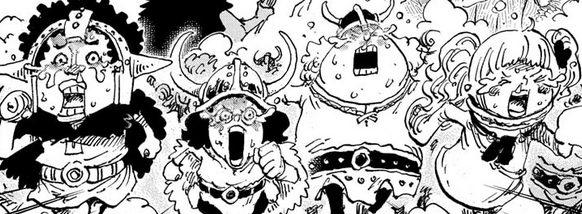
But even within this new, fast era we can see growth and adaptation. Egghead felt underpopulated without a single named lab assistant outside the main Vegapunks. Nothing in the arc would have changed if the island had been staffed entirely by robots, a flaw that stood out in a series so full of large and vibrant casts that make its settings feel fleshed out. Elbaph will not face this accusation despite reaching a state of open conflict before the end of its second volume. Kids, teachers, warriors, leaders and animals, all with different personalities and interpretations of the local mythology. There’s enough going on to give the impression of a large, functioning society of individuals. And yes, Elbaph is advantaged by so many giants having been introduced earlier in the story, but I’m still impressed.
The first big forward movement of the chapter is the Holy Knights’ attack on the Walrus School, with a very unique set of powers. If I’m reading between the lines properly, Killingham can put people to sleep (what limitations are on this that kept him from outright disabling the adults too?) and Sommers can manifest people’s fears. It’s very cool how the children’s fears take on a rougher look with crayon-like textured shading. I think these things will look great in the colour manga a few years from now, given splotchy, bright tones that can stand out even more from the sharper surrounding art. Will any adults’ fears that get pulled out take on the same style? And which character is inevitably going to make Sommers do the Enel face when they say they have no fears?
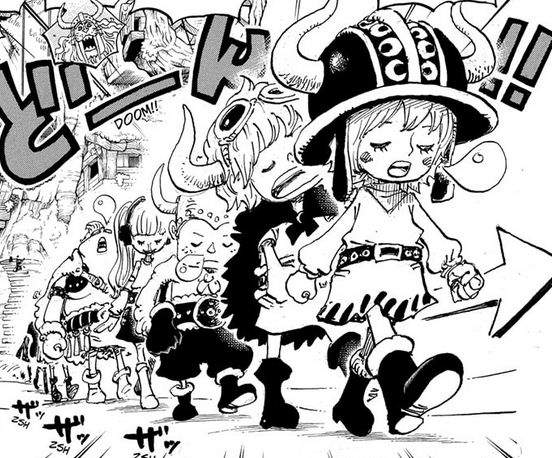
We also get a fun new application of Gunko’s arrows in leading the unconscious. This brings to mind the hypnotic suggestions of Miss Goldenweek’s painting (coincidentally, a power also showcased in an arc with giants) and the possibility of arrow traps that redirect her opponents’ attacks or movements in more favourable directions. Again, I refer to Medusa from Soul Eater for how creative and visually distinct this kind of power can be. And if Luffy could be tricked back into the unthinking instinct mode he used to dodge Enel’s Mantra, would he be totally at the mercy of the arrows like the sleeping children?
Also in this sequence, we’re meeting more school staff. I guess that’s why they call it the Walrus School then. Wonder if this guy has any connection to Islewan from Whitebeard’s fleet. They can’t both have a walrus Devil Fruit, right?

Down in the Underworld, Loki cuts an intimidating figure, not revealing his own power but proving there’s something special about that hammer. The lightning that crackles around it as he winds up the swing is rendered differently to the crackle of energy produced by Haki, but we can see also that the blow calls a thunderbolt from the sky rather than being charged with its own power. And man, I did not expect the ticking clock of the burning tree to be started so soon. Almost too soon. It barely counts as setup if it happens the chapter after it’s first mentioned.
We don’t have much time to go into responses to this here. I’m really curious to see how Luffy’s going to act, whether he’ll demand Loki explain himself or go straight into fight mode to put things right.

The final pages, returning to the school, deliver a stunning piece of art as Norse myths and classic childhood specters alike come to life. I hope Loki and Luffy get to meet the reflections of themselves here. Love seeing that one kid’s mum hidden between two speech bubbles in the bottom left. What’s interesting as well, is the sky. The space above and behind the monsters is filled in with the same rough shading as their colours. Oda doesn’t use screentone like that for clouds or skyboxes, so it’s a part of Sommers’ powers. An extension of the storm that one kid feared, or some indication of a closed space where his power works?
Break weeks are never fun, but I’ll take it here to get the next few events from here in an uninterrupted string, which include the finale for volume 112. Feel like we must be due for a colour spread when we come back as well, so things aren’t all bad.
-
One Piece chapter 1141 review
Man, things are moving in this arc! I expected at least another chapter of transition and chapter before Luffy and Zoro even reached Loki, let alone freed him, but Oda’s wasting no time at all on this one. And we’re still in volume 112, with at least two chapters of it to go. This book is going to be stacked.

But despite the huge plot movements, this chapter finds time for fun and characterisation as well. I loved Nami’s exaggerated and insincere insisting that she was only there for the treasure and wasn’t involved in Luffy’s Loki plan, and then a totally wasted Usopp going crazy at the party a couple of pages later. This arc is a long time coming for Usopp, so I’m glad he gets a bit of fun before it puts him through his paces.
We get a little more Adam Tree lore as Franky learns about the fallen branch of Haugen. This feels like some big, important setup. Fire and lightning being Elbaph’s weakness has to be setup for the final act of the arc. It wouldn’t be One Piece without a ticking clock to the whole island getting destroyed, and an out-of-control fire bringing down the tree could be exactly that, especially if Loki’s big hammer is about to reveal some Thor-like powers. It’s not my favourite way for things to go, feeling repetitive so soon after Onigashima turned into an inferno and Egghead burned under the Marines’ bombardment, but we’ll see what twist Oda decides to put on it. If some bits of the tree have to be lopped to stop a fire, will that maybe give Franky material for a final upgrade to the Sunny though?
I’ve seen the idea float around that we’ve just learned an unexpected weakness for the Sunny, but I don’t think the threat is any greater than to any other wooden ship. Elbaph has a weakness because every part of it is interconnected on the tree, not because Adam Tree wood is particularly flammable or conductive. Not to mention that planks on a ship will be sealed and treated and constantly damp from the seawater, making them much harder to burn than a dry land tree.

Cut to the debate over freeing Loki. I’m not usually into the idea that Zoro is a substantially different character after the timeskip, let alone a worse one, but even for me he comes across way too harsh here. Anyone else remember his first big fight, where kicking a wounded man in the wound was a villainous act? Maybe if he had just prodded the wounds to test for a reaction, or he’d just been blase about Loki dying, or he’d just suggested eating the animals, it could have been a reasonable characterisation moment, but all three of them together just scans as a big much.
(Also did anyone else notice Loki’s wearing gloves now? He definitely wasn’t at first, but they show up around the time Shamrock attacks him. Wonder if the volume release will ink his hands in properly for the early chapters.)
Hadjrudin’s arrival on the scene definitely feels a little rushed, and a little contrived, but it at least manages to be funny. I wonder if it’ll be a factor that most of his group are now “severely injured” or if they’ll shake it off when the time comes to fight. Probably worth noting as well that Sanji and Gerd both escape being hurt and should be going into any future battles at their top capacity.

The final spread is a banger. I’ve said it a bunch of times through Elbaph already, but I love the sense of scale in the art lately. Look at those details!
Some have questioned why Loki was imprisoned with Ragnir in the first place if it’s so dangerous, but I don’t think we know enough about how he was locked up in the first place to say if they had a choice or not. Look at the size of this guy – I don’t think he was dragged down here; more likely he was knocked out against the tree and the chains hastily set up around him where he fell. It might have been too dangerous to try and get the hammer out from behind him first.
A lot of questions linger about what makes both Loki and Ragnir so dangerous. What Devil Fruit does Loki have? What makes the hammer such a big deal, and does it have an inherent power outside the DF/Haki power system? Does the timeline work out for Ragnir having a Devil Fruit (probably not)?
But hey! It’s another no-break week, so answers may be coming very soon. And with the volume so close to its end, they should be big ones.
Captain M Entertainment
Reviews, news, retrospectives, thoughts
 Captain M Entertainment