-
Isles of the Emberdark review
Isles of the Emberdark is Brandon Sanderson’s latest Cosmere release and the fifth of his “secret project” novels produced during the pandemic and independently published via Kickstarter. Set in the Cosmere’s far future space age, where worlds are becoming more connected, it follows Dusk, who was a Trapper (a kind of ranger/custodian) of the deadly jungles of Patji before his planet’s industrial revolution engineered the role out of existence. As he struggles to find a new direction, visitors from the stars arrive promising even greater technological leaps, but their assurances disguise a soft-power takeover that will leave the planet dependent and subordinate in galactic politics. Now a portal to an endless ocean of darkness and Dusk’s traditional navigational skills represent his world’s last hope at establishing its independence.
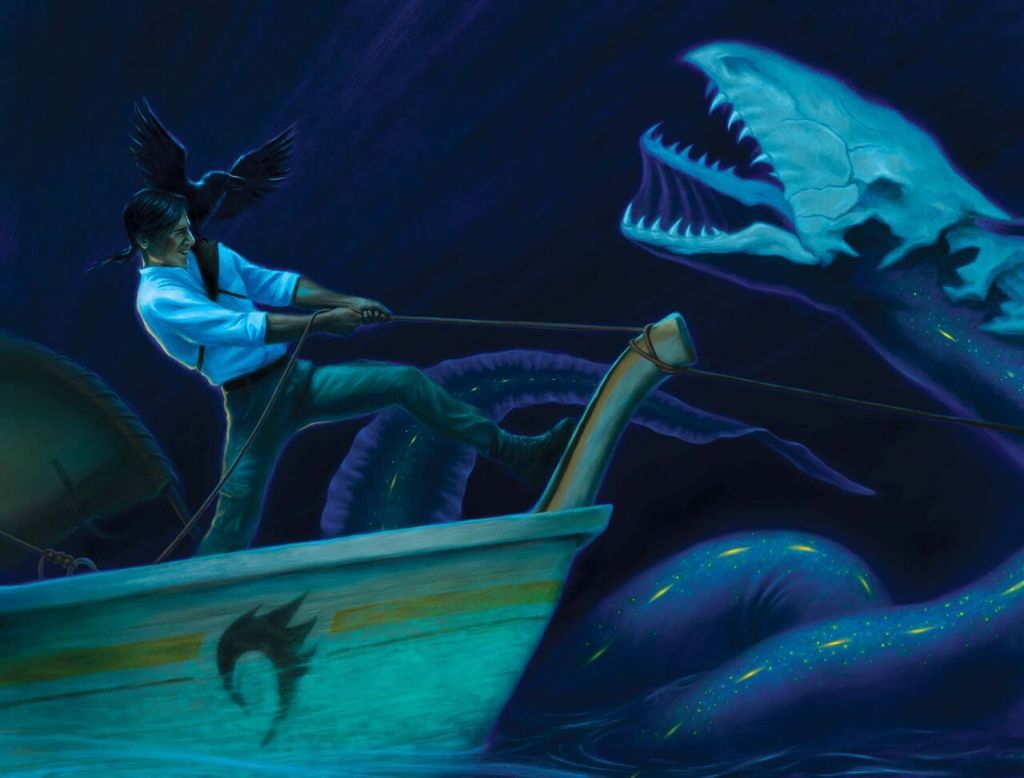
In contrast to the bloated, unedited feeling of Sanderson’s last couple of blockbuster releases, Emberdark is a lean and focussed piece of literary machinery. It knows how many characters it needs and their personal arcs run like clockwork toward satisfying conclusions. A few carefully chosen themes about progress, politics and embracing change thread through every subplot. The climax brings a whole bunch of things from the first half of the book back in interesting ways. It is a hard work to find technical fault in.
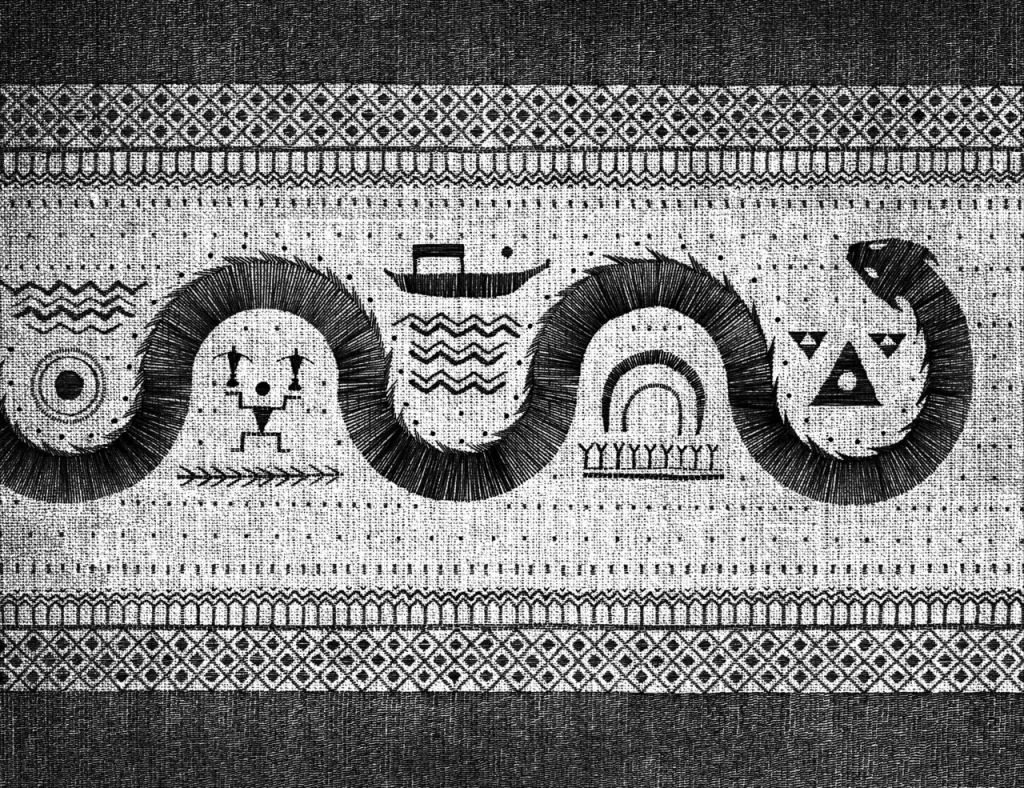
If I felt inclined to nitpick I could talk about some of the secondary characters feeling indistinct and underdeveloped compared to the main cast, I could say there are a reasonable number of jokes that don’t land (a Sanderson trademark, but at least they’re timed better than in certain other books). I might say Sanderson pulls punches in places where he could instead have raised the dramatic stakes, or I could wonder aloud whether the references to Cosmere lore and magic would be offputting to a casual reader or simply blend into the genre-staple technobabble. But I don’t feel inclined to nitpick. I’ve just been on a charming science-fantasy adventure ride with an ending that made me smile.
Is this an ideal Cosmere starting point? Probably not, but I don’t think you’d need to be fully up to date to appreciate it either. And as a side adventure to go between the hulking Mistborn and Stormlight-type epics Emberdark does everything it needs to and a couple things more.
-
One Piece chapter 1158 review
Mmmmm okay, one more week. It’s looking more and more likely this flashback is going to fill most if not all of volume 114, with God Valley, Harald’s fate and Loki’s rampage and capture to still to cover. This is a very transitional chapter though, a little unfortunate to return to after a break week.

What could Oda possibly be cooking with a Kozuki Moria? Our man Gecko Moria hasn’t shown up in years and hadn’t seemed to be angling for an endgame role, but now there’s all these questions about what he found and what he kept from Wano during his invasion in Oden’s backstory, besides Ryuma and his sword of course. The Kozuki cypher (Poneglyph language) maybe? And if Cross Guild continues its trajectory of being a collection of former Warlords, that could put them in the race for real.
This chapter has a lot of things we already knew happened, just going a little deeper into the how and when. Shakky chooses Rayleigh over Roger. Yup, that’s foregone, but I like the ‘being tied down’ joke. Rocks finds a woman of his own and moves on from Shakky. Go figure we’re told of this and not shown it. The back and forth among all the big names at the bar is a lot of fun, and it was good thinking to use their obsession with Shakky to set up a no fighting rule that lets it all work as dialogue without having to escalate to battle. Still, I think I’m at my limit of watching the last generation’s legends fawn over their collective love interest. The nature of a flashback gives a story flexibility to shorthand things that would want more detailed showings to develop in the present – doing a love story as a montage rather than a character play for example – and we’re well past that point for this tangle of relationships. Time to bring it all to a head.

To get to the actual substance of the chapter, there’s Harald and Rocks’ fight. I’m shocked to see Harald actually going through with it so suddenly. And obviously it reflects poorly on him to betray a friend to win the World Government’s favour; I’ve called out Harald’s naivety repeatedly in these reviews. But for all the people online I’m seeing ready to fully condemn him for this, Harald articulates a decent point about political optics and his responsibility as a leader. He’s still ultimately in the wrong and making a bad choice, as we know from the present, but the motive of working within the system as he knows it to give his people a more peaceful life is noble. I don’t envy any leader who has to find the balance between short-term peace and long-term good. All that said, I think Oda might have stumbled in this flashback by making Rocks too charismatic and leaving out the crimes and cruelty. Even when we see him allegedly stealing donations meant for starving children it turned out the collectors were embezzling it! Maybe it was assumed the physical abuse of Loki would be enough to set readers hard against him and make Harald’s hesitation more understandable. Maybe I’m forgetting the child abuse too easily in my lust for anti-Government action. At least Dragon is only neglectful…
And the other thing of note: God Valley and Garling. So there was something more than resources there. I might be reading into things, but it’s interesting that they’d choose to hold this whole hunting trip to get it instead of just having the Marines invade or extort the leaders like they’re doing for Elbaph in the present. Was it an excuse for the Celestial Dragons to go in person because a normal Marine or Cipher Pol agent wouldn’t have clearance for what Garling found? A Poneglyph? An Ancient Weapon? And we get further confirmation that the Holy Knights are looped in on Imu and his desires.
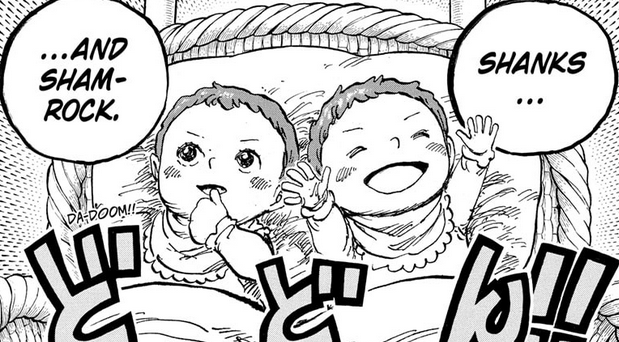
And the kids! I’d forgotten for a while that Shanks had been established as a West Blue baby after learning of his Celestial Dragon heritage. But this actually makes a lot of sense now that it’s happening. What I want to know is the relationship between Garling and the mother (obvious source of the red hair ever since Garling was revealed to be blonde), since these panels don’t read as a Ginny situation. Especially considering Garling was at least willing to bring the offspring back to the Holy Land to raise as nobles later, something we know is not a requirement. But if Garling really did show this woman some kind of sincere, consensual affection, why did he turn around and bring the Celestial Dragons’ genocidal game to her doorstep? Surely this will be its own flashback later.
A slightly flat chapter for sure, but likely an important one in the grand scheme. I’m daring to set my hopes high for the main event kicking off next week.
-
One Piece chapter 1157 review
Okay so we’re definitely doing God Valley, huh? I wonder if it’ll be the full story, or if there’ll be one last POV to go through to find out how baby Shanks ended up in that chest. It’s agonising to have another setup chapter to get the pieces aligned to do that, but given the unfinished art this week, maybe that’s for the best. You want Oda to be firing on all cylinders going into such a vital sequence.
So the grave in the cover story is someone new? Or one of the bunch of lords who were locked up in that cave with a young Yamato maybe? What is this story doing bringing up new elements nearly 40 stages in? I like Ulti’s snow Kaido in the background though.
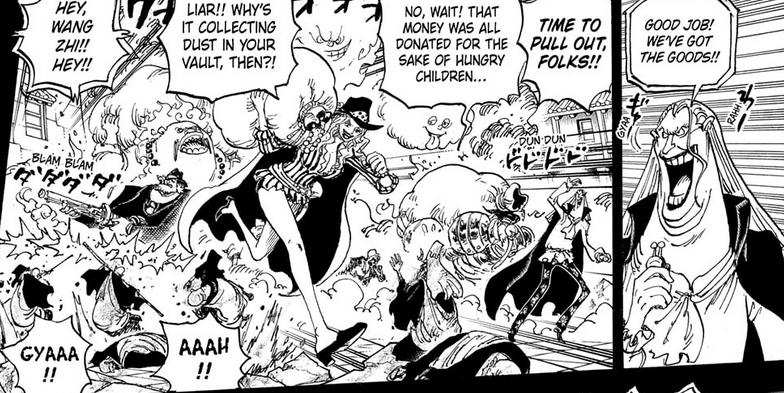
It’s really cool seeing how the Rocks Pirates actually worked together in the opening spreads. This era and all of these figures have become so mythical it almost felt like we’d never see the human side of them, only ever getting rumours and implications so that our imaginations could fill in the rest. It’s actually a wonder this crew stayed together as long as it did, especially with Rocks seeming mostly unconcerned by the toxic atmosphere he’s created. I said before and I’ll say again that he’s turning out a lot more likable than I could possibly have predicted as an individual. There’s a lot of truth in the man’s politics. But the thing he lacks that the likes of Roger and Luffy as pirates or Dragon as a revolutionary have is the ability to sway others to his beliefs and genuinely befriend them. These people are only with Rocks because power is part of his ambition, and he thinks that’s all he needs. They’re here because he won them in a game, not because he won over their hearts. I wonder if this distinction is going to be what makes him the loser at God Valley.
We also see Rocks’ ‘blasting’ sword attacks in action here. Visually, they remind me of the ‘Sovereignty’ duo attacks we saw Dory and Broggy and Kaido and Big Mom pull off. But here we see a telltale crackle of Haki around the blast to make it really clear what’s powering the move. So interesting that this particular technique only ever seems to come from people associated with or in admiration of giants.

Article 18 of World Law feels like the kind of thing that seems innocuous but gets brought back and explained in full later. But we’ll see.
Rejoining Harald, we get to see World Government cruelty and propaganda in action. Harald shows the naivety typical of a flashback sacrifice in continuing to work with the WG in any capacity after this, even continuing to buy into the idea of the Marines as a force of good. He’s even facing blatant hypocrisy as the World Government begins accepting Elbaph recruits to the Marines while reasoning behind his back that giants are too dangerous to let be citizens. To hear John Giant come up in this capacity is interesting through – I would have thought he and the wider Marine Giant Squad were all the result of Mother Caramel’s trafficking. It’s also weird Oda wouldn’t take this opportunity to show and name them in this flashback. There’s five spots in the Vivre Card Databook numbering around Marineford that’s still not filled and can really only be the guys from that squad, so there must be some kind of plan for them. When could it come up if not now?
And on the topic of characters the series is suddenly remembering exist, hi Kong! Bye Kong!

A few weeks ago I was really questioning the appearance of the Kujas in this flashback, how we could possibly have gone from Harald and rocks to them. The end of this chapter finds an unexpected way to bring it all full circle, seemingly setting up Shaky to be a pivotal figure to God Vally. I could not have seen that coming. It’s pretty crazy she and Rayleigh both live right under the World Government’s nose in the present. One high value target in that zone is a big deal, but two of them? What kind of system must they have for early alerts for Marine raids or Cipher Pol snooping.
The last line is a big of an odd one though. I mean, it makes sense for the World Government to want to test Harald that way, but it’s not a great cliffhanger when all contemporary evidence suggests Rocks fell at God Valley with Harald nowhere nearby. We know it’s not going to happen. I guess then, does Rocks dying before Harald can reach him lead to the more hands-on Holy Knight operation that ends in the massacre at the castle?
It seems then that the next few weeks are going to be big, and they’re going to make this flashback indispensable to the larger story. Hope Oda’s getting the rest he needs to give the big scenes the love they deserve.
-
One Piece chapter 1156 review
Were we premature talking about 28 years with the last chapter? Because this week’s colour spread feels a lot more like an anniversary celebration piece than the previous one. The parallels with Roger’s crew. The whole gang together in Luffy’s backpack. It cuts a lot closer to the core of the story than last chapter’s fantasy piece that while beautiful, could have gone with any chapter.
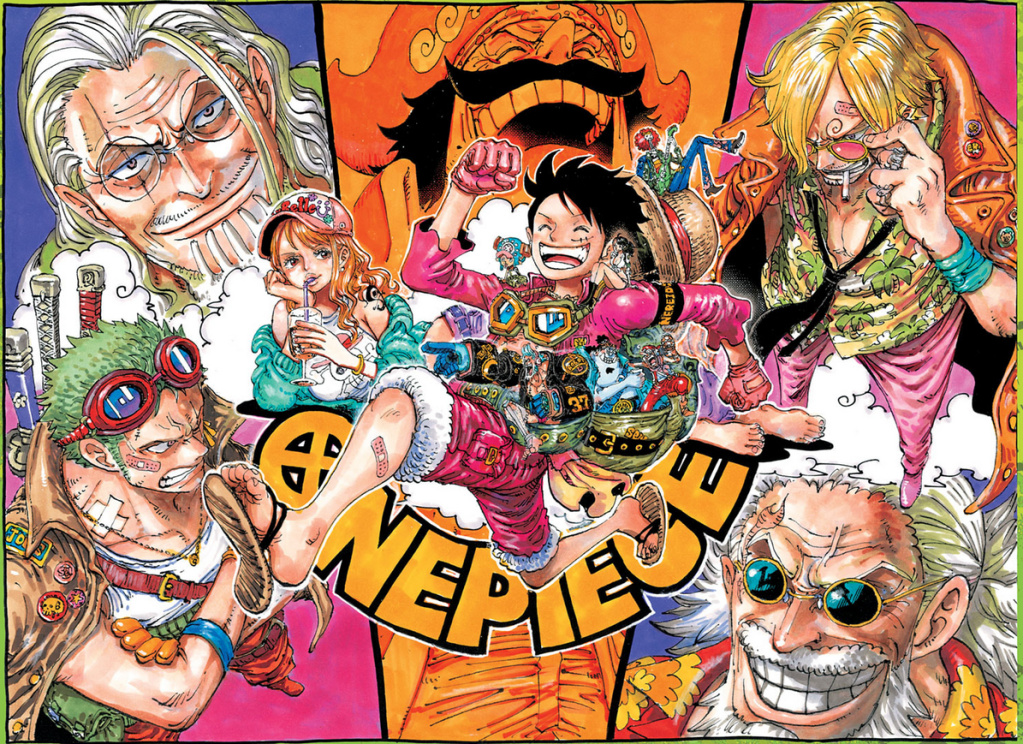
And we get a Pokemon-collab Jump cover too. I’ve seen a lot of ‘what would his Pokemon team be’ type posts and Luffy and Pikachu is an uncommon pairing. I wonder how much say Oda really got in which one to draw – it would make sense if the Pokemon Company wanted their mascot as front and centre as possible, while everyone else seemed to go with more obscure favourites. If I’m honest, I feel kinda let down that this collab happened when it did. I’m not reading anything else in the magazine at the minute. I’m not invested enough in these characters and the artists behind them to see what they pick and and how they draw them. Wish this could have been a couple of years ago, but that’s just me and my media diet, not a real knock on the quality of the piece.
The flashback takes a surprising detour this week. Harald and Rocks were both logical extensions of a story about Loki. And Roger, sure, only one more degree of separation there as Rocks’ rival. We sorta have to visit him every time we wander through his heyday, and I imagine with the end so close Oda doesn’t want to run our of chances to explore him. But old-gen Kuja pirates? Sure, let’s just get everyone in this thing.

I could take or leave Gloriosa basically just repeating Hancock’s shtick, but having Shaky acting as a more popular internal rival brings a welcome change to the dynamic. And speaking of differences, after all the series-wide parallels and comparisons between Roger and Luffy, it’s cool seeing a side of Roger here that contrasts our captain. Not only does Luffy not experience the kind of attraction we see from Roger here, let alone to a great enough degree to throw a fight over it, he’s not the type to attack another crew to purposely win a crew member from them in battle. He’ll go the distance to recruit someone he’s interested in, but nothing he’s done has ever come off like this. And that little love web of Gloriosa, Shaky, Roger and Rayleigh is also something Oda wouldn’t write Strawhats going through. It definitely gets you thinking of what else might have changed across generations.
Switching back to Elbaph, Harald falls a parenting rung in my estimation that isn’t just about being absent and ignorant. He should be right there at Ida’s side telling the longboat captain off for hesitating to help. Who cares if Loki did something dumb first, he’s literally a child!
And Ida continues to rise. She could easily resent Loki as a symbol of the romance she couldn’t continue with Harald. He’s not her son to spark the protective instinct when he nearly drowns. Child or not, Loki acts like a little shit to her in this scene. It would be easy to understand her not liking him. But she still leaps to his defence, and even offers to take him in afterwards. What a genuinely wholesome figure. God, she can’t possibly survive a One Piece flashback, can she?

Switching to Rocks, this Silver Axe guy gets a pretty big introduction for a character I’d otherwise assume was a one-off for hype-building (even considering he’s been mentioned once before). Those X-mark glasses are a pretty cool design element though. I wouldn’t say no to someday learning more about this guy.
I also enjoy seeing that the big skull on Fullalead seems to be a deliberate creation of Rocks’. That’s a pretty bombastic move. And learning it was seen as fish-shaped before that intervention. I can’t unsee Oda’s fish-head avatar in the old version now. And while this last scene seems to mostly be fanservice cameos of old gen big names, it ties some threads between a bunch of noteworthy thumbtacks on our conspiracy theory board. What two Devil Fruits are Rocks after? How does the long lost Galleila crew play into it? (Should we be reading into the ‘they ain’t comin’ back to life’ comment?) Is it just respect for Harald’s strength and boldness that makes Rocks defensive of him, or is there a deeper reason Elbaph needs to be allied with rather than conquered? (And what does that mean about Imu’s ongoing conquest attempt?) Again and again, why is Elbaph so important to everyone?
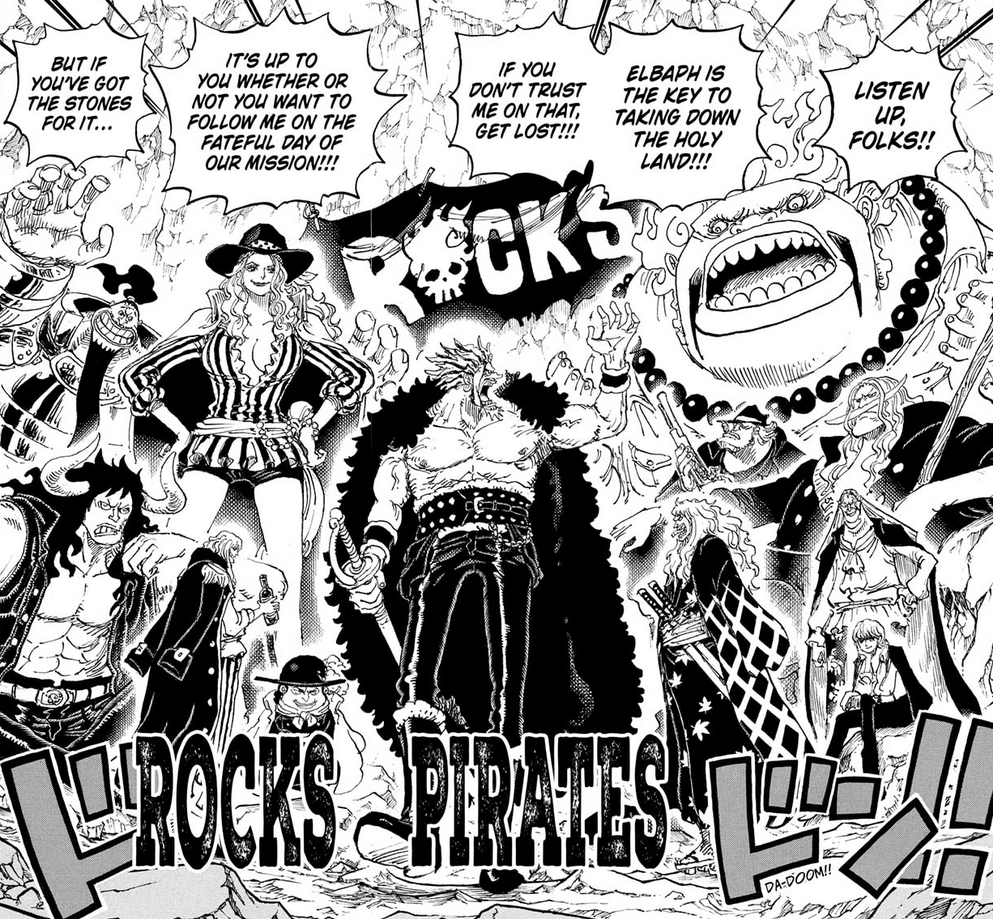
Thematically, the two fruits have to be the Dark Dark and Gum Gum, right? This feels like as good a time as any to talk more seriously about the possibility that Loki never ate the forbidden Devil Fruit at all, and it was just presumed he did after it disappeared the same day everyone else in the castle died.
Two weeks ago, I wouldn’t have put money down on this flashback revisiting God Valley, but now it’s looking a lot more possible. And if you want to tie it back to what this story was originally about, we might see the World Government extract some info from a defeated and dying Rocks after the battle there, cluing them into the things he learned about Elbaph’s importance and prompting them to reach out to Harald and start making ties to find out what the king of giants is really sitting on. That would be my guess.
Whatever happens, this expanded focus on the big names of the old gen rather than the short tease I’d expected has left me very excited to see what’s coming up next.
-
Realm of the Elderlings series review
(this review covers the whole series but should scan as spoiler-free to all but the most sensitive of readers)
Robin Hobb’s Realm of the Elderlings comprises 16 full length novels, one novella and half a dozen short stories, but its not as intimidating as it sounds. The novels are divided into five arcs with distinct beginning, middles and ends and timeskips of sometimes close to a decade between them (the main story ends up taking place across nearly 60 years!), so there’s built-in spots to take breaks, and things are regularly reigned in so it never ends up suffering from the bloat of supporting characters and subplots that hamper other huge sagas.
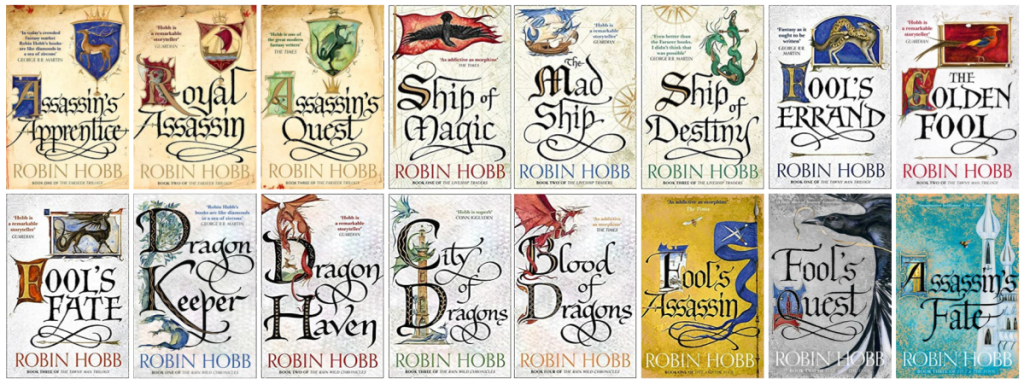
The 16 main novels in order. There are two narrative threads that the series alternates between from arc to arc.
The first follows Fitzchivalry Farseer, bastard son of a disgraced prince who is taken in by the king and told his two choices are either to disappear quietly before anyone thinks of propping him up as an alternate heir to the throne, or to prove his usefulness by apprenticing under the crown’s ageing assassin. And as he struggles with court politics, Fitz forges a bond with the king’s jester, a mysterious and androgynous figure known only as the Fool, who claims he can see the future. Fitz’s stories are told from a first person perspective, framed by him trying to take down his memoirs later in life.
The other is set on the Cursed Shores, where traders and pirates deal in magic artifacts stolen from the ruined cities of an extinct civilisation. Here, the Vestrit family is divided by a inheritance dispute. Eldest daughter Althea was promised the family’s Liveship (a vessel with an animate, talking figurehead) by her late father, but her brother in law Kyle Haven stole it from under her, weaponising the social and legal precedents of the trader world, which say that women belong in the homestead instead of behind the helm. Meanwhile the pirate Kennit is brewing a plan to make himself a king, but he’ll need a Liveship of his own to do it. These arcs use the rotating set of third person POVs more traditional for modern fantasy.

A Liveship encounters a sea serpent. While there are references and character cameos between the two narrative threads, the strongest connection is the reader’s growing understands of who/what the ancient Elderlings were and why they aren’t here anymore. And the final volume, despite being a Fitz story, takes a tour through the Cursed Shores and gives all the major characters there a moment to shine for the saga’s finale.
Hobb’s language is beautiful and efficient and so, so evocative of each character’s headspace that you can’t help feeling their sadness, frustration and occasionally joy along with them. The psychology of the main cast is rich and detailed and they all scan as genuine, believable people. This is the kind of character writing where some characters need to make a mistake multiple times and be beaten over the head with a lesson repeatedly before it sinks in enough to change their behaviour (especially if they’re a main character, and especially as hell if it’s Fitz), which certainly feels realistic to how real people tend to be set in their ways, but can also verge on frustrating.
The long timeline plays to the advantage of a lot of these heroes when you eventually get to see them grow from young adults to actual adults and approach familiar dilemmas with newfound maturity and perspective (while also making all new grown-up mistakes). Hobb also uses it for some of her most devastating emotional blows, as the cast confront some of the harder realities of ageing, such as outliving beloved pets and mentors, and outgrowing lifestyles and relationships you once fought and sacrificed to acquire. When this series wants you to bleed, it will cut you to the bone.
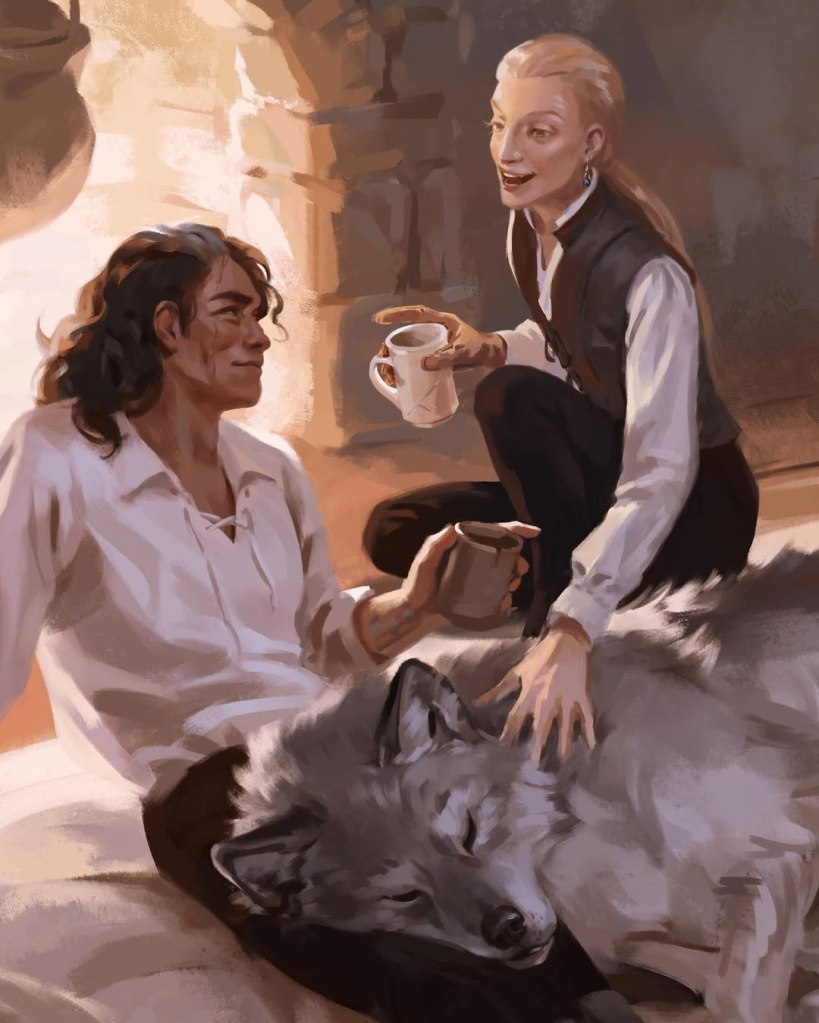
Fitz, the Fool, and beloved animal companion Nighteyes the wolf. There are a few fantasy standard megalomaniacal royals and mad prophets among the roster of villains, but the most effective and memorable ones are the everyday bullies, the tyrant bosses in the workplace you can’t afford to leave and the abusive partners that every has encountered at some point. The petty evils performed by people who can’t help turning the smallest amount of social power against the people closest to them. Hobb writes these bastards so effectively (and is so good at putting you in the emotional zone of the victim) that I actually felt my temperature rising and heart rate increasing through several scenes. I can think of few characters I’ve wanted to reach into the page and throttle more.
I have very little negative to say about this saga. Some individual books could maybe have had their pacing tightened, the fourth arc is kinda weirdly structured and not quite as compelling as the stories around it. But overall Hobb has rocketed to the top of my list of fantasy authors over the past year and a bit of reading. It’s been a long time since a book has pulled such visceral emotional responses from me, and I think it will be a while before anyone is able to do so again.
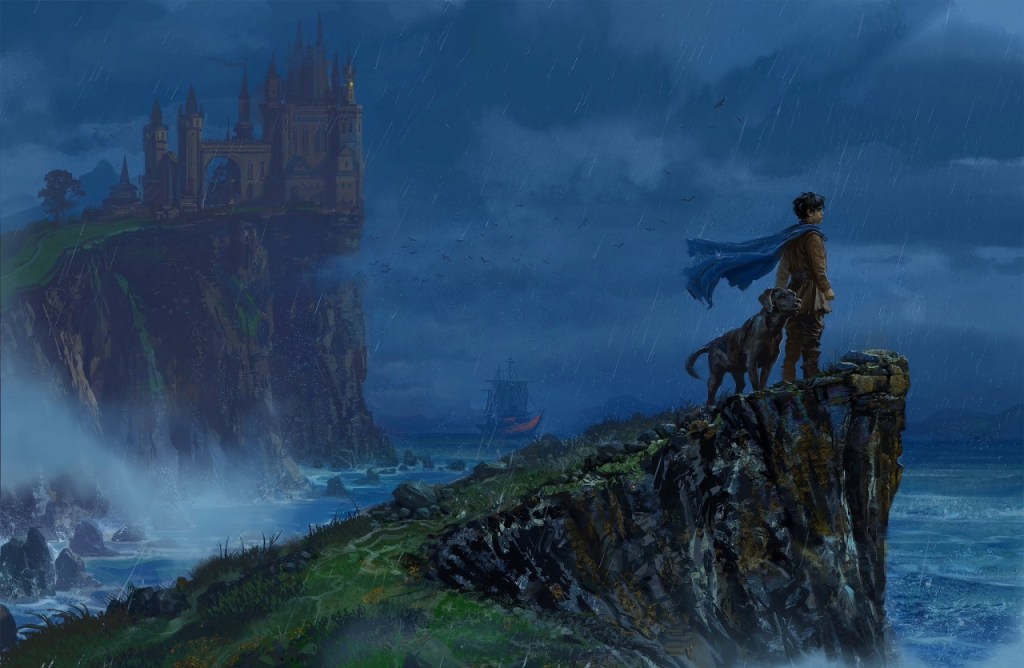
A young Fitz and his home, Buckkeep Castle. Readers be warned though, the tone of this saga is fairly bleak, and most protagonists are put through physical and emotional wringers before being allowed even the most minor or bittersweet of wins. Just about every common content warning applies to at least one book, including sexual violence, domestic abuse, graphic injuries in the context of battle, torture, surgeries and butchering fresh meat, animal deaths, facing various prejudices and bigotries, and spending a whole lot of time in the heads of characters battling depression, addiction and suicidal impulses. I wouldn’t say any of it was gratuitous or felt like it was there purely for shock value, but this overwhelming grimness over such a long saga is going to mean these books aren’t for everyone. But if you have the stomach for sad and dark stories, I can give no higher recommendation.
-
One Piece chapter 1155 review
Twenty-eight years. Ain’t that something. Makes you wonder what you could achieve working nonstop on one project for that long. As is traditional, we get a Jump cover and a colour spread. The sense of scale and level of detail in the cityscape for the colour spread is awesome even if there’s not a lot that’s noteworthy about it outside of that. I like the Zoro penguin and appreciate that Gera Five Luffy only appears as an Easter egg wanted billboard instead of dominating the piece.

We see more of how Loki builds and sees relationships this week. Obviously we’d known that at some point he would be savagely beaten by Rocks, but I didn’t think it would start within pages of their first meeting and that Loki could still think of him as an idol after. Does it not break your heart that little Loki can’t believe his dad would come back after hearing he’s injured, even after it happened? (Maybe someone should have noticed his wounds weren’t consistent with a fall, but a superstitious healer could have not cared, and Harald would then have taken them at their word of what’s under the bandages.) Love just doesn’t make sense to him. Abuse of power is all he’s been shown, and Rocks stakes his claim on more of it than anyone. No wonder Loki found that enchanting. And of course his opinion wasn’t swayed by the beatings; how different could they be to the abuse and neglect he’s been shown by everyone else in his life?

But the real meat here is Rocks at the Reverie, something I wasn’t expecting to circle back to so soon. And to open with the bombshell that he made it to the Flower Chamber and saw Imu directly. Huge. Unmatched audacity. I’m really curious about what they saw in each other though. Rocks doesn’t seem the type to back down from a fight, even a challenging one, so how does he know he can do know more? Was his goal just to verify Imu’s existence? Was he sure of that going in, or did he only realise it after confronting Imu? And that fact that he does get away, when we know Imu isn’t lacking in power and powerful servants (Gunko is literally right there). Did Imu hesitate, or was he forced to restrain himself to avoid spilling secrets to the kings at the Reverie, allowing Rocks to make a clean exit.
Harald being on fire before his clash with Rocks is weird. Maybe if he’d been the one fighting the admiral we could theorise about a former user of the Flame Flame or Magma Magma fruit, but the records don’t show him in combat with anyone but Rocks. Could ordinary Celestial Dragon bodyguards (of the kind the Strawhats beat effortlessly at Sabaody) do that? Or could it have been Cipher Pol?
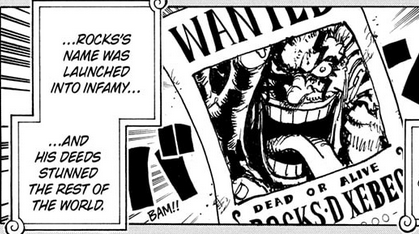
Okay, so. Last week, a lot of people online were comparing Rocks’ face to Buggy’s as well as Blackbeard’s. I didn’t exactly post about it a whole lot, but I thought that was pretty stupid. The kind of reaching, conspiratorial fan theory not worth putting stock in. The kind of thinking that props almost everyone up to and including freaking Crocodile as Luffy’s mum. So why now is Rocks doing the same pose as Buggy on his bounty poster? That’s way too much of a similarity to ignore. I went and double checked: Buggy is just barely old enough to have been born before God Valley too. Oh god, I’m actually starting to believe there could be a connection there. Argh, what if the red nose actually is fake and he’s got the Rocks/Blackbeard schnoz underneath? That would be an insane twist after all these years. I may have been wrong as a naysayer (potentially, nothing is confirmed from just the poster) but I’m not going to feel bad about waiting for more evidence before jumping on board with a farfetched theory.
The Davy Back Fight coming back as a way for Rocks to build his crew sure is something. As is Rocks namedropping Davy Jones when he speaks to Imu. I’m not sure what thing it is, but it’s a thing for sure.
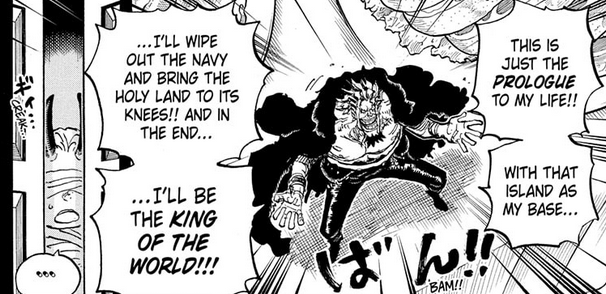
Despite being set up as a villainous force, Rocks almost manages to come across as likeable in this chapter. Give or take the child abuse. I think he makes some decent points that cut to the heart of the Harald’s issues with the Government. Maybe Harald doesn’t know the worst details yet, but it’s undeniable the Government is in the wrong and should be stopped, and it’s probably going to take force to do it. The underhanded pragmatism he takes to his plans is fun to watch as well (you can see where Blackbeard gets it from). Of course, he loses me when he says he’ll simply make himself king instead of destroying the system just to have it gone. I wonder if he thinks the comment about no authority lasting forever will apply to his own future dynasty as well…
This was a great chapter for the 28th anniversary to land on, setting up all kinds of awesome stuff. I don’t dare hope for more Rocks next week. It doesn’t seem like there’s much more to do with him until God Valley, and somehow I think Oda’s going to keep banking that one. I’m sure we’ll see Loki reacting to the news that he fell there – not unlike Oden getting news of Roger’s execution in his flashback. If this is truly the end of the Rocks portion of the flashback, it could make a decent volume ender as well, trailing off onto Rocks’ pirating career and resetting to Loki at the start of the next book.
-
One Piece chapter 1154 review
We’re truly moving into the endgame with this one. This is the first possible end point for volume 113, and while that would make a pretty short volume, it’s a huge reveal to use for the final cliffhanger. Even the cover story is building into something promising with (maybe) the long-awaited reveal of Ryuma’s shrine. Some have cast doubts if it’s really his, and I agree that it’s pretty run down for someone as well-spoken of as Ryuma, but on the other hand I think it makes sense for Ryuma to be hailed as a West Blue hero. Read Monsters and tell me it’s taking place in Wano. Obviously Ryuma got around a bit during his life.

After racing down the timeline for a couple of installments, this chapter eases onto the brakes to develop Loki and Harald’s characters. One thing I appreciate in One Piece flashbacks is that even while they build up their key characters as monolithic figures, they also spotlight their flaws and blind spots. Vegapunk’s thirst for scientific opportunity and lack of social intelligence leave him working for the bad guys. Oden chases his personal adventure instead of resolving Wano’s issues before they become too bad for him to face. Now Harald proves himself to be an excellent king both for his nation and the world, but he’s so focused on that he turns into an awful father. He clearly doesn’t outright abuse Loki like the baby’s mother and uncle did, but his neglect must have made their rejections cut deeper. It’s not that Harald doesn’t care – the pride with which he lifts Loki seems genuine – but he’s too busy to even ask follow-up questions about what’s wrong with his son’s eyes or why he’s injured.
I’m not sure whether to overanalyse Harald’s tears at Estrid’s funeral or not. Even though the marriage was political and she was unpleasant, it’s a natural place to cry if you have even a scrap of empathy, but it’s interesting how the tears are juxtaposed with the narration explaining how Estrid’s legacy was the nation’s superstitious hatred of Loki. Does Harald cry for his son? But surely he hasn’t been home long enough to recognise the damage done to the kid’s reputation yet.

The other side of the coin is Loki himself. I think we can see the truth of the theme surrounding the new generation’s apparently weakness here: Loki, the most vocal advocate so far for toughening them kids up like the good ol’ days, is revealed to be a neglected child lashing out at a world that rejected him. There’s no real ideology underpinning his love of strength and violence, it’s just the only thing he’s ever known that earned him a modicum of control in his life. And what a miserable life it’s been. The poor kid was set up for failure long before he had the agency to do anything more than reach out for comfort. Mum despised him. Her brother just as bad. Dad wasn’t around enough to notice, let alone intervene. How telling it is that the first time we see him smile is when his uncle’s body is found. He found one thing he could do that eased the pain and tried to take further. He grins again as he rampages through the village and tries to raise his own standing by setting Hajrudin lower. But while killing his uncle earned him some respite from abuse, and hurting Hajrudin earned a grudging, fear-driven respect, it can’t make Loki loved. And you can see how that cuts him. Hajrudin’s friends coming to his aid (Gerd has jumped up a few rungs in my mind for her determination here) even though he’s weaker and illegitimate frustrates Loki, making him double down, but the hate in that one woman’s eyes as she cradles her injured child shatters the facade. Then, grimmer than anything, even his suicide attempt fails. How can you not feel bad for this poor kid?
I’m really looking forward to rereading the early parts of this arc with a better understanding of Loki’s psychology to see better what’s under all that bravado. It also reframes the alliance between him and Luffy. There were concerns that Loki was too violent, too almost-villain-coded for it to work out, but now we can see there’s something broken inside him for that friendship to heal. An actual character arc starts to take shape.
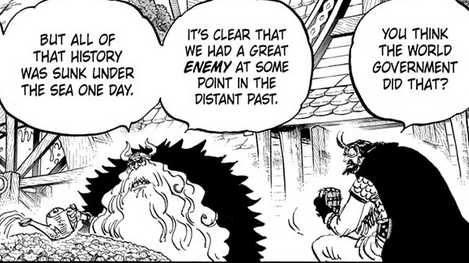
There’s a few other random bits of lore scattered through the chapter. The origin of Galley La’s name? And there’s speculation they’re the frozen giants at Punk Hazard, but putting the pages side by side, I’m not sure the match is as exact as it’s made out to be. Guys, do these characters have the same faces, or are they just drawn in the same ultra-high contrast shadows? Jarul’s mention of an army of frozen giants also invokes a little bit of Punk Hazard, but it feels to me like a separate point he’s bringing up to the long lost Galley La guys. And how would people learn about them from inside this top secret Government lab anyway, and has it even been built at this point on the timeline? I’m more inclined to wonder if this is connected to the land of ice Moria found Oars’ corpse in.
But who is this enemy the giants had in the past? The obvious answer and reading of the Harley mural is that it’s the group that became the World Government, but time will have to tell.
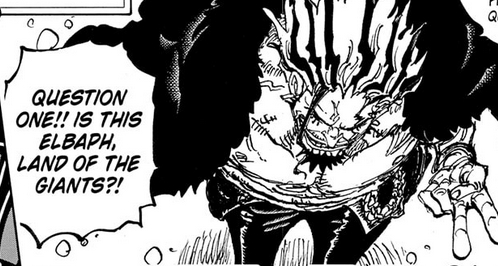
The talk of the Reverie sows some interesting seeds about figures of the past, particularly Rocks being there. Was he a king before he was a pirate? I appreciate that the flashback actually lines up with the four year cycle of the meetings. I feel like a lot of authors think too late about things like that and have to handwave a past version being out of sync, but this all feels planned out.
And of course we get the surprise Rocks reveal at the end. Holy shit, look at this dude. He seems like he’s gonna be fun to have onscreen, in an unhinged, chaotic and probably evil kind of way. Blackbeard’s father too. After a couple of arcs of building up Imu, it was about time to put Teach back on the final boss radar. Not much you can say besides that from just an intro page, but I’m excited to see how this relationship builds up next week.
-
One Piece chapter 1153 review
Our flashback is chugging a long at a fairly pleasing pace. Harald’s story plays out fast enough that we didn’t have to wait long for the real key figures of Hajrudin and Loki to turn up. The same can maybe not be said for Yamato’s cover story, which now feels like it’s running down a checklist past the point of its actual plot being resolved, but whatever.
I really enjoy how expressive Harald is in the early pages of the chapter. That Kaido-like portrait we first see him in would never have had me guessing he could look like that after taking a slap in the face. And man, casually destroying a shark with flicked snot in the second page is such a funny detail. Some real Mr 5 moves. Wait, could the secret Devil Fruit of Elbaph really be…?

And speaking of faces, Ida has a pleasantly unique one in a series full of Nami and Robin clones. And I like how her budding romance with Harald plays on the themes of cultural exchange and connectivity that have been building in the series. Vegapunk spoke of how limiting isolation is to people who can’t find the means to travel between island nations in this flooded world the Government has created, and we see that proved as the giants are enriched by the engineering, spices and fabrics of the humans. The messages about not being superior just because you’re born bigger, and the obviously genuine anthropological fascination Harald develops over different cultures as he gets to know Ida resonate with these ideas. We also, a little later on, get the suggestion that celestial navigation is not widespread knowledge in this world, closing up a logical hole in the log pose system that’s existed from the start. Wonder if that’s information the World Government discourages researching.

Few quick lore notes from this bit – Harald swims to collect a shark for the native population of that one island. While the initial exposition about Harald and Loki and the legendary Devil Fruit implied that Harald had the power and Loki killed him to take it, I’m becoming increasingly sure Harald never ate it, as if the panel of the treasure chest last week wasn’t proof enough. Second, the blood-soaked serpent being confirmed as the Red Line. Ain’t that curious, after Dory and Broggy’s mention of the serpent on Little Garden and then the big snake in the Harley mural. If I wanted to theorise boldly I might even mention the ancient Shandians’ worship of their local giant snakes as another possible connection. And finally, Ida’s South Blue origin. It’s curious how many giant colonies there actually are relative to how legendary they’re made out to be in the story. Saul was also a South Blue native. Sanjuan Wolf and Morley are from West Blue. Oars allegedly from the North. They’re on all seas except East Blue and the first half of the Grand Line. And yet when anyone talks giants, and when the World Government needs giant soldiers for military power, it always comes back to Elbaph. Definitely something special about these giants on this island, and I have to wonder if it’s the Ancient Giant genetics they’ve managed to preserve in such relatively high numbers.
But Harald brings Ida back to Elbaph to collide with the politics of the untraveled leaders of his homeland. Hard to argue against tradition with people who’ve never opened themselves up to seeing things another way. I would have liked to see more of Harald feeling conflicted over being forbidden to marry Ida and forced to wed Estrid. And how the relationship plays out after this happens. We’re not given much of an indication of how much, if at all, Harald was able to see Ida and Hajrudin after this, save for Ida thinking Haj would get the chance to meet his half brother. Did Harald and Ida remain lovers, or did the politics of it, or just jealousy from one side or another, force them to call it quits? My first impression of Harald was of the hind of free-spirited royal who would tell his advisors to shove it and do what he wants in scenarios like this, so why not show how the chiefs threatened him or pressured him into submitting? Or had he always been sailing and harassing other nations to get away from the restrictions and pressure of being king?

Estrid puts forward such a pettily hateable persona as she makes herself at home in the palace. This isn’t necessarily a Spandam or Orochi kind of vileness (up until the attempted baby murder) but the insistent and self-serving faux-mysticism lands a lot closer to a kind of person you might actually encounter in real life. Of course geomancy means all the things she wants go closest to her. Of course she makes up (at least that’s how I’m interpreting it) a prophecy that justifies the removal of someone she was already uncomfortable with. Add to the fact that she’s exactly the kind of generic Nami-clone princess I was glad Ida wasn’t, and it’s not looking good for Estrid.
I like her horse though. That thing’s crazy with the legs and the flaming mane and tail. Imagine how small a normal human would be next to that monster. Too bad it’s doomed to die of Loki’s “curse” in the near future.
Of all the reasons for Loki to wear the blindfold, I’m not sure I would have guessed that his eyes were simply weird in a way that provoked superstition. From his reputation, you might think he wouldn’t care about the discomfort his features cause others, that’s their problem, not his, but like Harald’s marriage, the apparently free-spirited and unstoppable warrior is bound by culture, tradition and expectations. I wonder if this is going to be a theme. And has a more educated, modern Elbaph moved away from these kinds of issues? Maybe Loki missed the forest for the trees, getting caught up on losing the right to rampage and pillage and missing that he could have gained the right to walk around barefaced in exchange.

Loki’s return from the Underworld is a crazy note to end this one on. It’s such a classic One Piece tall tale kind of development. And the dead bear as well? God damn, this kid was something else.
What I’m really curious about after this chapter is what’s happened to both Ida and Estrid by the present day. They don’t see to have been counted among the victims of the massacre of the castle, and I don’t recall any other kind of death for them coming up. I’ve been big on Jarul as Loki’s Shaggy friend, but Ida would make for a really interesting dynamic. Well, we have their fates, alive or dead, to discover, the start of Harald’s relationship with the World Government, which may be the focus of the next chapter, and then the main event after that.
I think there’s a chance the flashback could wrap inside of volume 113 if the book runs long to 12 chapters (that’s three more), but I’m not counting on it, and I’d rather Oda take the time to properly flesh everything out here anyway.
-
One Piece chapter 1152 review
Oh damn, flashback’s on! And sooner than I expected. Let’s take a minute to think about why it’s been placed like it is. Oda likes to use flashbacks to build into a moment of catharsis or emotional payoff, and usually that means setting them up at the darkest hour. Right when Bonney’s about to be shot. Right after seeing the samurai fleet isn’t coming. Etc. Etc. This means we can go from the darkness of the flashback to the high of these characters getting rescued. While things are looking dire for Elbaph up above, I would expect that kind of flashback to be used right as the blade is about to fall on Jarul or the first of the child hostages, but that’s not what we’re doing.

Some flashbacks precede the tides suddenly turning against the heroes, like the moment before the assassination plan fails on Whole Cake Island, or shortly in advance of Law’s one on one clash with Doflamingo going south on Dressrosa. It means going from one downer scene to another before giving the mood a chance to rally. But that’s not the one for this arc either.
The last thing a flashback tends to build to is a character’s big decision or realisation, such as Jinbei request human help to save Fishman Island, Luffy remembering what he still has after Marineford or Robin choosing to live at Ennies Lobby. With the choice to free Loki in Hajrudin’s hands, I think that’s where the emotional heart of this flashback is going to be. But how well will this work? Hajrudin has an understandable internal debate going over whether to change what he believes about the man who killed his father and acts as his rival to the throne, but despite him having been around since Dressrosa, is anyone truly that invested in Hajrudin’s emotional stakes? I don’t dislike him, but I don’t think he sticks out that much as a character either. Loki is a lot more interesting, and the release of being exonerated and freed would be clearly meaningful to him, but he’s not a character we’ve known for very long to build a relationship with. It’s going to be the job of the flashback to build these two half-brothers up enough for its climax and the present-day decision that follows it to stick the landing.

Buuut we don’t go straight into the flashback. There’s some present day stuff to go through first. There’s the disappointing revelation that the answer to the immortality problem is just more Conqueror’s Haki. Boooo. I can only hope there’s at least going to be something special about how it’s used to make the trick work. Because if it’s just any kind of Conqueror’s coating, it wouldn’t have made sense for Luffy’s attacks to not work at Egghead unless he was forgetting to use his newest and strongest skill against those seemingly-unstoppable monsters just so we could have this reveal an arc later.
And if it’s so hard to pick up that Scopper can’t do it reliably after just going a bit out of practice and Luffy didn’t get the knack of it out of sheer desperation, how come Loki was doing it intuitively without even knowing the name? It just feels messy coming up like this.
I did enjoy Sanji being absolutely snubbed and Zoro getting told off as it gets discussed though. The Zoro one is particularly interesting when we think back to him in Punk Hazard having a go at Luffy for not taking the New World seriously enough. I wonder what steps he’ll take to feel like he’s catching back up? Maybe it will put in perspective something that happened at Ryuma’s grave for him to remember…

I don’t believe for a minute Loki becoming a Strawhat, but it’s interesting that making him a subordinate is thrown out as a solution to his wildness. How believable do we think that really is? The argument that Loki is too large to ride on the Sunny is obvious and insurmountable. I’ve seen some comments from people saying the presence of Adam Tree wood on Elbaph could be used to expand the Sunny, and to that I say, did you guys freaking read the series? The best shipwrights in the world walked us through this. The upper limits of a ship’s size are dictated by it’s keel, which has to be a single piece. Since everything else builds on the ribs which connect to the keel, you can’t replace the keel without rebuilding the ship from the ground up. The Going Merry didn’t die of a broken keel just for these engineering problems to disappear on the Sunny. It would fully break the rules and I won’t entertain it.
After this, the flashback starts properly. Within a few pages we’re seeing surprises. Did Loki acquire Ragnir after this incident, or did something happen to change the hammer’s appearance between now and the present? Loki reads abrasively in this first scene, embodying everything I was worried the themes of the arc might be when it first contrasted the children of peace with the warriors of old.
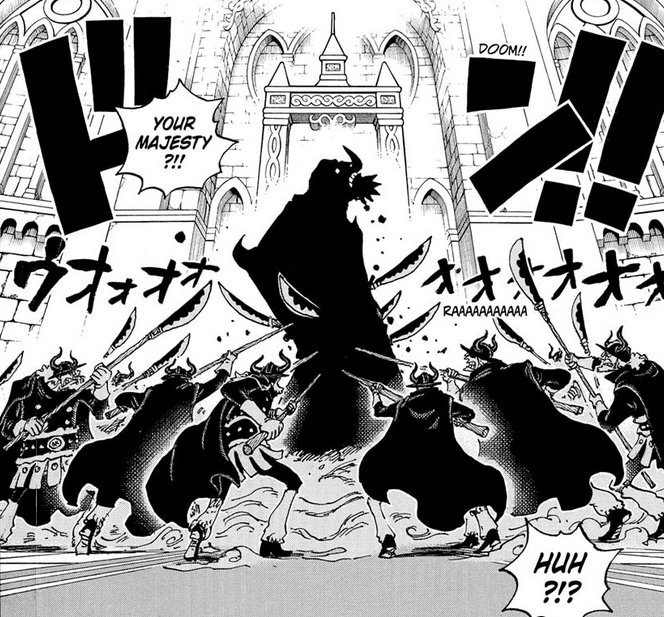
And the big shocker, Harald being attacked by his own guards. Though most are horned, everyone here lacks the wings and glowing eyes of Imu’s flipped giants, and even if they were, wouldn’t it make the most sense to flip the king who’d already been collaborating with the Government? So already things aren’t playing up the way it seemed like they would. I’m more curious about the truth, and how Loki came to be blamed for it, than ever.
But that was only a teaser. From there we get Scopper and Shanks, and what’s that on Shanks’s arm? It looks very similar to the mark on Sommers and Killingham’s armbands, minus a few lines. But it’s far less intricate than any of the marks or tattoos seen on Sommers’ arm underneath. But I think it’s a point in favour of a connection that they’re all marked on the upper parts of their right arms. Shamrock and Gunko don’t show these parts of their bodies (Gunko has a bandage or arrow wrapped around where then band should be, Shamrock keeps his arm under his cloak), but for Gunko at least we can be fairly certain they didn’t mark her legs. We knew Shanks visited Marie Geoise after sailing with Roger, but integrating enough to be touched by the Holy Knights’ system is a shock. For the differing levels of detail in the marks, I wonder if it’s some kind of ranking or scaling system. Like, the first stage just lets you travel through the abyss, the next one lets you borrow Imu’s immortality, and the ultimate form is a transformation like the Elders’, for example. Whatever the case, this lost marking puts Shanks’s sacrifice for Luffy in a new light. “Only an arm,” he said to reassure the boy after. You liar!
I’m unsure of what to make of this “child of fate” line. It could be anything from a poetic way of saying it was good luck – a twist of fate – that resulted in Shanks landing in that treasure chest and ending up on Roger’s ship unharmed, or it could be that Roger had been grooming Shanks for the Nika role and to claim the One Piece when the time was right. The Red-haired Pirates did seem to be searching fairly intently for something when they stayed at Windmill village, making so many expeditions using that one port as a base. How would a prospective chosen one feel seeing his Devil Fruit choose a child instead? Like a weight was lifted (see how he laments not being able to pirate freely with his friend), or that a whole new one had been placed?

And truly unexpected is that we enter a deeper flashback with the apparent intent of showing Harald’s life story. Given what we see in these first two pages, it’s going to be a long and fascinating journey to make him someone would forge a land of peace and cooperate with the World Government.
To feel like the whole arc has been building to this flashback sequence and Loki’s crime, and then for it to start with surprises despite all that time feeling like we were getting clues to put together makes me very excited to see what Oda’s cooking up for the next couple of months.
-
One Piece chapter 1151 review
Alright, slightly softer week following two big ones. That’s fair. With maybe three or four chapters to go in volume 113, it’s worth taking the time to get everyone aligned and where they need to be for the climax.
Yamato’s cover story lingers, but at least it means we get a Kawamatsu cameo. Given Yamato’s usual tendency toward the masculine, I’m surprised Oda didn’t have them shock everyone by competing in more traditional attire. Maybe that would have been low-hanging fruit even for him.

Oh hey, it’s Kashii! As important as he and Oimo were to the journey to get here, they’ve really been overshadowed by Dorry and Broggy for the crew’s welcome. I’d almost forgotten they were around! Since Kashii at least manages to escape being Reversii’d, maybe they’ll get a time to shine in the fights with the turned giants. There’s a few other interesting things in this scene, like Brogy’s dialogue. He’s not just going for Jarul because he’s been ordered to, he’s found an actual justification that almost makes sense for a lifelong warrior to have. Does Imu’s power bring out suppressed feelings, or does it invent things like this for the victim?
I’m surprised to see the chain capturing continue. I thought it would be a one-off joke last week, but Oda is doubling down. Are we going to see a power that runs on board game rules as a counterpart to Luffy’s comic book rules? I’m not sure how I’d feel about that.

An enjoyable development here is the feedback loop of Imu’s arrival into the kids and the Sleeptids. The haki knocks them out with the last thing they remember being the demonic villain, and their bad dreams about it cause devils to appear. It all goes to increase the feeling that these guys are a threat that only escalates the longer they’re in play. Like most abilities, it’s likely the way around this will be to take out the user. But how can you do that when he’s immortal?
And speaking of Killingham, I don’t think I could possibly have guessed what his human form looks like. It’s really changed my impression of the character. Early Killingham seemed pretty affable as villains went. Doing bad things, obviously, but in kind of a goofball way, being caught by surprise by the summoning, always nodding off or having those half-lidded, sleepy eyes, even keeping the peace between Sommers and Gunko when they discussed music. I’d kinda wanted to like him. But this new Killingham looks like an edgelord and is coming at his cruel work with much more enthusiasm. I wonder it’s a case of the devil fruit influencing the user, the chill qilin sometimes overcoming everyday Killingham. Also, while we’re reassessing this guy, I have to admit, I thought the breathing mask on the front of his bubble was a bulbous nose on the dragon head. Looking back over old chapters, it’s really obvious it’s not, but that’s how it made it into my mind.
Absolutely love that we see the mother who clearly inspired the nightmare mum in the crowd watching the kids. And of course she would withstand the haki blast too. I can’t wait to see what she ends up doing here, especially if it’s fighting her kid’s Sleeptid version of her.

Also, it looks like there’s a Zunesha among the Sleeptids right at the end of this sequence. Knowing that Zunesha lived through the Void Century and knew Joyboy and was given a sentence to walk endlessly for an unknown crime, I wonder if Zunesha features in any ancient texts or drawings that Elbaph might be protecting for a local to learn from.
I could not be more ready for the Harald flashback with Imu’s last line. Imu speaks of Harald like an ally that made a single mistake, but treats Harald’s most famous works, the school and the library, as two of the country’s biggest issues. That’s not a single-day lapse in judgement. Was Harald trying to pull a fast one on Imu before he got turned?

The rest of the chapter jumps back in time to show Luffy’s group getting cued into Imu’s arrival. Oda doesn’t typically like going over the same stretch of time twice, he usually cuts to a new group in the present, in a way that infers they’ve been doing stuff offscreen while the camera was pointed elsewhere. That’s why even though the walk-back is only a couple of minutes, the whole sequence is treated like a flashback with grey panel gutters. The full vertical panel emphasising how far Chopper and Scopper (hey, that rhymes!) fell was a great choice as well. It’s easy to diminish Elbaph’s scale in your mind, but the place truly does stretch on forever.
I’m not sure what to make of Luffy being not sure how he knows Chopper fell. Are we building to some new application of Observation Haki, or is it going to be something more like a Voice of All things angle? Then we have Shaggy’s farewell to Loki. Everything about the framing here seems to support the idea that it’s Jarul. I wonder if him going into battle then falling, probably just as Loki arrives to see it, will be what triggers the inevitable flashback. Aaaaand I really enjoyed Scopper insisting he was the second strongest even in his injured state. Which leads into a hype-building final page as we get ready for the real fight in the next chapter.
Captain M Entertainment
Reviews, news, retrospectives, thoughts
 Captain M Entertainment